



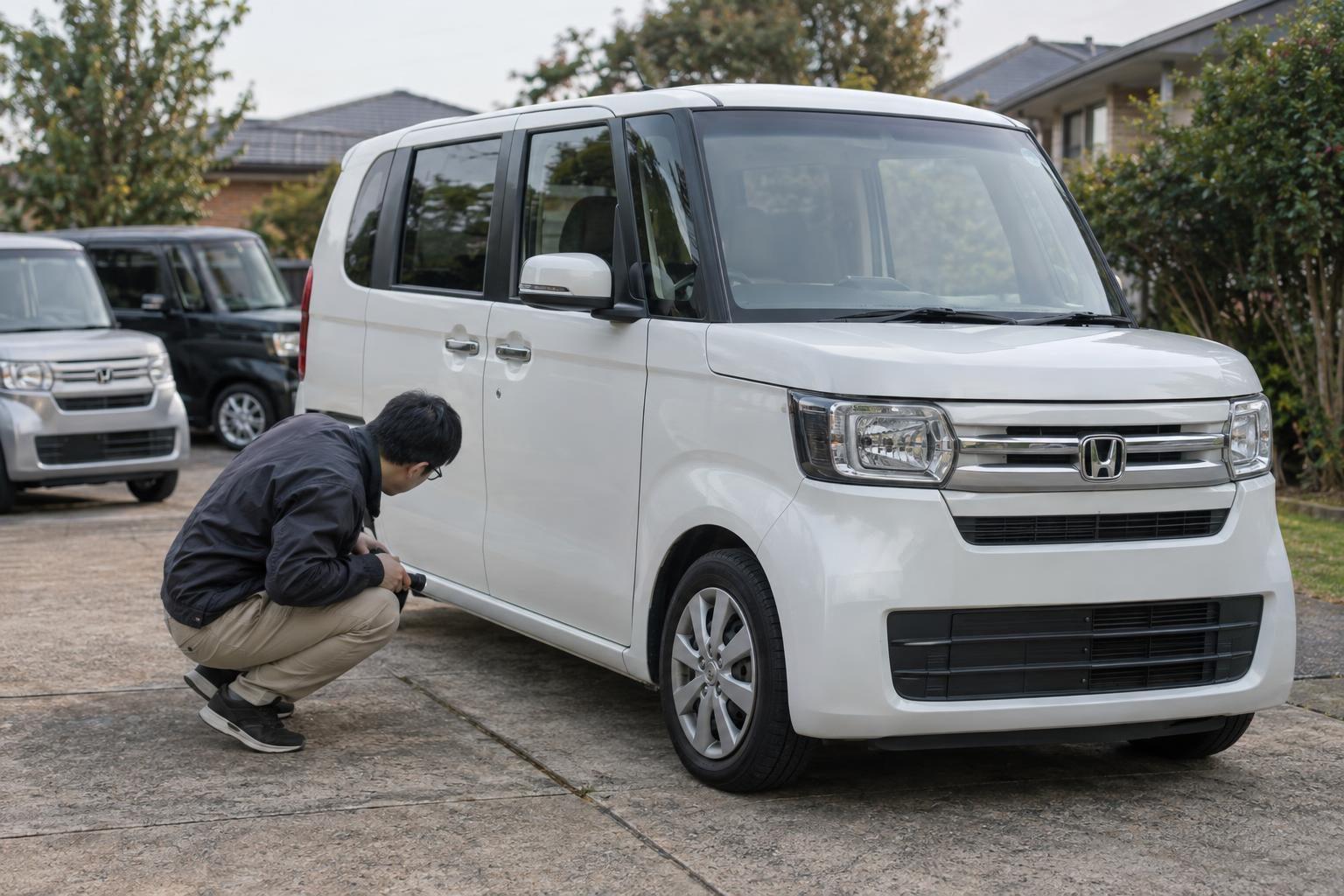
Ready to Hit the Road in Style?
Save money and reduce emissions with vehicles designed to deliver exceptional mileage. Visit our inventory and find a car that fits your lifestyle.
Ready to Hit the Road in Style?
Save money and reduce emissions with vehicles designed to deliver exceptional mileage. Visit our inventory and find a car that fits your lifestyle.
You've settled on a Honda N-Box. You've read that it's cheap to run, absurdly practical for its footprint, and built by a company with a reputation for making small engines last. The question isn't which model any more. It's whether the specific car in front of you is any good.
That's a harder question with a kei car than with a locally delivered Corolla. The weak points are different. The paperwork is different. And the auction grade sheet that came with the car tells a detailed story about its condition that most Australian buyers have never been taught to read. This guide walks through the seven things to physically check before you hand over money, how to read the grade sheet, which generation to hold out for, and what the compliance documents should actually say.
In short:
- The JF3 and JF4 generation (2017 onwards) is the one to target. Honda Sensing on most grades, better packaging, fewer early quirks.
- Grade 4 with a clean interior letter is a sound baseline. Grade 4.5 is the comfortable spot.
- The air conditioning condenser is the most common expensive fault on these cars. Check the lower bumper seam for oily residue before anything else.
- CVT fluid history matters more than the odometer. Honda's recommended change interval is every 60,000 to 80,000 km under normal use (Honda CVT service intervals, HondaRide).
- A December 2023 recall covered roughly 270,836 N-Box units for a fuel pump defect (Japan MLIT). Ask for the stamp.
Which N-Box Generation Should You Be Looking At?
Target the JF3 or JF4. Every N-Box currently listed in Australian dealer stock that we checked carries the JF3 code, and that generation runs from late 2017 onward with Honda Sensing fitted to most grades. The older JF1 and JF2 cars from 2012 to 2016 are cheaper, but they predate the active safety kit entirely.
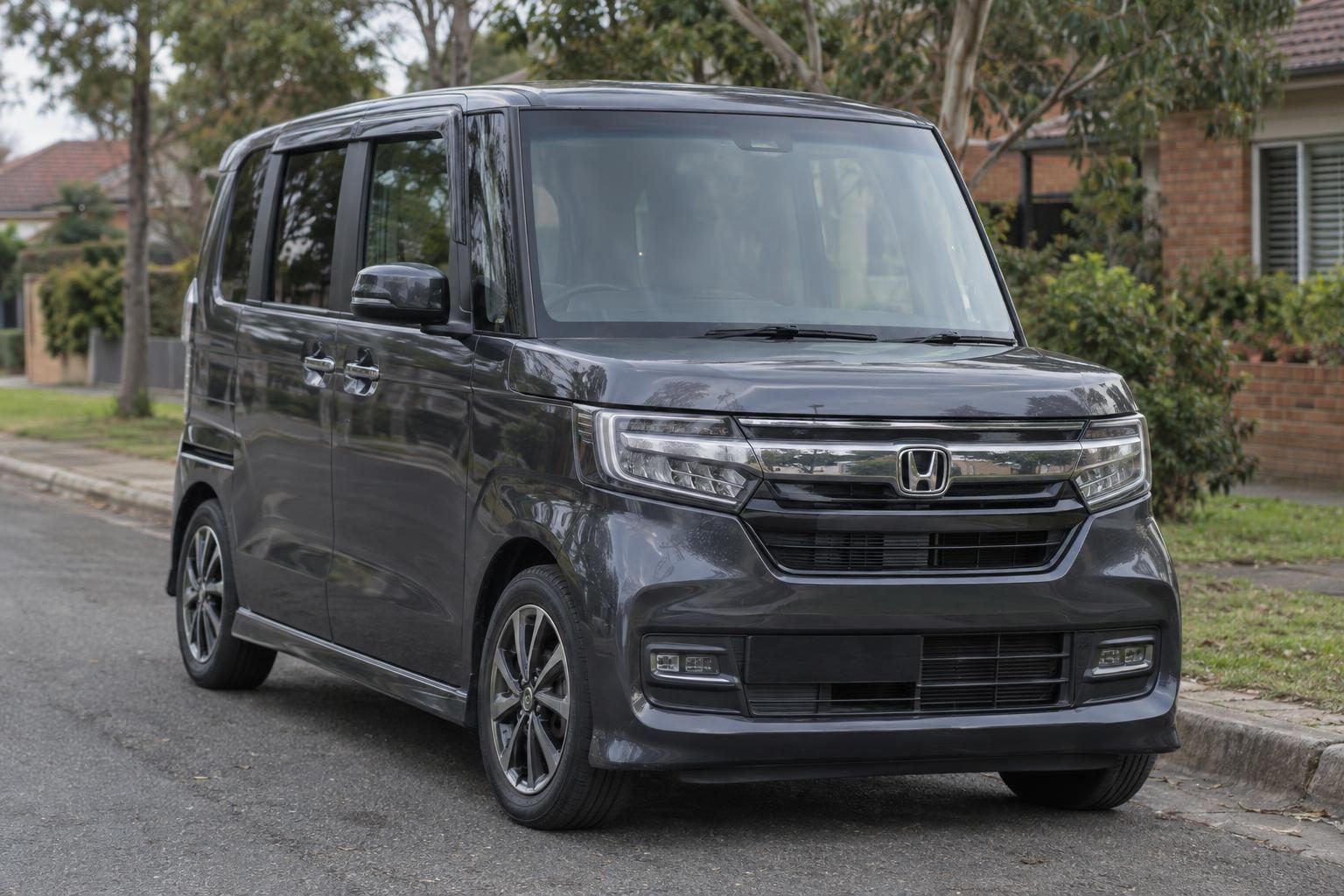 The JF3 arrived in late 2017 and is the generation worth holding out for.
The mechanical package is consistent across the whole JF3 run. All of them use the 658cc S07A three-cylinder petrol engine, naturally aspirated at 43 kW and 65 Nm, or turbocharged at 47 kW and 104 Nm on the Custom Turbo grades. Drive goes through a CVT to the front wheels on 2WD cars, all four on the JF4. Kerb weight sits between roughly 890 and 950 kg depending on grade, which is why 43 kW feels adequate around town and thin on a long hill.
The body is 3,395 mm long, 1,475 mm wide and 1,790 mm tall. Those first two numbers are the kei class ceiling, so every rival is the same size. What Honda did differently was build upward, and that's the whole argument for the car. If you want the value case rather than the inspection case, we covered it separately in our guide to the N-Box as a cheap city car.
Should you look at a JF1 or JF2? Only if the price gap is genuinely large and you're prepared to inspect harder. No Honda Sensing, older CVT calibration, and an extra five or six years of heat cycles on the air conditioning system. For most buyers the newer car is the easier decision.
How Do You Read a Japanese Auction Grade Sheet?
Every car that came through a Japanese auction was graded by an independent inspector on a scale running from 1 to 5, plus S for essentially new and R for structural repair history. The grade sheet is the single most useful document in an import's history, and it's consistent across the major auction houses including USS, TAA, JU and HAA.
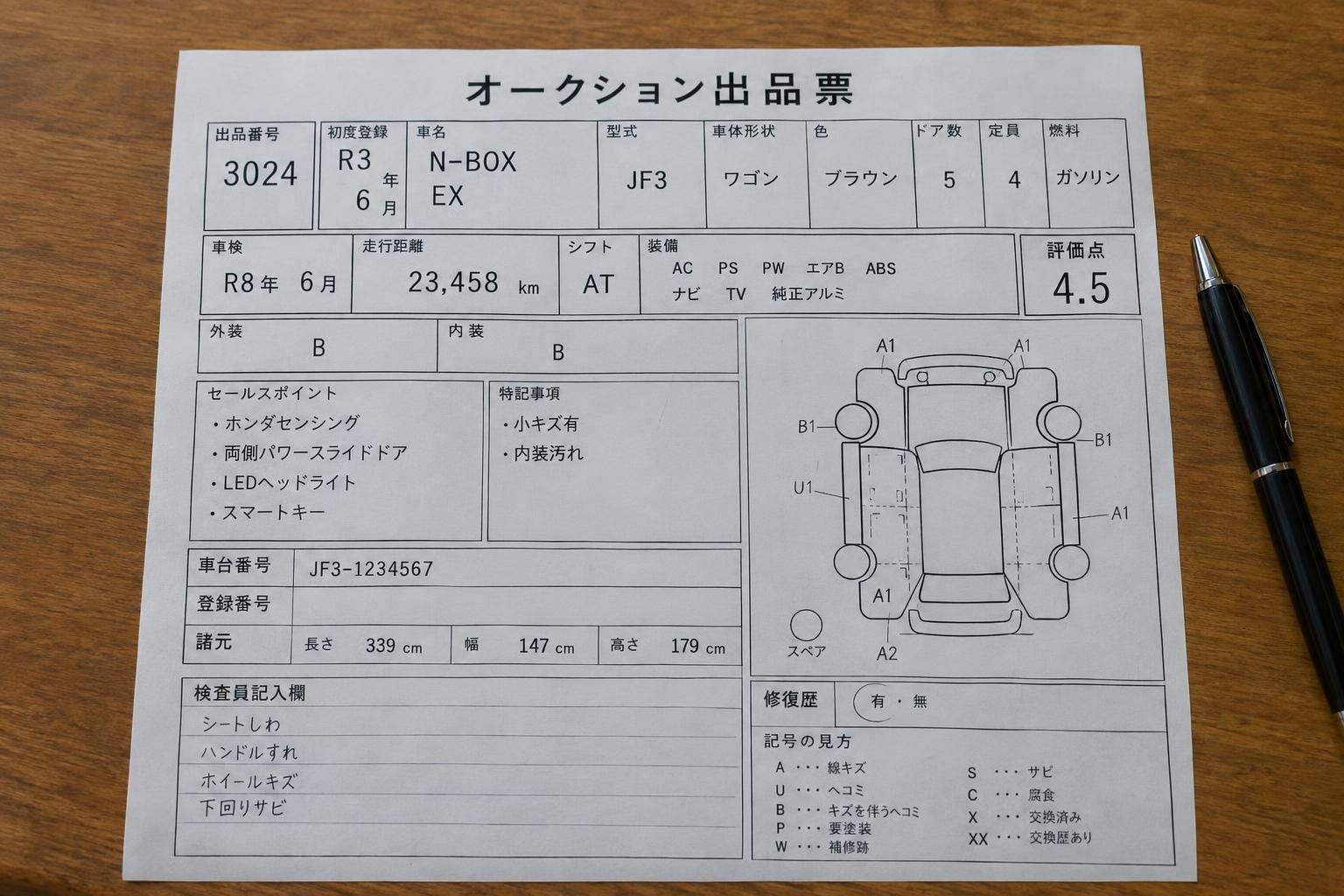 The auction sheet is the closest thing an imported car has to a birth certificate.
Two numbers do most of the work. The overall grade covers mechanical and structural condition. Separately, a letter from A to E rates the interior. That split matters more than people realise: a Grade 4 body with a C interior is a sound car with a hard-used cabin, and it should be priced accordingly. A Grade 4 with an A interior is a genuinely well-kept example.
| Grade | What it means in practice | Typical N-Box odometer |
|---|---|---|
| 5 | As-new, minimal use | Under 30,000 km |
| 4.5 | Light use, small cosmetic marks | 30,000 – 80,000 km |
| 4 | Sound, minor scratches and swirls | 50,000 – 120,000 km |
| 3.5 | Visible wear, small past repairs | 80,000 – 150,000 km |
| 3 or lower | Noticeable damage, scratches, dents | Varies widely |
| R / RA | Structural repair history | Any |
Grade descriptions and odometer bands compiled from SheetJP, JDMBuySell and ProvideCars, consistent across the USS, TAA, JU and HAA auction houses.
R and RA are the two letters to treat as a stop sign. They mean the car has had structural repair, usually after a collision. That's not automatically a compliance failure in Australia, but it follows the car forever in resale and can complicate an insurance claim. For most buyers it's a pass, and where a vendor describes an R-grade car as simply "repaired", ask to see the sheet itself rather than the summary.
Don't confuse the SEVS 80,000 km import eligibility ceiling with a quality threshold. It's a rule about what can be brought in, not a judgement about condition. A Grade 4 sitting at 79,000 km can easily be a worse buy than a Grade 4.5 at 55,000 km. Grade first, kilometres second.
One last cross-check: Shaken. Japan's roadworthy inspection happens every two years and records the odometer each time, which creates a paper trail. Any inconsistency between the auction sheet, the Shaken certificates and the service receipts is the clearest warning sign of odometer tampering there is (MDK Japan).
The Seven Pre-Purchase Checks
These apply to any JF3 or JF4 you're looking at, whether it's at a dealer, in a private driveway, or still sitting in a Japanese auction photo. They're ordered roughly by how much the problem costs to fix, most expensive first. None of them need special tools. Most need about ten minutes and a willingness to crouch down.
Check 1: The Air Conditioning Condenser
This is the most common expensive fault on the JF3 and JF4, and it's the one to check first. The condenser sits low at the front of the car, behind the bumper, in exactly the zone that collects stone chips and flexes over speed humps. A full system repair covering compressor, expansion valve, liquid tank, refrigerant and labour runs ¥100,000 to ¥200,000 and up in Japan, according to Japanese parts specialist Carweakpoints' JF3/JF4 fault guide. At Australian workshop rates, assume more.
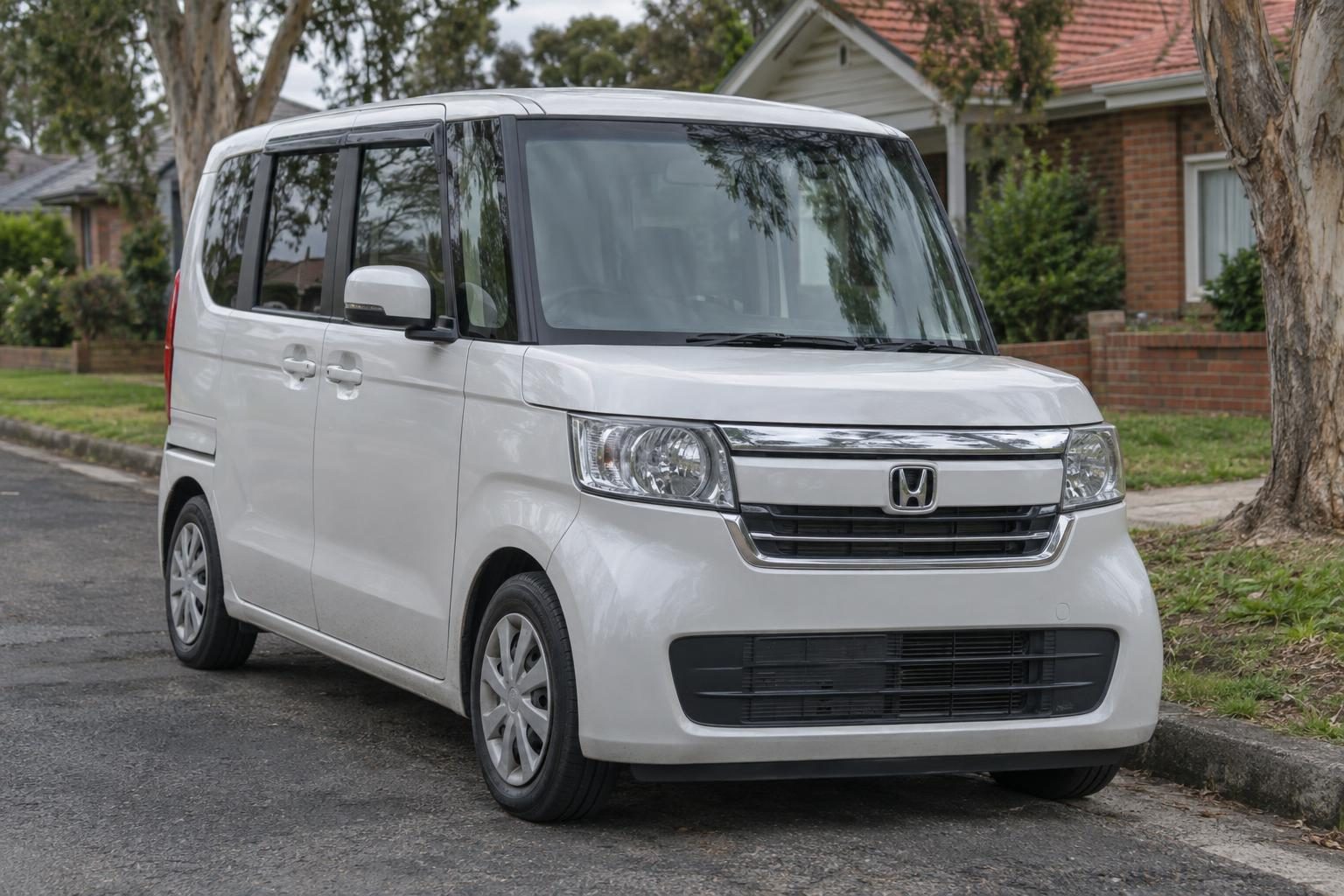 The condenser sits low behind that grille, which is why stone damage is common.
Crouch at the front of the car and look along the lower bumper seam on both sides. You're looking for oily residue, a faint oily shimmer, or discolouration near the grille. Refrigerant carries oil, so a slow leak leaves a mark. Then start the car, set the air conditioning to cold and let it run for five minutes. On a mild day it should be uncomfortably cold well inside that window. Slow cooling, or air that never quite gets there, means the system has lost gas or the compressor is tired.
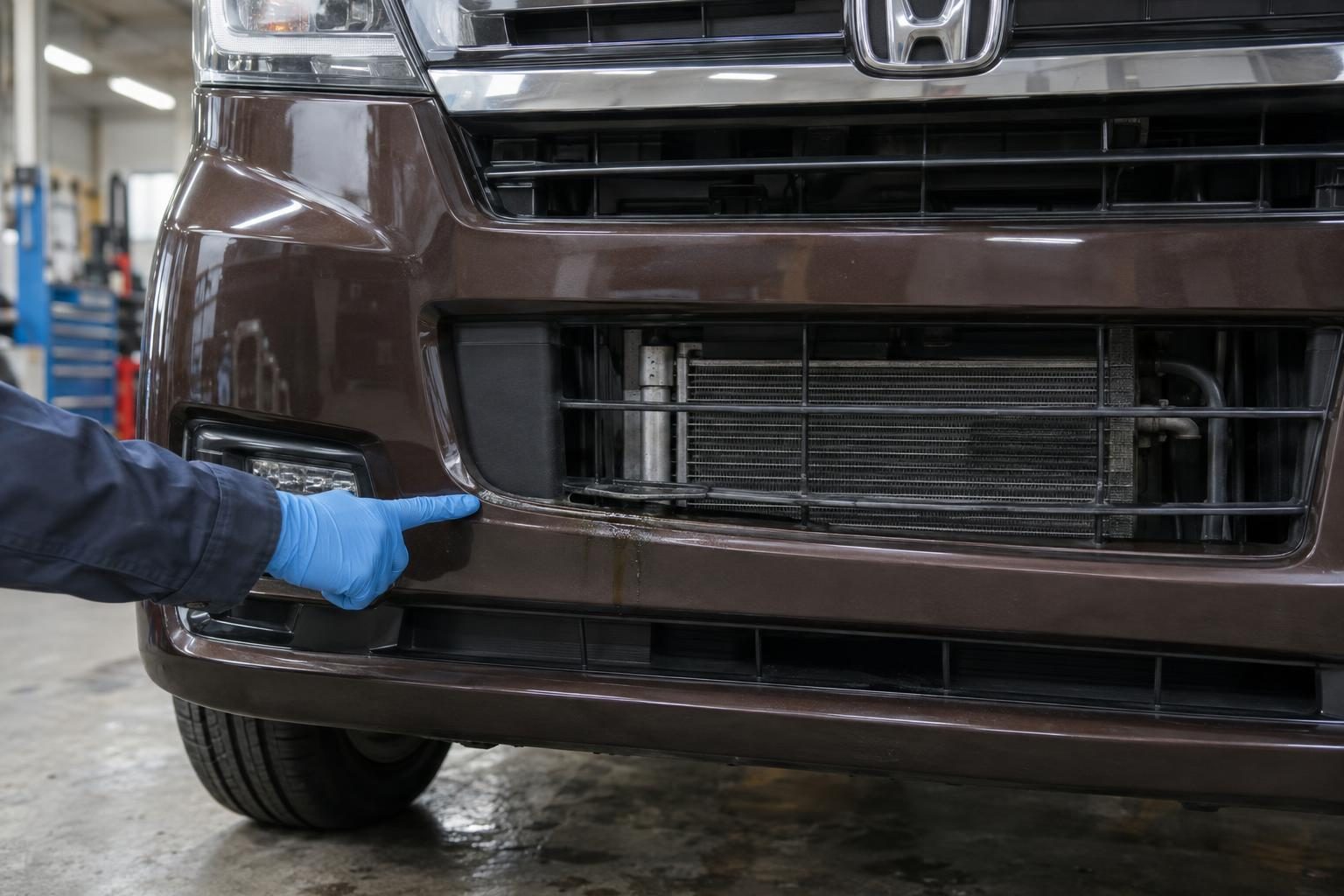 A gloved mechanic points to an oily stain below the N-Box grille.
Ask directly whether the system has ever been regassed, and whether there are receipts. A regas on its own isn't a red flag. A regas with no explanation of why it needed one usually is.
Check 2: CVT Behaviour
Two things to establish here: whether the car falls inside a known recall window, and whether the fluid has ever been changed. Honda recalled 44,974 JF3 and JF4 units built between August and December 2017 for a torque converter spring fracture, after 263 or more incidents were reported (Honda-Yorozu). If the build date sits in that window, ask whether the work is stamped in the book.
 Transmission fluid is drained from a Honda N-Box on a workshop lift.
Outside that window, fluid history is the variable that matters. Honda's recommended interval is a change every 60,000 to 80,000 km under normal use, dropping to around 24,000 km in stop-start traffic, heat or hilly driving (Honda CVT service intervals, HondaRide). Sydney traffic is closer to the severe end of that scale than the normal one. When you ask for receipts, ask specifically whether the fluid was changed or just topped up. They are not the same job.
On the drive, do two things. From a cold start, pull away gently from rest and feel for shudder, hesitation, or a delay between throttle and movement. Then find a stretch where you can go from 40 km/h to 80 km/h under moderate throttle. The revs should rise and hold cleanly. Hunting, slipping, or a flare in engine speed that the car doesn't convert into acceleration all point at degraded fluid or a worn belt.
Check 3: Engine Bay and Oil
The S07A is a sound engine, but a 658cc triple runs tight tolerances and doesn't forgive skipped oil changes the way a lazy 2.0-litre might. Carbon building up on the exhaust valves from extended service intervals shows up as a misfire under hard acceleration, and Honda-Yorozu puts that repair at around ¥150,000, close to AUD $1,500 at current rates.
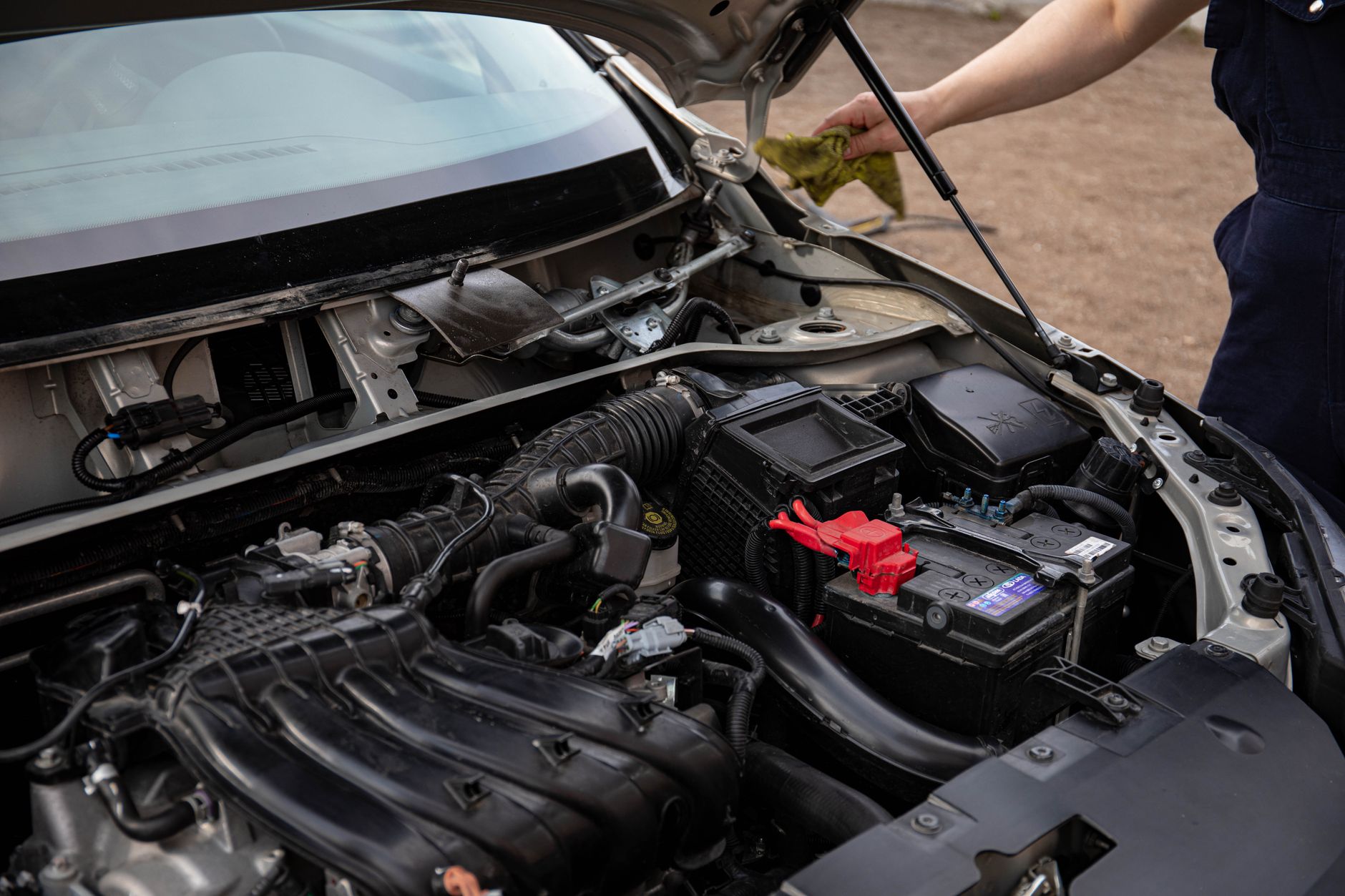 An open engine bay showing the battery, intake and fluid reservoir.
Pull the dipstick. Oil should be amber through to light brown. Black and thick means the service was overdue, and on an engine this size that matters. Then unscrew the oil filler cap and look at the underside, which is the part people skip. It's the coldest surface in the system and it collects evidence. Clean metal or a light brown film is fine. A dark, coffee-coloured sludge means intervals were missed repeatedly.
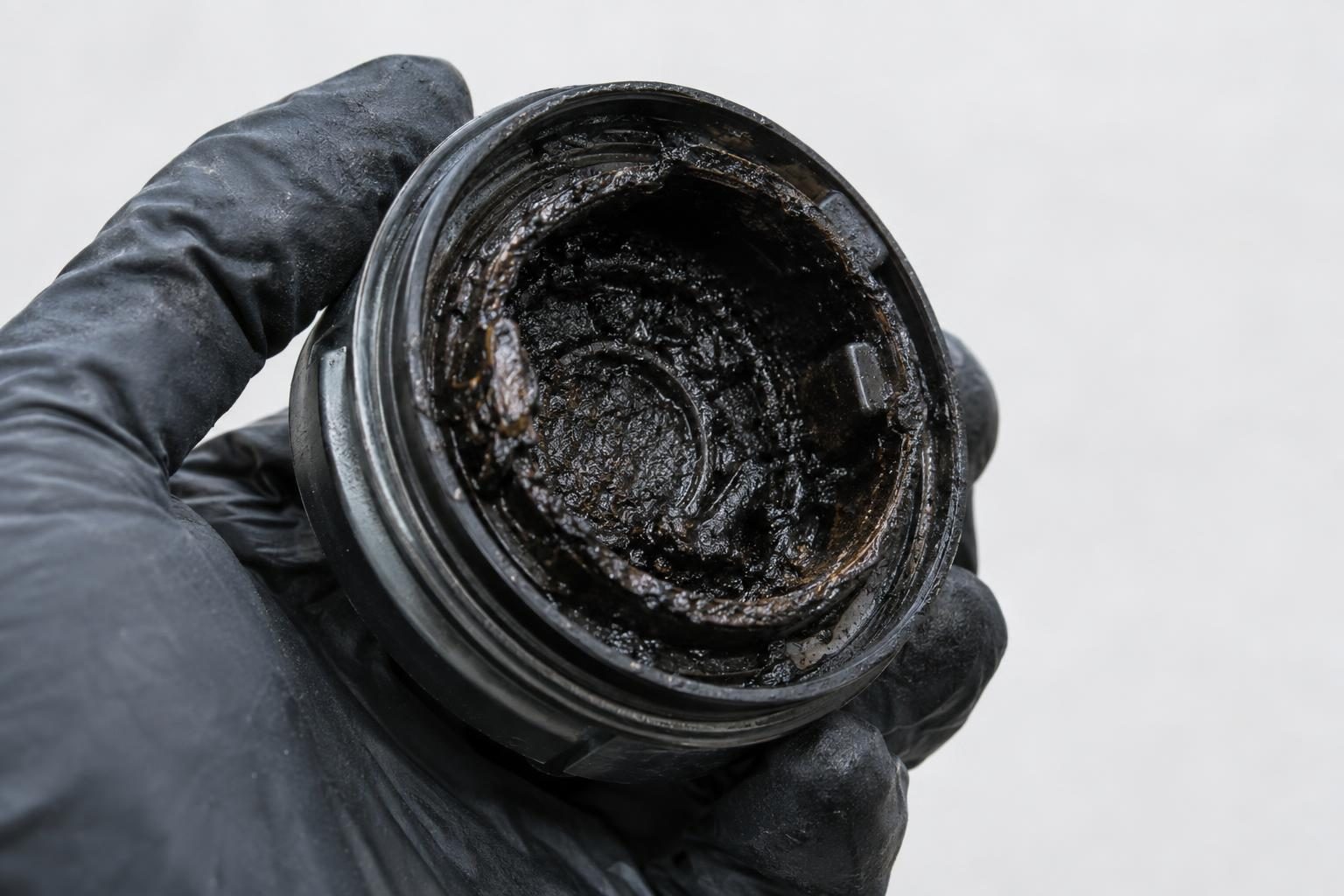 Heavy dark sludge coats the underside of an oil filler cap.
While the bonnet is up, check the coolant reservoir for level and colour. Rusty brown or milky coolant is a walk-away. Carweakpoints lists radiator and coolant repairs on these cars at ¥100,000 and up, and notes they can appear regardless of kilometres because the trigger is age rather than use. Last, run your eyes around the valve cover gasket and the hose junctions for any wet seepage.
Check 4: The Alternator
Alternator failure is the second recurring electrical fault on the JF3 and JF4, and it tends to surface in summer when the air conditioning is loading the charging system hardest. A rebuilt unit costs ¥50,000 or more in Japan (Carweakpoints), and the kei car's tight engine bay makes the labour component worse than it would be on a normal-sized car.
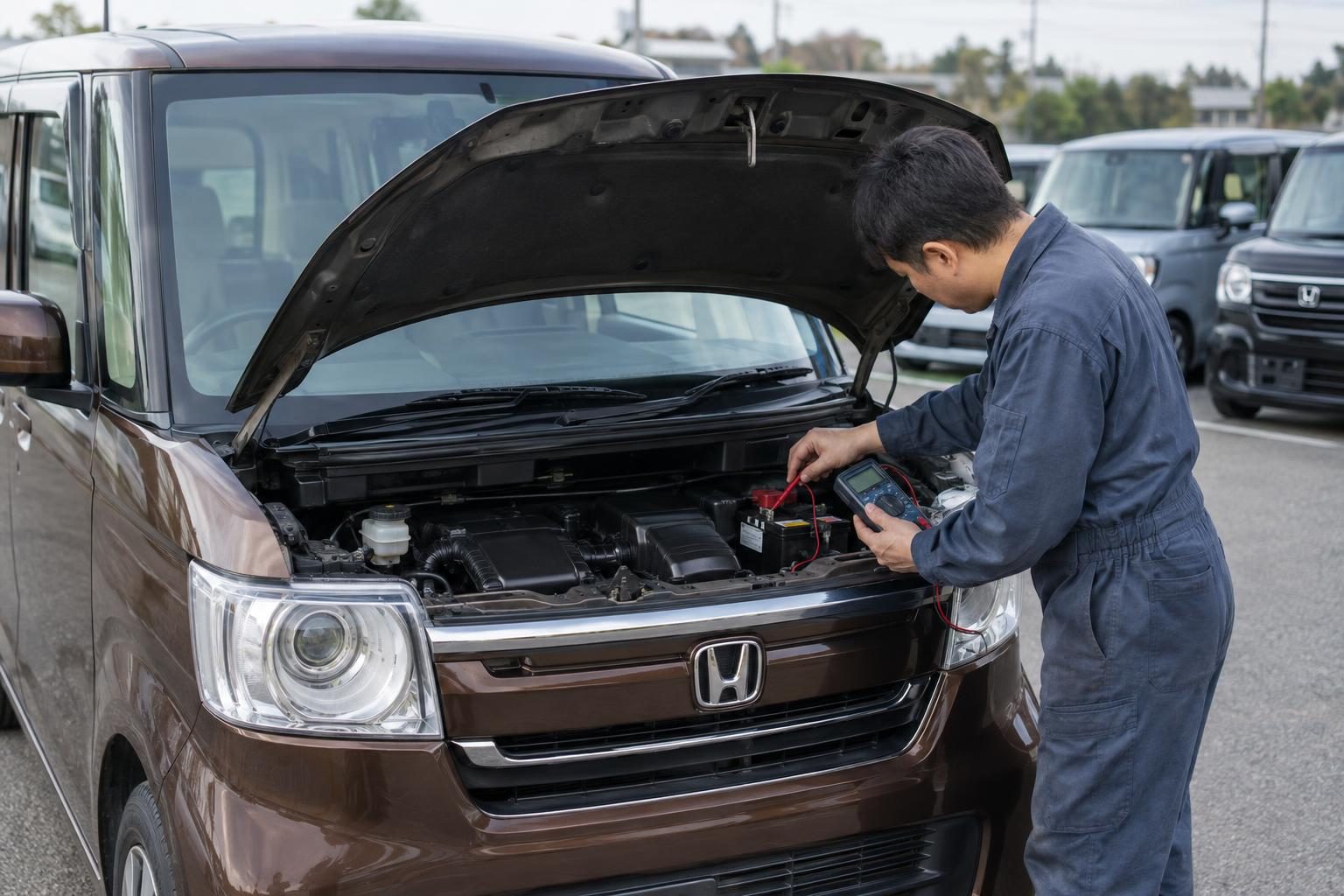 A mechanic checks the N-Box battery with a multimeter.
Start with the battery terminals. White or green crystalline corrosion is a hint that the charging system has been working unevenly. If the car has a voltage readout, or you can put a cheap multimeter across the terminals with the engine running, you want to see somewhere between 13.5 and 14.5 volts at idle. Below 13 volts with the engine running means the alternator isn't keeping up.
Then just listen. A high-pitched whine from the front of the engine that rises and falls with revs is often the first audible warning of alternator bearing wear. And ask whether the battery has been replaced recently. A battery that died young is frequently a battery that was killed by something else.
Check 5: Bodywork and Underbody
Japanese cars generally arrive in good cosmetic order, but cars from the northern prefectures see road salt, and the auction grade only covers what an inspector could see. The underbody deserves its own look, because it's the part that photographs never show properly.
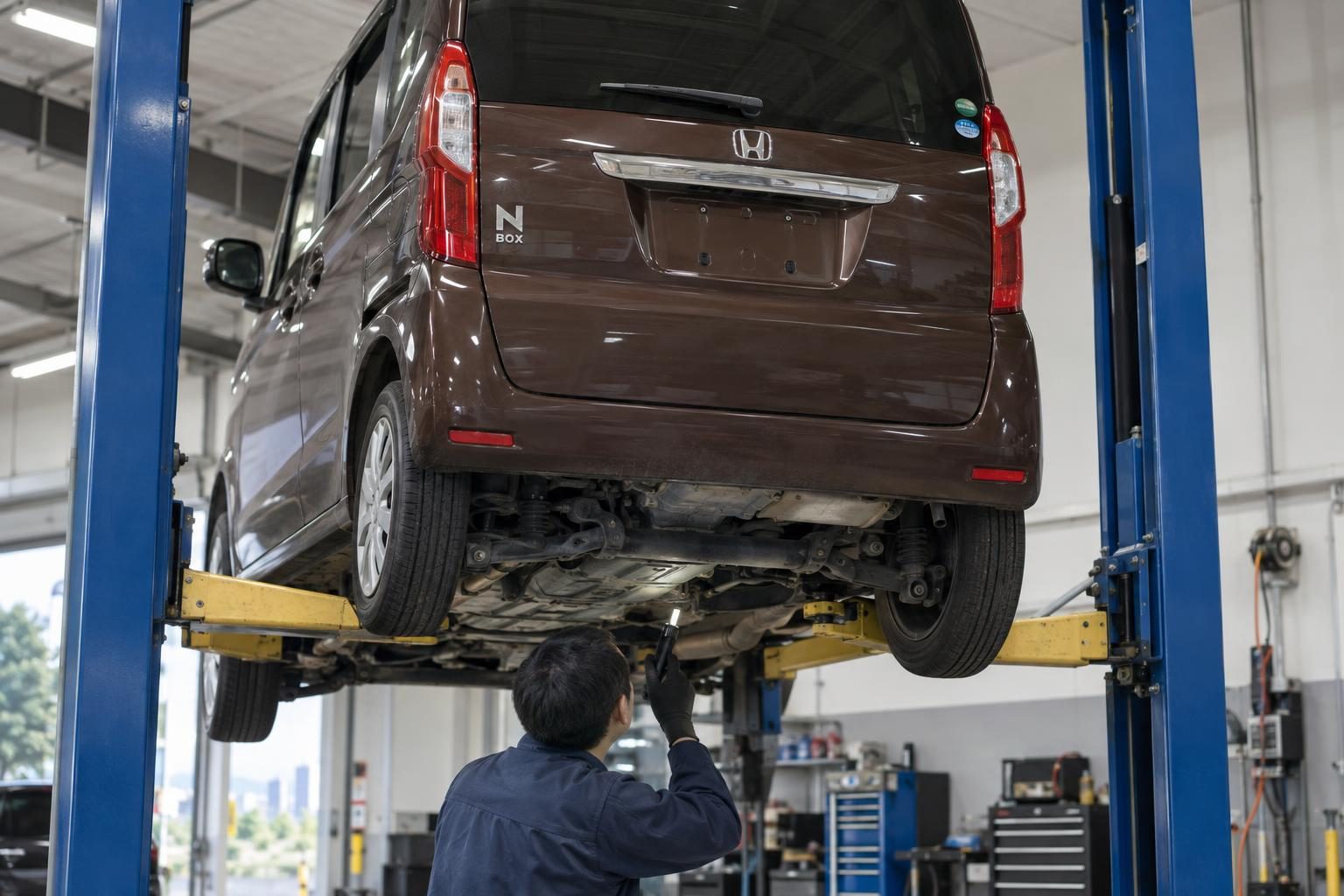 A Honda N-Box is raised for an underbody inspection on a workshop hoist.
Walk all four corners in natural light, ideally not under a showroom's LED strips. Look down the flanks at a shallow angle. You're checking for panel gaps that don't match side to side, paint that has a different texture or sheen on one panel, and overspray on the rubber seals or inside the door jambs. Those three signs together mean a panel has been off the car.
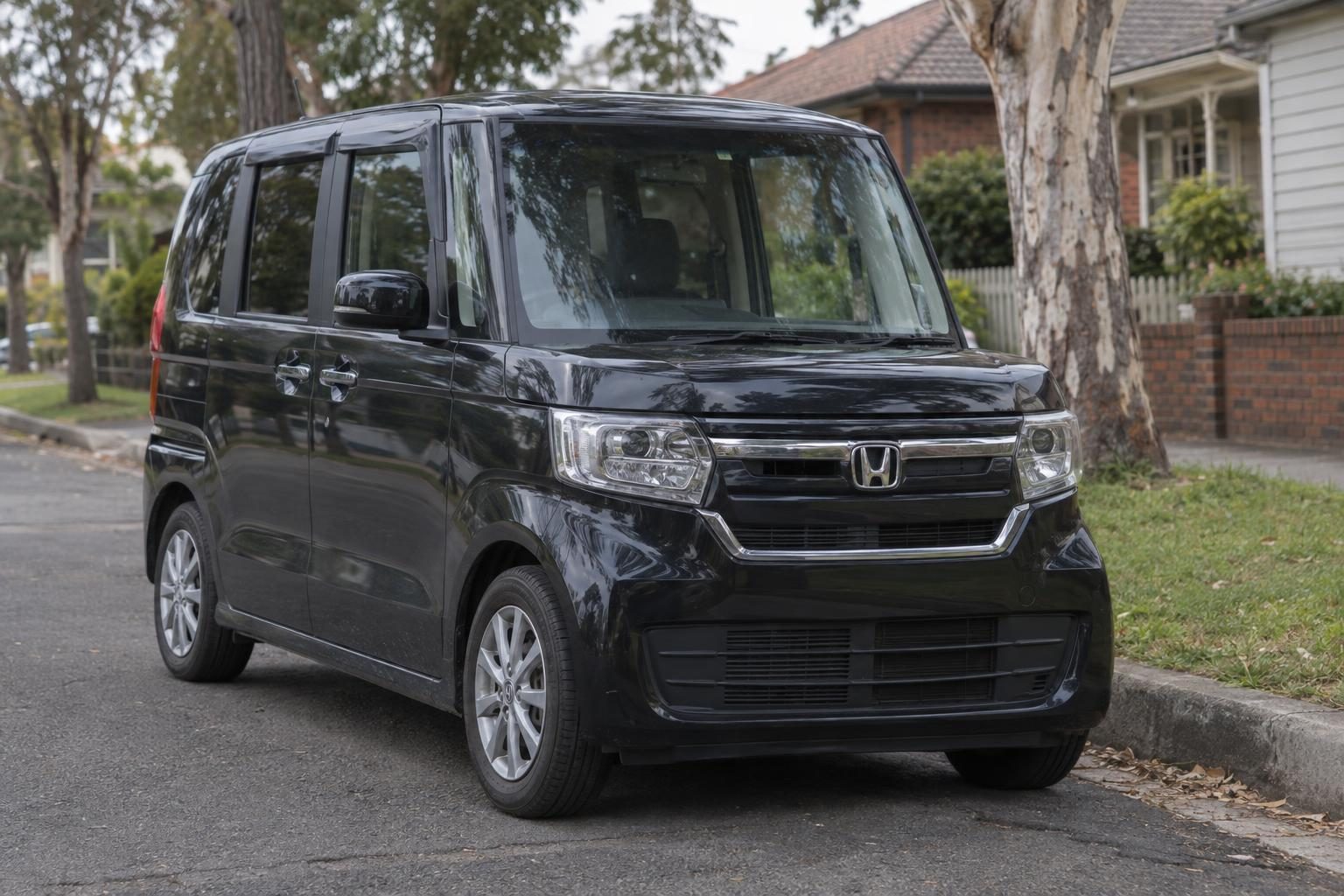 Inspect paint in daylight. Showroom lighting flatters everything.
Underneath, use a torch and check three places: the rear subframe mounts, the spare wheel well, and the sill ends where they meet the rear arches. Surface rust on a bolt head is normal. Flaking rust at a mount point is not. Be equally suspicious of fresh black underbody coating on an older car, because it's as often used to cover something as to prevent it. And if the grade sheet shows R or RA, insist on the structural repair history in writing before going further.
Check 6: Interior and Electrics
For a kei car the N-Box carries a lot of equipment, and every one of those systems is a potential fault. Honda-Yorozu puts a rear power window failure at ¥60,000 to ¥140,000, roughly AUD $600 to $1,400, and Honda Sensing radar damage from even a minor front-end knock at around ¥150,000. Those numbers are why ten minutes in the cabin pays for itself.
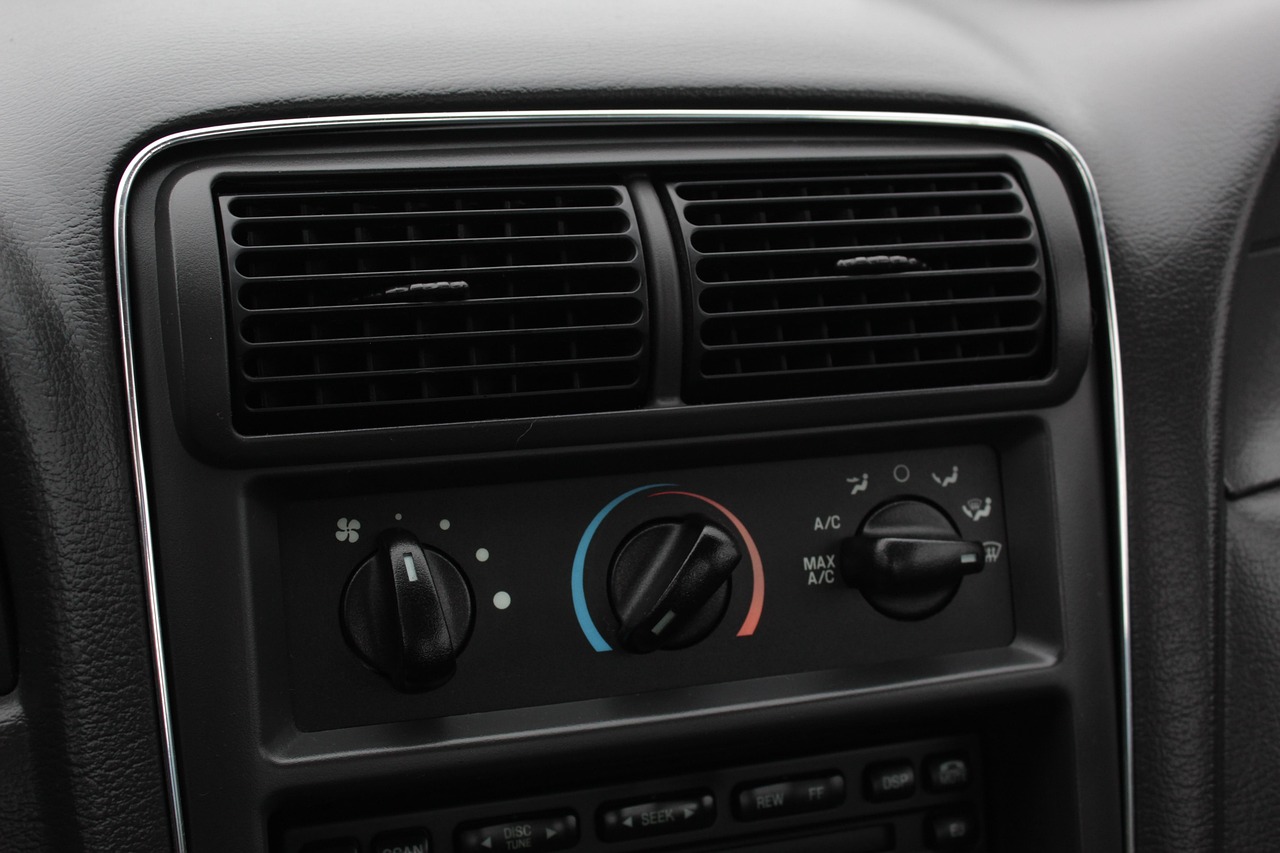 Dashboard vents and manual climate-control controls.
Work through it methodically. Every window, up and down, from both the driver's switch panel and the individual door switch. Both sliding rear doors, opened and closed by hand and by button if fitted, feeling for any binding or drop at the end of travel. Every screen in the infotainment system, plus the reversing camera image, which should be sharp rather than milky.
On Honda Sensing cars, look at the camera cluster behind the top of the windscreen. It should be clean and the glass in front of it crack-free, because a chip in that zone can put the whole system out. Start the car and watch the dash light sequence: the driver assistance lights should illuminate and then go out. One that stays on is an active fault, not a quirk. Finally, press gently around the dashboard edges and A-pillar trim. Panels that flex or click have been off before, which usually means something behind them was repaired.
Check 7: Compliance Documents
A used N-Box on Australian roads must be complied. Without compliance there is no registration, and no amount of good mechanical condition fixes that. The paperwork also tells you who did the work, when, and whether the recalls were closed out.
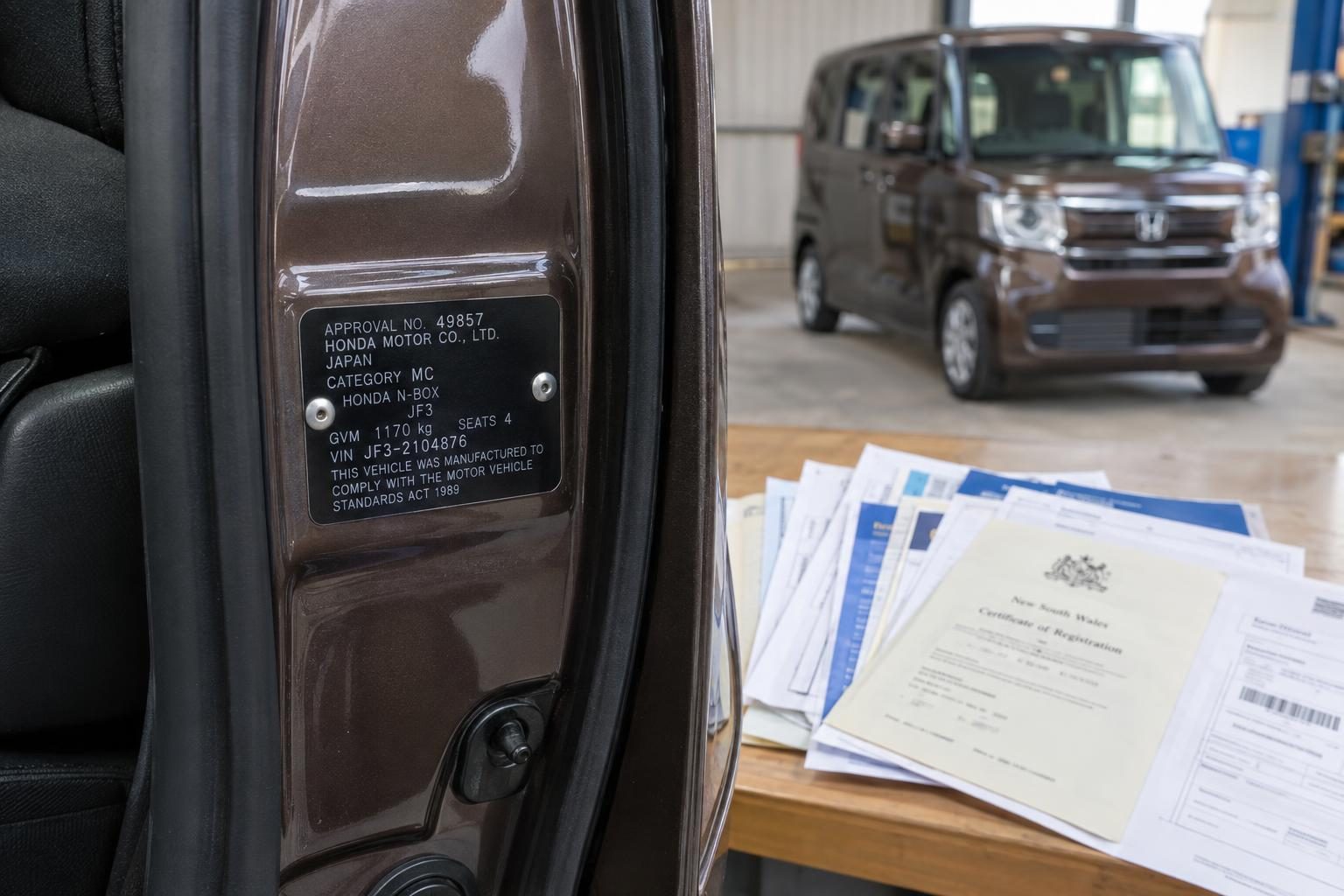 Compliance plate on a Honda N-Box JF3 door jamb with registration paperwork.
Five documents to work through:
- The compliance plate. Driver's side door jamb. It should show the compliance date, the workshop identifier and ADR confirmation. No plate means no deal, regardless of what you're told about paperwork being "on the way".
- A PPSR check. Run the VIN yourself before you commit. It costs about $2 online and confirms there's no finance owing and no recorded written-off status.
- A NEVDIS check. The national register covers registration history and write-off records across states, which is the gap a single-state check leaves open.
- Shaken certificates. Japan's biennial roadworthy records. Two or three with consistent odometer progression are worth more than any verbal assurance about kilometres.
- Recall stamps. Specifically the December 2023 fuel pump recall, covered in detail below. Honda Japan marks completed work with a yellow paint dab on the VIN plate stamp (located under the right rear seat carpet), so you can verify it visually as well as on paper.
On the 2024 SEVS situation: the Australian Government suspended SEVS approvals for several kei models in April 2024 over a gap between Japan's 26 km/h side-impact test and the 32 km/h required under ADR 85, with some importers left carrying costs of up to $10,000 per vehicle (About Regional). That affected fresh imports. A car already complied and on Australian roads is unaffected and fully legal. If the car you're looking at was imported recently, ask which SEVS approval code was used and whether it remains current.
What Recalls Should You Ask the Seller About?
Three recalls matter on the JF3 and JF4, and the largest by a wide margin is the fuel pump campaign of December 2023, which covered approximately 270,836 N-Box vehicles across four build ranges according to Japan's Ministry of Land, Infrastructure, Transport and Tourism. If the car was built between 2017 and 2020, it is almost certainly in scope.
The MLIT notice of 8 December 2023 breaks the N-Box figures down as 102,990 JF3 units from 2017 to 2019, 78,477 JF4 units over the same period, 77,095 JF3 units from 2019 to 2020 and 12,274 JF4 units. A further Honda Japan notice in May 2026 addressed cases where the original replacement work had been carried out incorrectly, so a stamp from the first round isn't quite the end of the conversation.
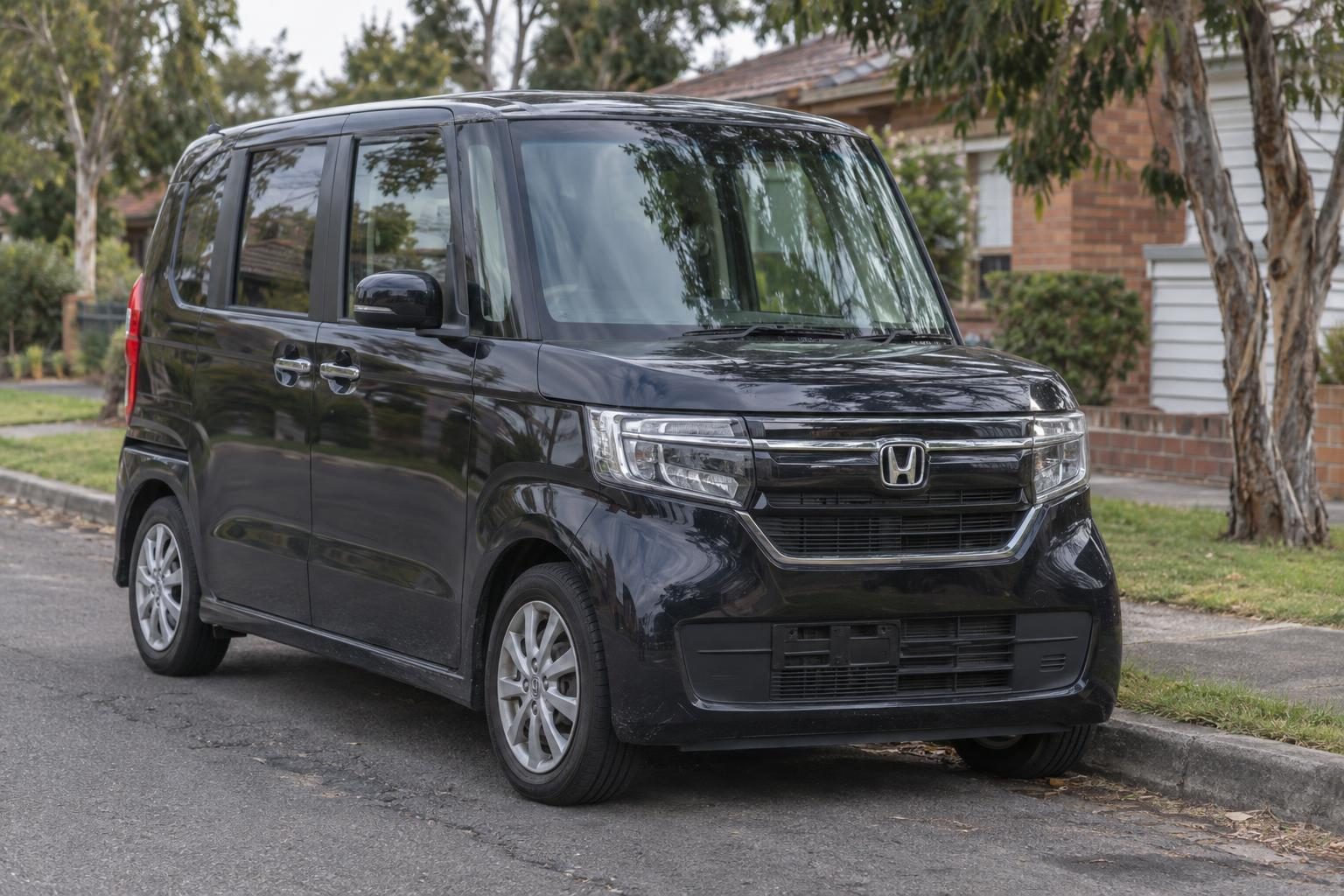 Any 2017 to 2020 build needs the fuel pump recall confirmed before you buy.
The other two are narrower. The CVT torque converter spring recall of February 2020 covered 44,974 cars built between August and December 2017. A backup light control relay recall in the same month covered 185,902 combined N-Box and N-Van units from July 2017 to December 2018 production (Honda-Yorozu). Both are cheap to verify and awkward to discover later.
Here's the cost context that makes the seven checks worth the effort. These are converted from Japanese parts-specialist figures at roughly ¥100 to AUD $1, and Australian labour rates will push most of them higher.
| Known JF3/JF4 issue | Indicative Japanese repair cost, converted |
|---|---|
| Honda Sensing radar (front-end damage) | ~$1,500 |
| Engine misfire, carbon on exhaust valves | ~$1,500 |
| Air conditioning system, full repair | $1,000 – $2,000+ |
| Radiator and coolant repair | $1,000+ |
| Rear gate / hatch replacement | $700 – $2,200 |
| Rear power window mechanism | $600 – $1,400 |
| Alternator, rebuilt unit | $500+ |
Figures compiled from Carweakpoints' JF3/JF4 fault guide and Honda-Yorozu, converted at approximately ¥100 to AUD $1. Australian labour rates may push totals higher.
N-Box Variants Available in Australia
Four JF3 cars are listed on Carbarn's N-Box page as at 29 September 2026, spanning 2019 to 2021 build years and 12,141 to 36,262 km, all petrol, all 2WD automatics, all confirmed PPSR-clear. They're useful as worked examples because each one sits at a different point on the inspection checklist above. Live prices, odometers and photos are on the listing page.
2021 Honda N-Box EX Package
The EX Package is the highest-specified car of the four and the lowest-kilometre example at 12,141 km, which makes it the reference point for what a healthy JF3 should feel like. Sit in this one first if you're comparing cars. A condenser at this age and mileage should blow properly cold within a minute, the CVT should pull away without a trace of shudder, and the sliding doors should glide.
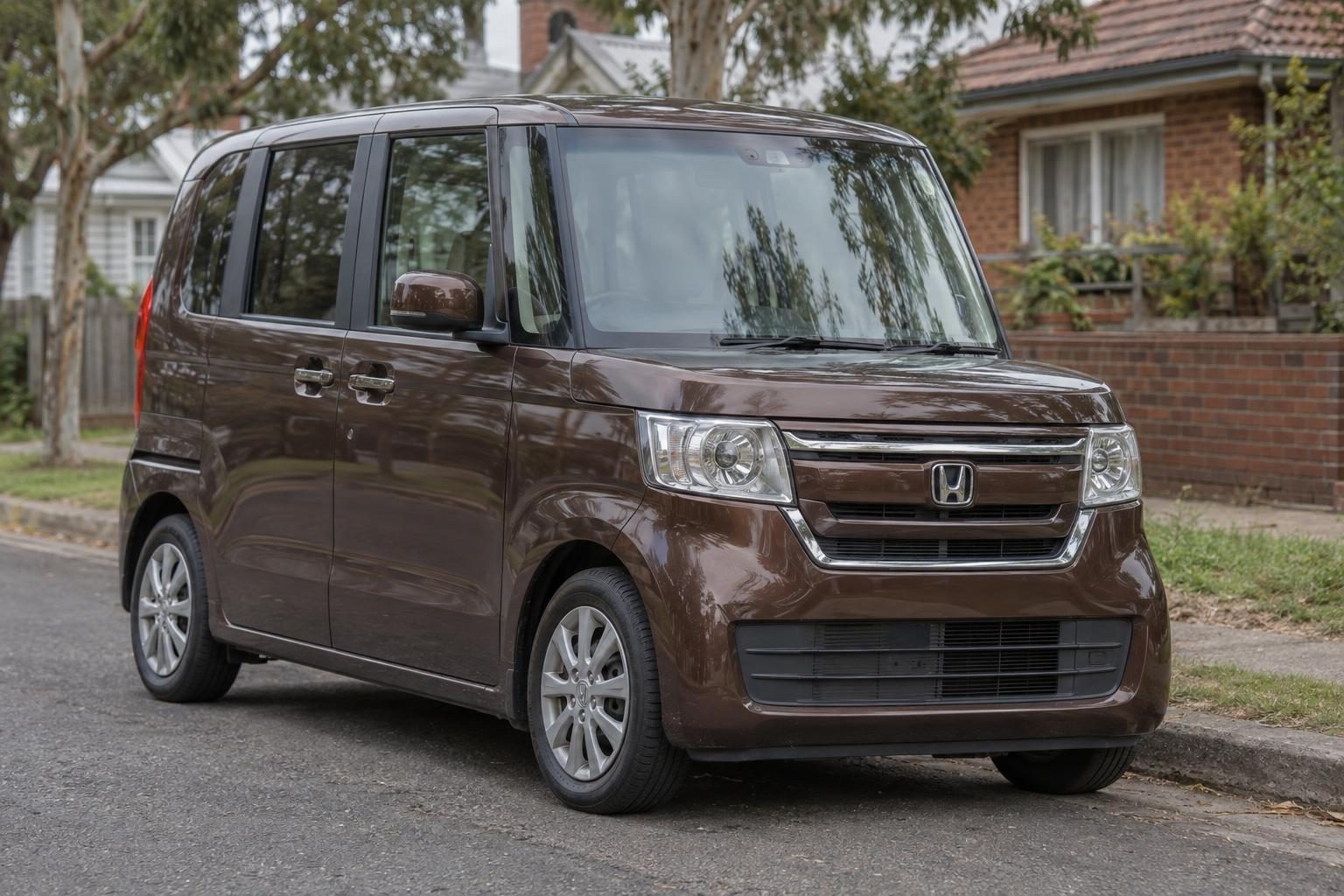 2021 Honda N-Box EX Package (JF3)
Mechanically it's the same 658cc S07A three-cylinder as the rest of the range, naturally aspirated at 43 kW and 65 Nm, driving the front wheels through a CVT. Body is the 3,395 mm by 1,475 mm by 1,790 mm kei wagon shell, five doors, four seats. Kerb weight under a tonne is what makes 43 kW workable in traffic rather than painful.
What the EX badge adds is equipment rather than performance: the fuller comfort and convenience list, which on a car this size mostly shows up as better seat trim, more storage detailing and a more complete infotainment fitment. At 12,141 km the interior letter on the grade sheet should be an A, and anything less would be worth asking about.
2021 Honda N-Box Custom L
The Custom L at 26,612 km is the variant most Australian buyers land on, and for good reason. Custom brings the sharper front treatment, upgraded lighting, alloy wheels and a lifted interior trim level over the standard grades, without the price step that comes with chasing the top of the range.
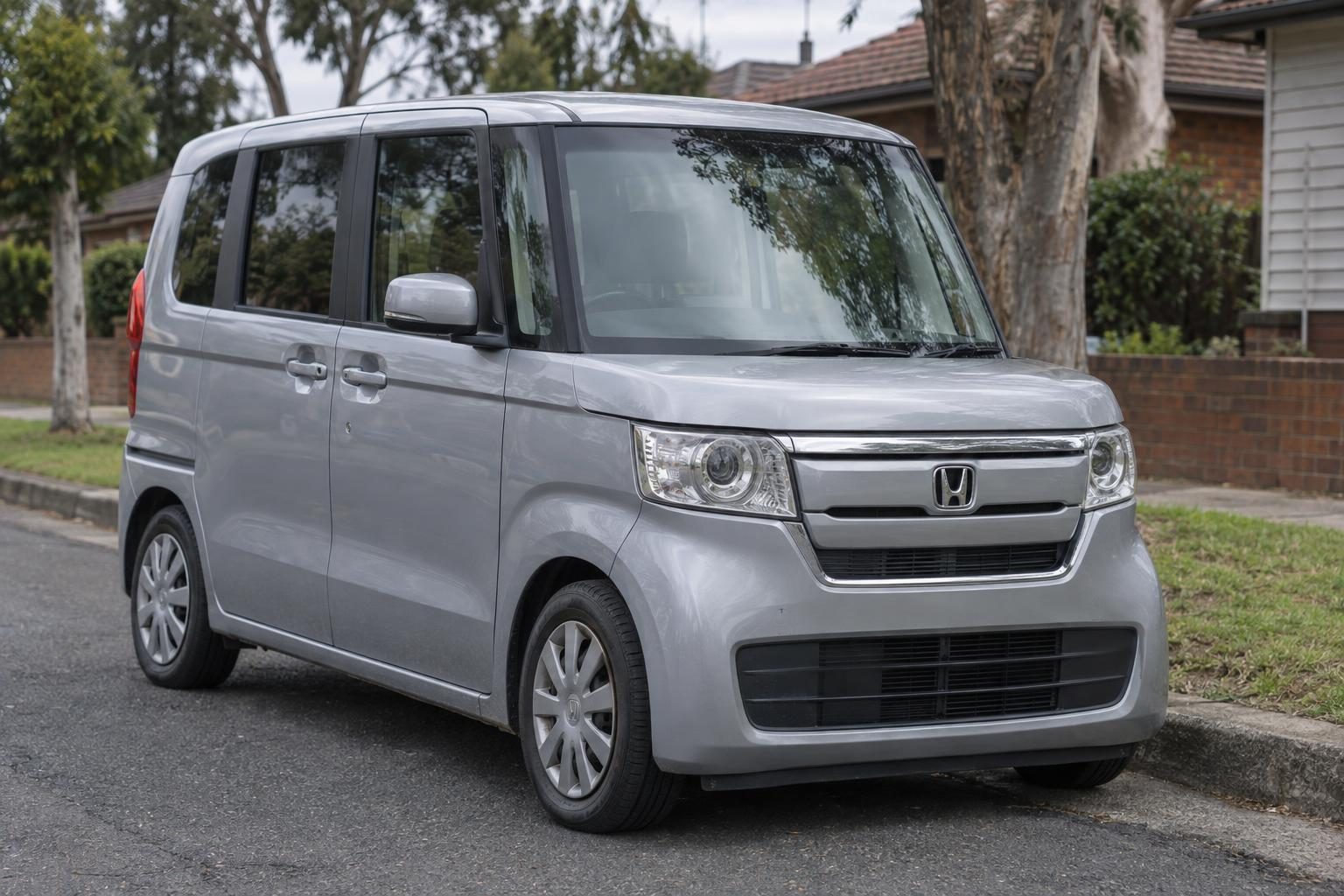 2021 Honda N-Box Custom L (JF3)
Underneath, it's the familiar package: 658cc S07A three-cylinder petrol, CVT, 2WD, four seats in a five-door wagon body, 1,790 mm tall. Worth knowing that Custom is the grade where the turbocharged engine most often appears in Japan, producing 47 kW and 104 Nm, so confirm from the listing which engine a given Custom car actually has rather than assuming from the badge. The naturally aspirated car is the more common fitment.
At 26,612 km this is the first of the four cars where CVT fluid history becomes a genuine question rather than a formality. It's not near Honda's recommended change interval yet, but it's far enough in that a service log showing regular attention is meaningfully reassuring. Ask for it.
2020 Honda N-Box Custom G L (Honda Sensing)
The 2020 Custom G L carries the Honda Sensing suite and sits at 17,220 km, which is very low for a car of its age. That combination, a full driver-assistance package on a five-year-old car with under 20,000 km on it, is the kind of thing that only really happens with Japanese domestic stock.
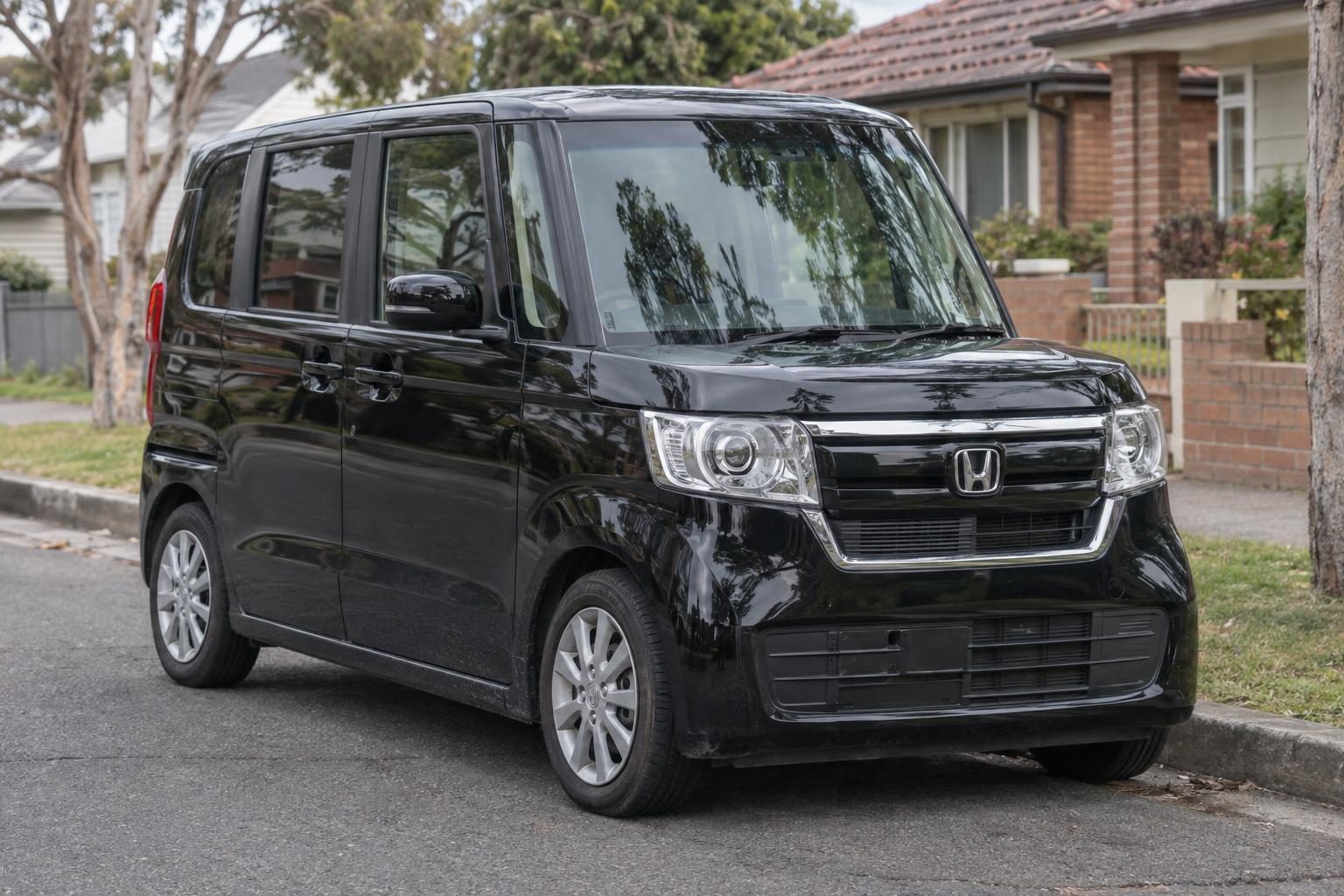 2020 Honda N-Box Custom G L with Honda Sensing (JF3)
Honda Sensing on the JF3 covers collision mitigation braking, adaptive cruise control, lane-keeping assist and road departure mitigation. That's the same core function set Honda fits to considerably more expensive cars sold new here, and it's the strongest single argument for the N-Box as a city car rather than just a cheap one. Mechanically it's the standard 658cc S07A with the CVT and front-wheel drive.
Because this car has Honda Sensing, Check 6 applies with more force. Test the camera cluster behind the windscreen, confirm the assist warning lights extinguish after start-up, and look closely at the front bumper for any repair evidence, since the radar behind it is the expensive part to replace. Black paint also shows swirl marks and fade more readily than lighter colours, so inspect it outside in daylight.
2019 Honda N-Box (Honda Sensing)
The 2019 N-Box with Honda Sensing is the oldest and highest-kilometre car of the four at 36,262 km, and the most accessible entry point into the generation. It's also the one where the inspection checklist earns its keep, because a 2019 build falls squarely inside the December 2023 fuel pump recall window.
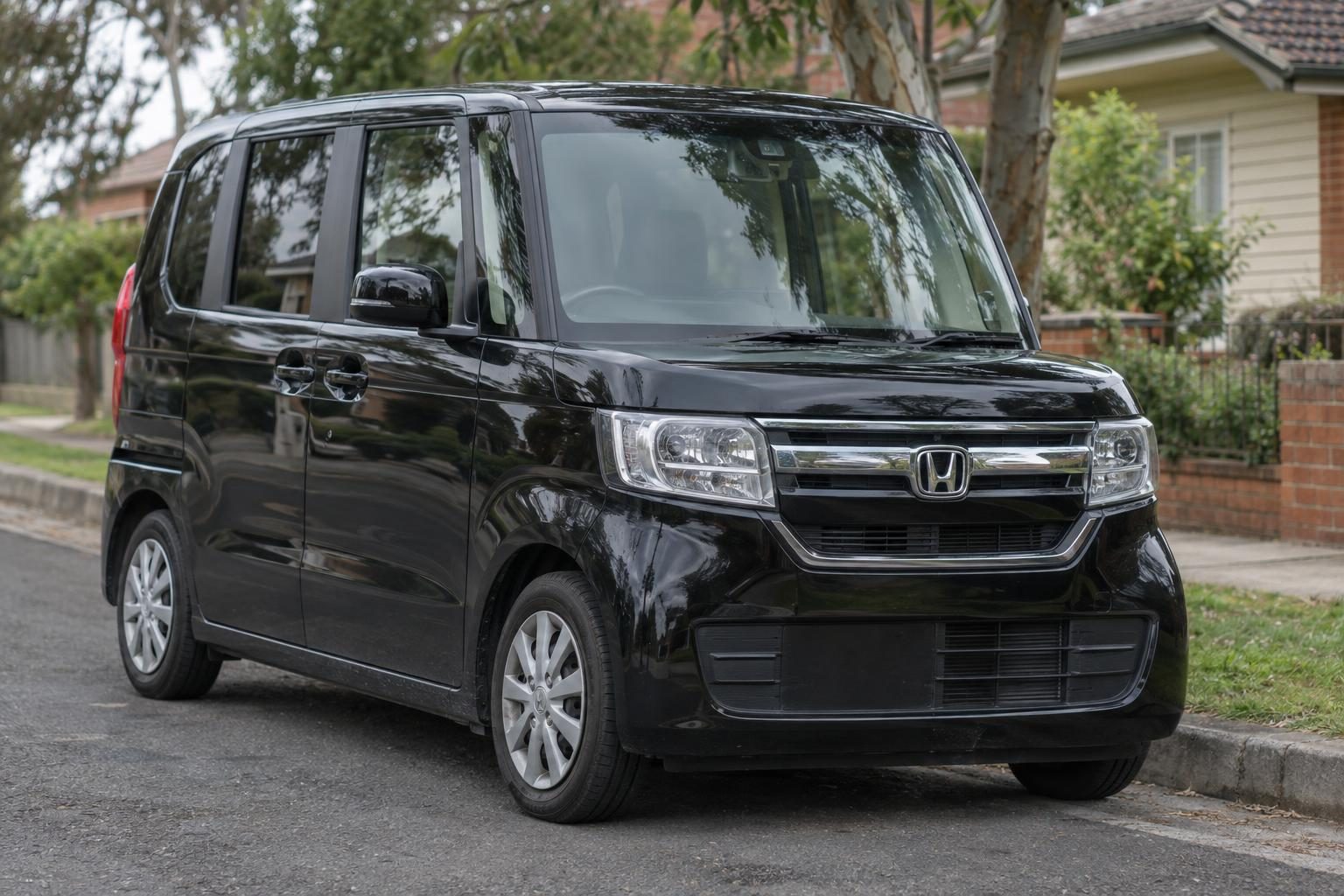 2019 Honda N-Box with Honda Sensing (JF3)
The specification is the same as its stablemates in the important respects: 658cc S07A naturally aspirated three-cylinder, 43 kW and 65 Nm, CVT, 2WD, four-seat five-door wagon at 3,395 mm long. What differs is age and use. At 36,262 km the air conditioning system has seen enough summers to be worth the five-minute cooling test, and the CVT has covered enough distance that a fluid change history is a reasonable expectation rather than a nice-to-have.
Get the fuel pump recall confirmed, check the yellow paint mark on the VIN plate stamp under the right rear seat carpet, run the condenser test, and this is a sound car. Skip those steps and you're gambling on a system that costs four figures to put right.
Carbarn operates from Lidcombe in Sydney under NSW Motor Dealer Licence MD056471, with a RAW-certified workshop handling compliance, AVV inspection and RAV entry, plus finance, three-month dealer warranty with a five-year extended option on eligible vehicles, in-person inspection and nationwide delivery. Both routes are open: buy a car already here and complied, or have one sourced from Japan through the importing service, where the JF3 remains a listed eligible model code and a Japan-side inspector checks the car before any bid is placed.
Which One Makes Sense for You?
Match the car to how hard you're willing to work at the inspection, not just to the budget. That's the honest framing, because every kilometre of extra use on a kei car shifts more of the risk from the seller's paperwork onto your own eyes.
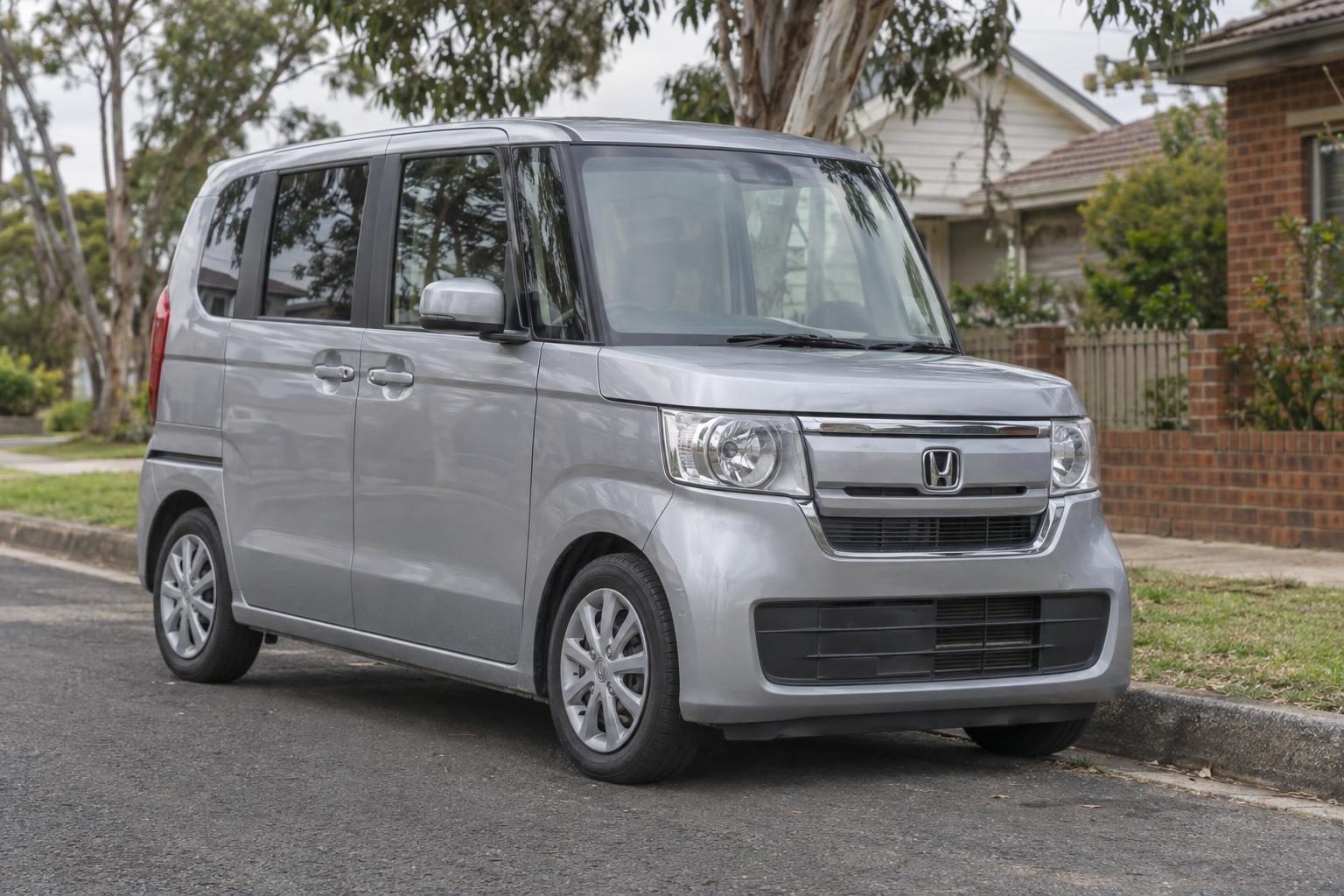 Around 50,000 km is still modest for a JF3, but the checklist matters more.
If you want maximum peace of mind, hold out for Grade 4.5 or better with under 30,000 km showing. The systems most likely to cost you money on an N-Box, the condenser and the CVT, are both age and heat-cycle sensitive as much as distance sensitive, so a genuinely low-use car buys you real margin. The 2021 EX Package at 12,141 km is what that looks like.
If you want a balanced daily driver, Grade 4 or 4.5 somewhere between 20,000 and 50,000 km is the sensible band. The 2021 Custom L and 2020 Custom G L both sit here. The seven checks are your main tool at this level, and you should expect to find one or two minor things. That's normal on a used car, and it's negotiating material rather than a reason to walk.
If the budget is tight, a car around the 36,000 km mark like the 2019 is viable, provided the recall stamps are present, the CVT pulls away cleanly from cold, and you've run PPSR and NEVDIS before you inspect rather than after. Price anything you find into the conversation.
If you're buying privately or from a third-party dealer, run exactly the same seven checks and add one: ask for the auction sheet by name. Sellers who have it will produce it. Sellers who deflect are telling you something.
Who should look elsewhere? Anyone who regularly carries more than two adults on longer trips. The N-Box seats four, and back-seat adults are comfortable around town but less so after an hour. Anyone doing consistent 110 km/h highway kilometres, where 43 kW and a tall, narrow body both start to work hard. And if you're weighing up a cheaper JF1 or JF2, apply stricter thresholds on air conditioning and CVT history, because those cars have more years behind them and no Honda Sensing to fall back on.
The N-Box is a genuinely well-built small car, and the JF3 generation in particular is a lot of engineering for the money. Nothing in this guide says otherwise. What it says is that the difference between a good one and an expensive one is about forty minutes of looking. Take the checklist with you, but don't read it aloud at the seller. Use it as a quiet sequence: crouch at the bumper, pull the dipstick, drive it from cold, work every switch, then ask for the papers.