



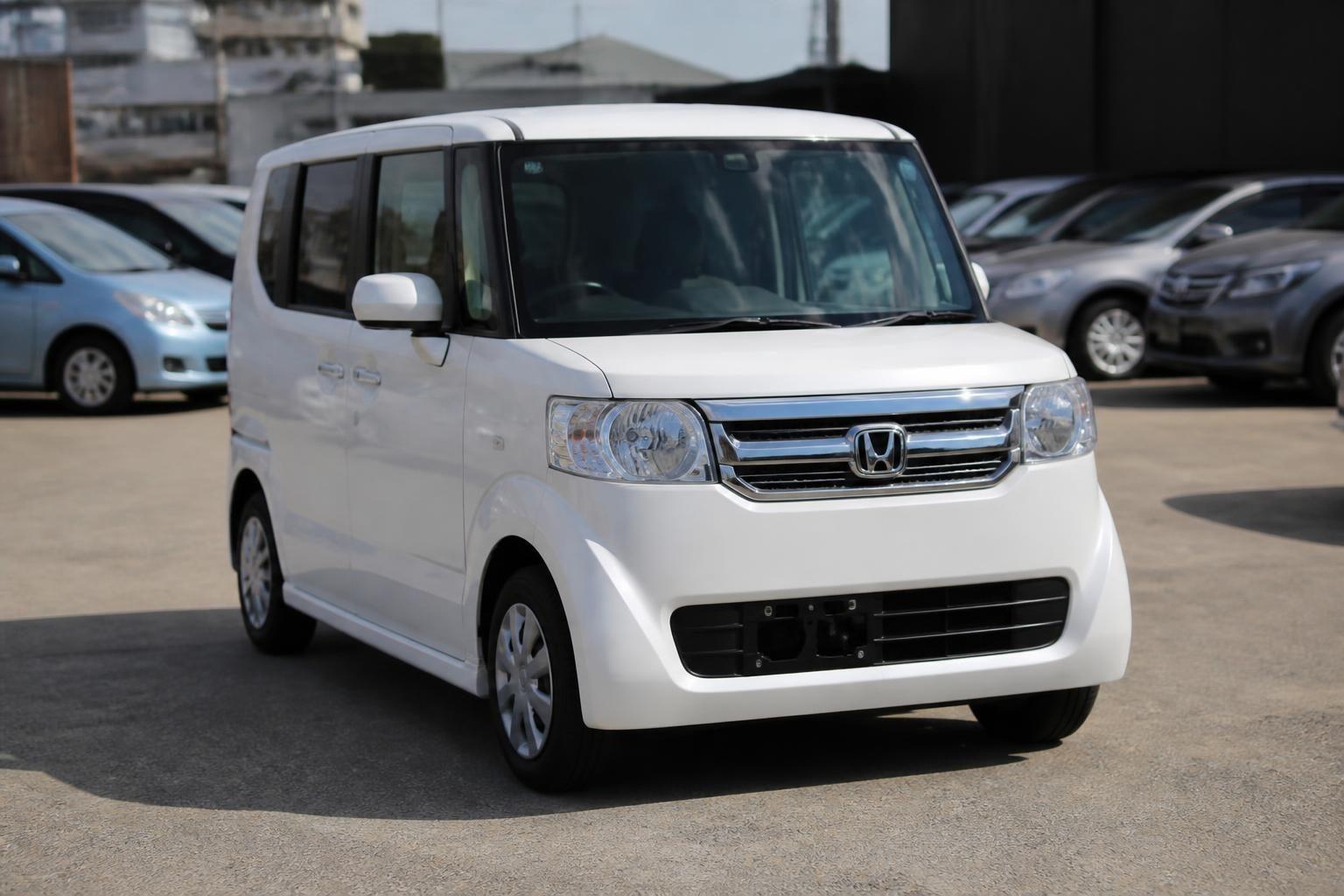
Ready to Hit the Road in Style?
Save money and reduce emissions with vehicles designed to deliver exceptional mileage. Visit our inventory and find a car that fits your lifestyle.
Ready to Hit the Road in Style?
Save money and reduce emissions with vehicles designed to deliver exceptional mileage. Visit our inventory and find a car that fits your lifestyle.
You've circled the same three blocks in Newtown twice, watching gaps open and close that your car simply won't fit into. Or you've priced up a small hatch and worked out that "small" in Australia now means something four metres long with a price tag to match. Plenty of buyers want a genuinely cheap, genuinely small car for city driving, and the local new-car market keeps moving the other way.
This guide looks at one answer to that problem: the Honda N-Box, Japan's kei-class wagon. We'll cover how small it actually is, what the JF3 generation gives you mechanically, what it costs to run, whether it's legal to bring here, and who it genuinely suits — a strong candidate if you're weighing up the best small used car for city driving.
Quick Answer
- The N-Box measures 3,395 mm long and 1,475 mm wide, roughly 550 mm shorter than a current Toyota Yaris (Toyota Australia, 2026).
- It was Japan's best-selling passenger car in 2025 at 201,354 units (Nippon.com, citing the Japan Automobile Dealers Association).
- The naturally aspirated 660cc version returns 21.2 km/L combined on the WLTC cycle.
- JF3 builds qualify for Australian import under the SEVS Environmental Criterion.
- Best suited to solo commuters and couples doing mostly urban kilometres, not highway families.
How Small Is a Kei Car, Really?
Kei cars are Japan's smallest legal vehicle class, built to a strict size and engine ceiling rather than a styling brief. The category caps engines at 660cc and bodies at roughly 3.4 metres long by 1.48 metres wide, and the N-Box sits right on those limits at 3,395 mm by 1,475 mm. That's about half a metre shorter than a Yaris, in a class that grew 8% to 1.3 million Japanese sales in 2025 (best-selling-cars.com).
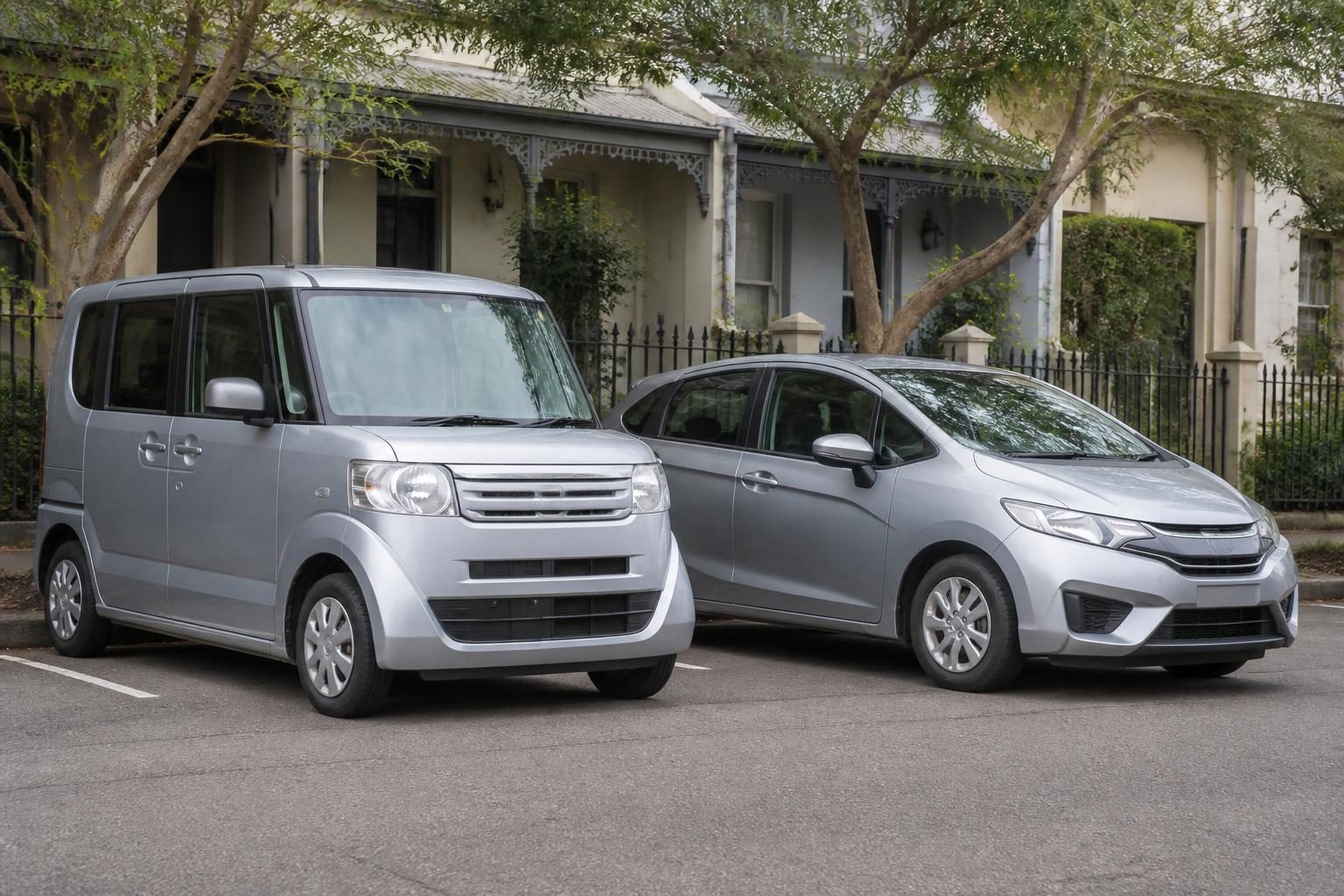 A Honda N-Box contrasts with a larger silver hatchback on a terrace-house street.
Half a metre doesn't sound like much until you're parking. It's the difference between a kerbside gap being usable and being a five-point exercise with someone waiting behind you. Narrow width matters too, particularly in older Sydney apartment garages and multi-storey car parks with 1990s bay sizes.
Honda did something different with the space it had: it built upward instead of outward. The N-Box stands just under 1.8 metres tall, and its cabin is packaged around that height rather than around the engine. The footprint stays tiny, but the interior feels far more like a small van than a microcar. Rear sliding doors on most grades make kerbside access easy in tight spots.
| Measurement | Honda N-Box (JF3) | Toyota Yaris (current AU) |
|---|---|---|
| Length | 3,395 mm | 3,940–3,950 mm |
| Width | 1,475 mm | 1,695 mm |
| Height | Just under 1.8 m | ~1,500 mm |
| Engine | 658cc 3-cylinder petrol | 1.5L 3-cylinder petrol |
2020 Honda N-Box G (Honda Sensing)
The Honda N-Box in its plain G (Honda Sensing) grade is the version that makes the strongest value argument, and a 2020 example with 20,767 km on it shows why. It's the entry trim, not the dressed-up Custom, so you're paying for the packaging and the safety kit rather than the chrome grille and alloy upgrades. Prices across listed JF3 examples in Australia sit in the high-teens to mid-$20K range depending on grade and kilometres.
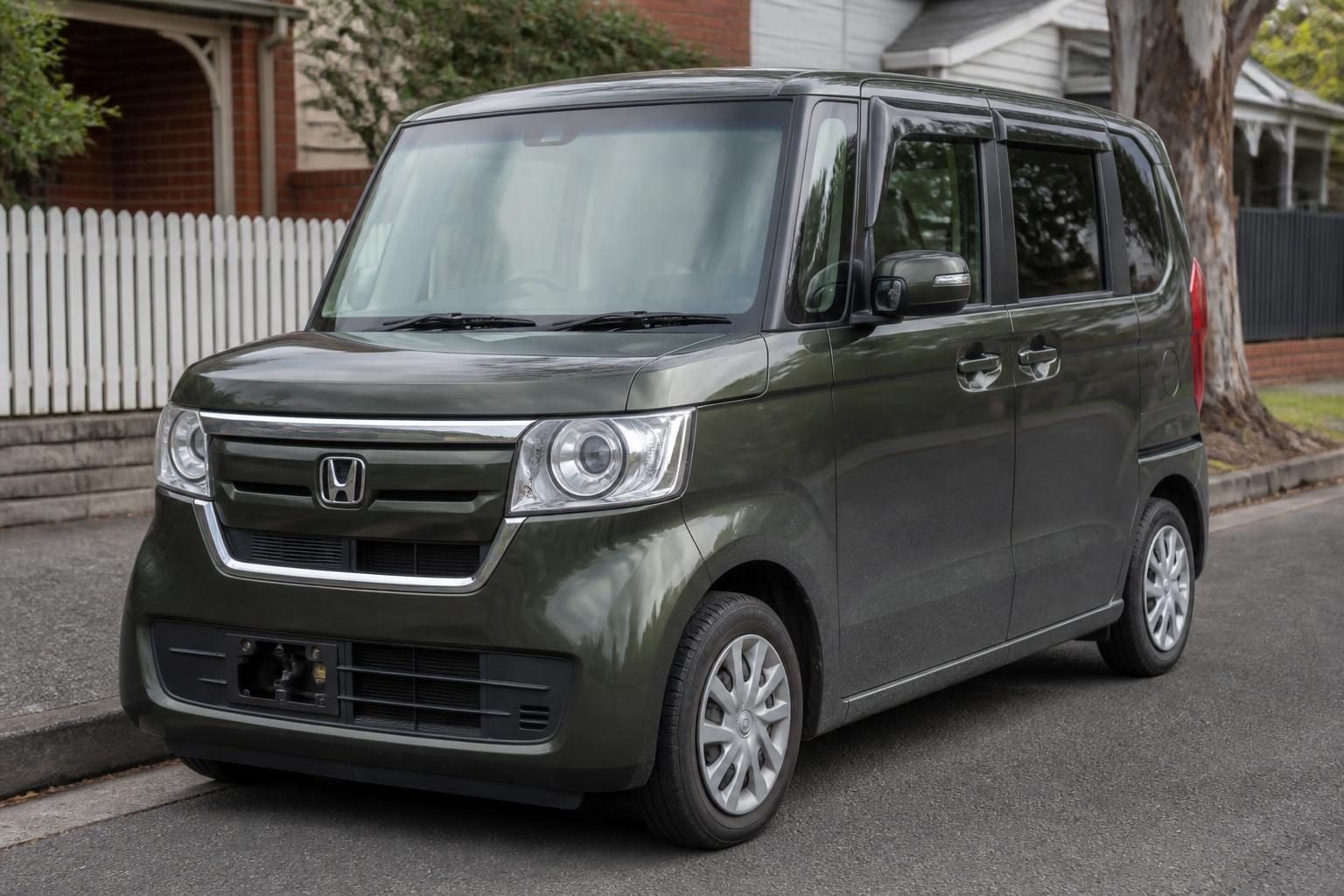 2020 Honda N-Box
Mechanically it's the naturally aspirated S07A: a 658cc inline three-cylinder petrol producing 43 kW and 65 Nm, driving the front wheels through a CVT (cararac). Kerb weight sits in the 890 to 950 kg band depending on grade. That light kerb weight is why 43 kW moves the N-Box around town without feeling strained. It's a four-seat wagon body with five doors, automatic transmission, and unleaded petrol.
Honda Sensing is Honda's active-safety bundle, and finding it standard on the cheapest trim of a used kei car is unusual. On this base G grade it covers collision mitigation braking, adaptive cruise control, lane-keeping assist and road departure mitigation — the same core functions Honda fits to far more expensive models sold new in Australia. That's a big part of why the N-Box has topped Japan's sales charts for over a decade rather than just being cheap transport: buyers get genuine safety technology alongside the packaging efficiency, not one or the other. For a used kei car buyer in Sydney weighing up daily-driver safety against sticker price, this is the detail that tips the decision.
What Does an N-Box Cost to Run?
The naturally aspirated two-wheel-drive N-Box returns 21.2 km/L combined on Japan's WLTC cycle, which works out to about 4.7 L/100km, and at $2.00 per litre and 12,000 km a year that's roughly $1,130 in fuel annually. Running costs are where this car pulls away from anything comparably priced. The four WLTC figures across the range tell a useful story: naturally aspirated 2WD returns 21.2 km/L, NA 4WD manages 19.8 km/L, turbo 2WD sits at 20.2 km/L and turbo 4WD at 19.0 km/L. The turbo option isn't there for excitement — it exists for merging, producing 48 kW and 104 Nm against the NA car's 43 kW and 65 Nm (cararac). That extra torque earns its keep if you regularly join 80 km/h roads with a full car.
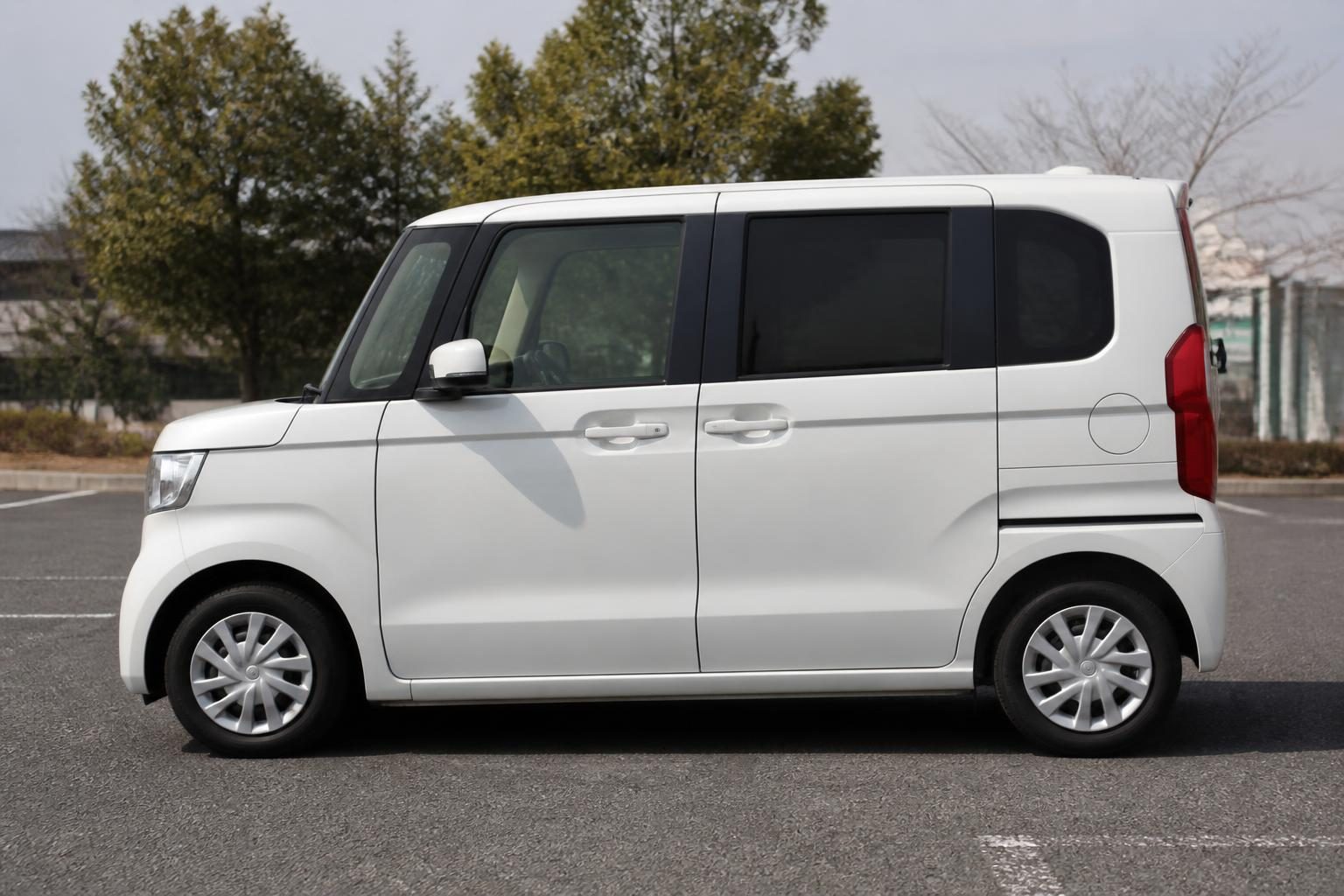 Side view of a white Honda N-Box with tall body and sliding rear door.
Tyres are small and cheap. Brakes and consumables are sized for a sub-tonne car, and servicing a three-cylinder Honda petrol engine isn't complicated work. The honest caveat is parts availability: this is a Japanese-domestic model, so specialist suppliers — not a local dealer shelf — carry some trim and body items, and that's worth factoring in before you buy.
Who Does the N-Box Actually Suit?
This car makes a lot of sense for a narrow group and very little sense outside it. If your driving is mostly urban, your parking is tight, and you carry one or two people plus shopping, the N-Box is close to ideal. It's a four-seater with a small boot, not a family hauler.
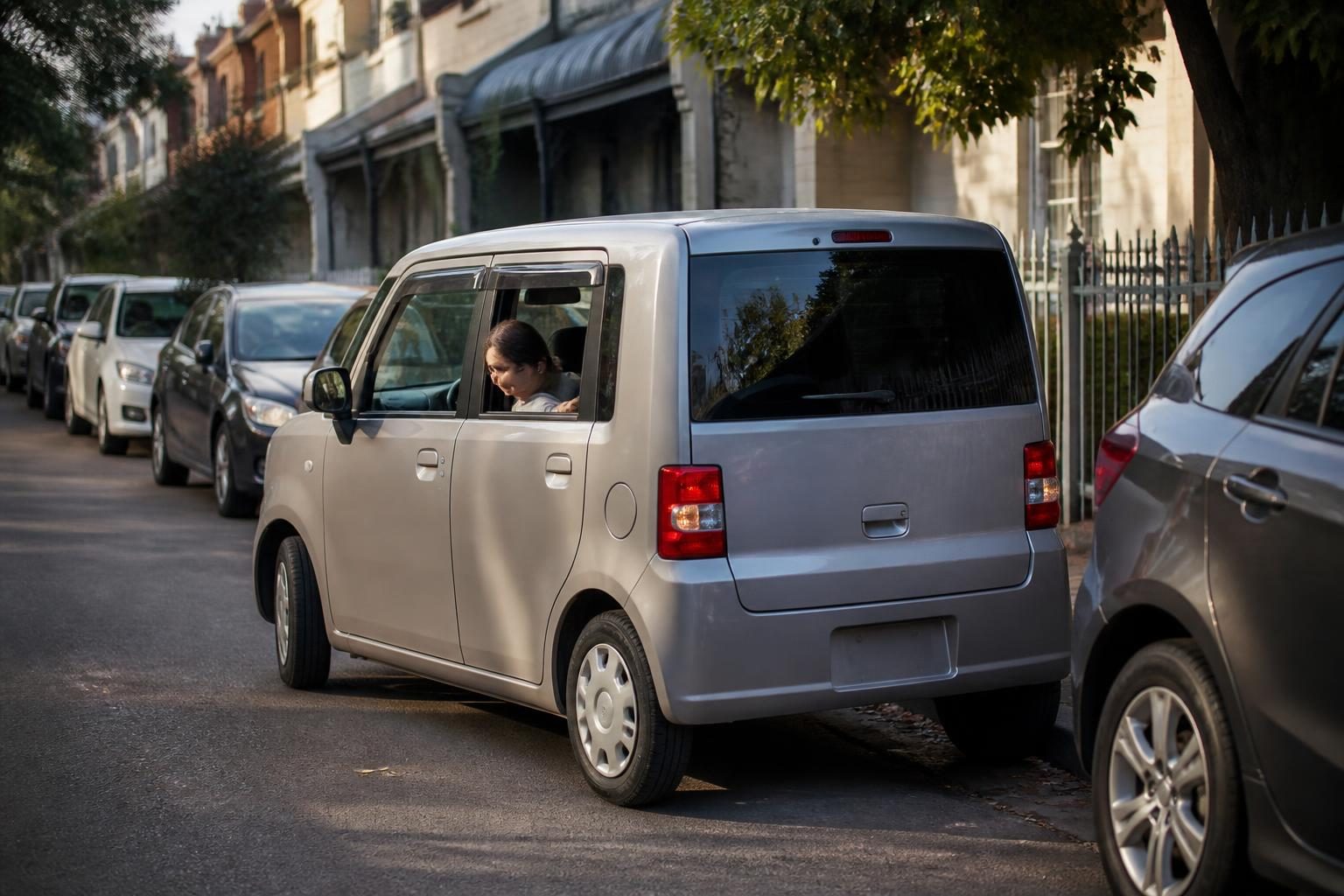 A compact boxy car manoeuvres into a tight kerbside space on a leafy urban street.
Worth a look if you're: a solo commuter in inner Sydney, Melbourne or Brisbane; a couple wanting a cheap second car; a parent needing an easy-access runabout with sliding doors; someone whose garage or driveway genuinely can't take a four-metre car; or anyone specifically shopping for a used kei car in Sydney's tighter inner suburbs.
Probably not the right fit if you: do regular highway runs at 110 km/h; need to seat five; tow anything; regularly load long items; or want a car where every replacement part is available same-day from a local dealer. A 660cc three-cylinder is comfortable at freeway speed, but it's working, and wind noise from that tall body is real.
If you fall in the middle, the turbo grades split the difference. You give up about 1 km/L and gain 39 Nm, which is the right trade for anyone doing a mix of city and motorway kilometres.
How Do You Buy an N-Box in Australia?
There are two sensible routes into one. The first is buying a car that's already here, complied and registrable, so you can inspect it, arrange finance and drive away. The second is sourcing a specific grade, colour or odometer reading from a Japanese auction and importing it, which takes longer but gets you exactly the car you want.
Carbarn handles both from its Lidcombe workshop in Sydney. You can browse locally available N-Box stock with live pricing, odometer readings and auction grades. Carbarn is a licensed NSW motor dealer (MD 056471) with a RAW-certified workshop, handling VIA applications, AVV inspection, RAV entry, compliance work, warranty options, finance and nationwide delivery. Typical end-to-end import timing runs six to ten weeks.