



Ready to Hit the Road in Style?
Save money and reduce emissions with vehicles designed to deliver exceptional mileage. Visit our inventory and find a car that fits your lifestyle.
Ready to Hit the Road in Style?
Save money and reduce emissions with vehicles designed to deliver exceptional mileage. Visit our inventory and find a car that fits your lifestyle.
You've narrowed your search to a Prius, and now you're stuck on the harder question: which generation? A tidy Gen 3 hatch sits comfortably under $20K in Sydney. A Gen 4, sourced from Japan, asks for more money and a wait. The gap buys you newer safety gear and a younger hybrid battery, but not much extra fuel economy. And the battery question is the one that keeps buyers awake, because a 2013 pack is now 13 years old.
This guide compares the two side by side on real specs, honest fuel maths, battery replacement costs in Sydney, and who each generation actually suits.
The Bottom Line
- Gen 3 (ZVW30, 2009–2015) is the cheapest way into a Prius. Expect an ageing NiMH pack and no driver-assist tech.
- Gen 4 (ZVW50/55/52, 2015–2022) ranks #1 for reliability across all Prius generations, while Gen 3 ranks last at #5, per Consumer Reports survey data cited by Jalopnik in January 2026.
- Gen 4 adds Toyota Safety Sense P. Toyota's own data credits the system with cutting rear-end collisions by around 50%.
- Among SEVS-importable Prius generations, the Gen 4 ZVW55 is the only AWD option available to Australian buyers. The E-Four ZVW55 is import-approved for Australia; Gen 3 was front-wheel drive only.
- The fuel saving between them is small. The safety and battery-age gap is not.
How Do the Two Prius Generations Compare on Paper?
Both generations run the same 1.8-litre 2ZR-FXE Atkinson-cycle engine, but Toyota lifted its thermal efficiency to 40% for Gen 4, then wrapped it in a stiffer platform and a full driver-assist suite. The specs below are the ones that change day-to-day ownership.
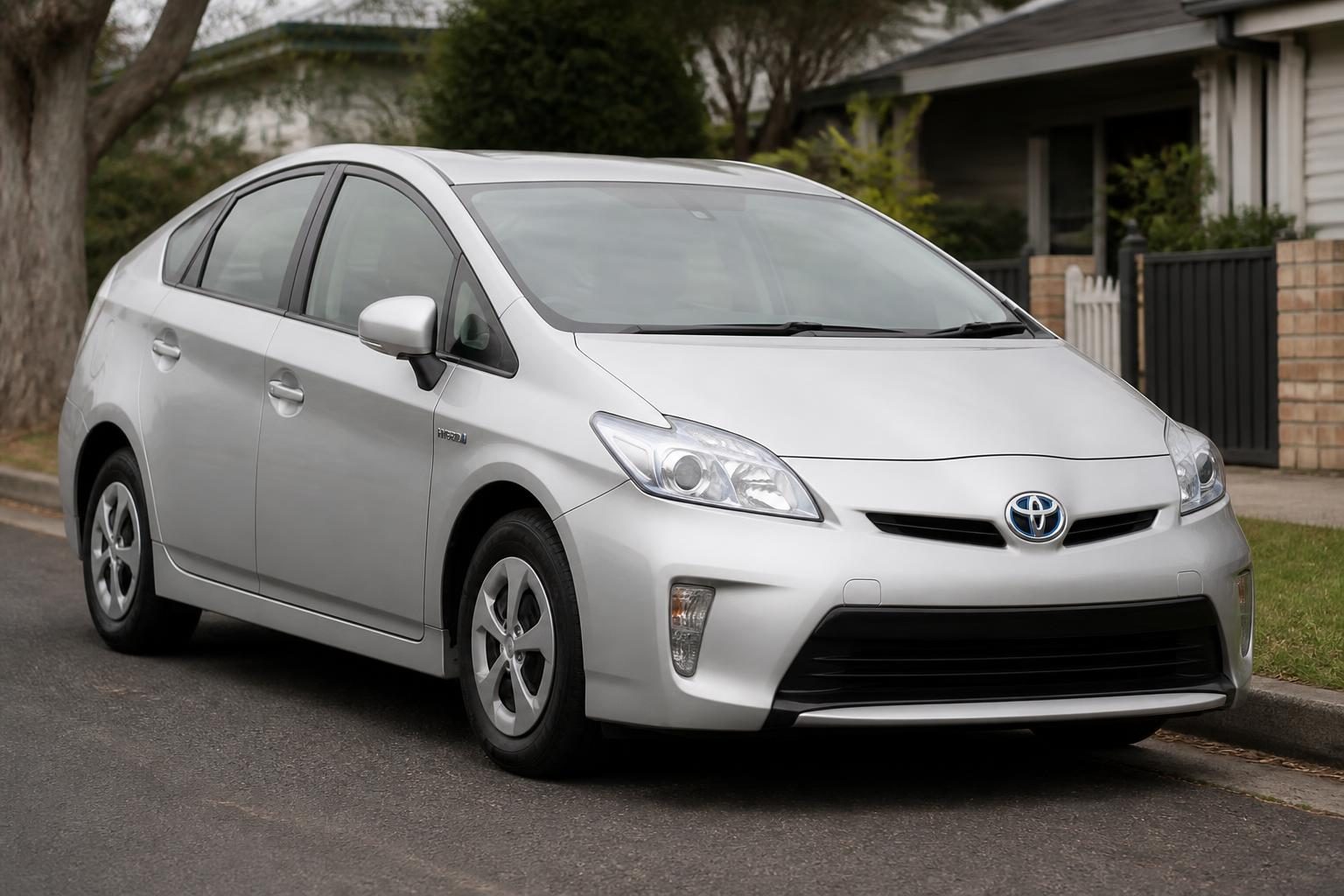 2013 1. Toyota Prius S Hybrid
| Gen 3 (ZVW30) | Gen 4 (ZVW50 / ZVW55 / ZVW52) | |
|---|---|---|
| Production | 2009–2015 | 2015–2022 |
| Engine | 2ZR-FXE 1.8L Atkinson | 2ZR-FXE 1.8L, revised to 40% thermal efficiency |
| Drivetrain | FWD only | FWD, AWD E-Four (ZVW55), PHEV 2WD (ZVW52) |
| Traction battery | NiMH, 201.6 V | NiMH or Li-ion depending on model code |
| Fuel (combined) | 3.3 L/100km, Carbarn listing data | 3.4 L/100km, ADR combined at AU launch (Drive, 2016) |
| Driver assist | None | Toyota Safety Sense P on most variants |
| Availability route | Local Australian listings | Japan-sourced under SEVS |
Those two fuel figures aren't measured the same way, so don't subtract one from the other. More on that below.
What Do You Get in a 2013 Gen 3 Prius ZVW30?
The Toyota Prius in Gen 3 ZVW30 form is the value pick, and a low-kilometre example is genuinely usable transport. The Australian-listed 2013 S Hybrid we've used as the reference car for this section reads 60,341 km, which is unusually low for a 13-year-old car. It's a pearl five-door hatch with a beige interior, five seats, and a Grade 4 auction condition rating.
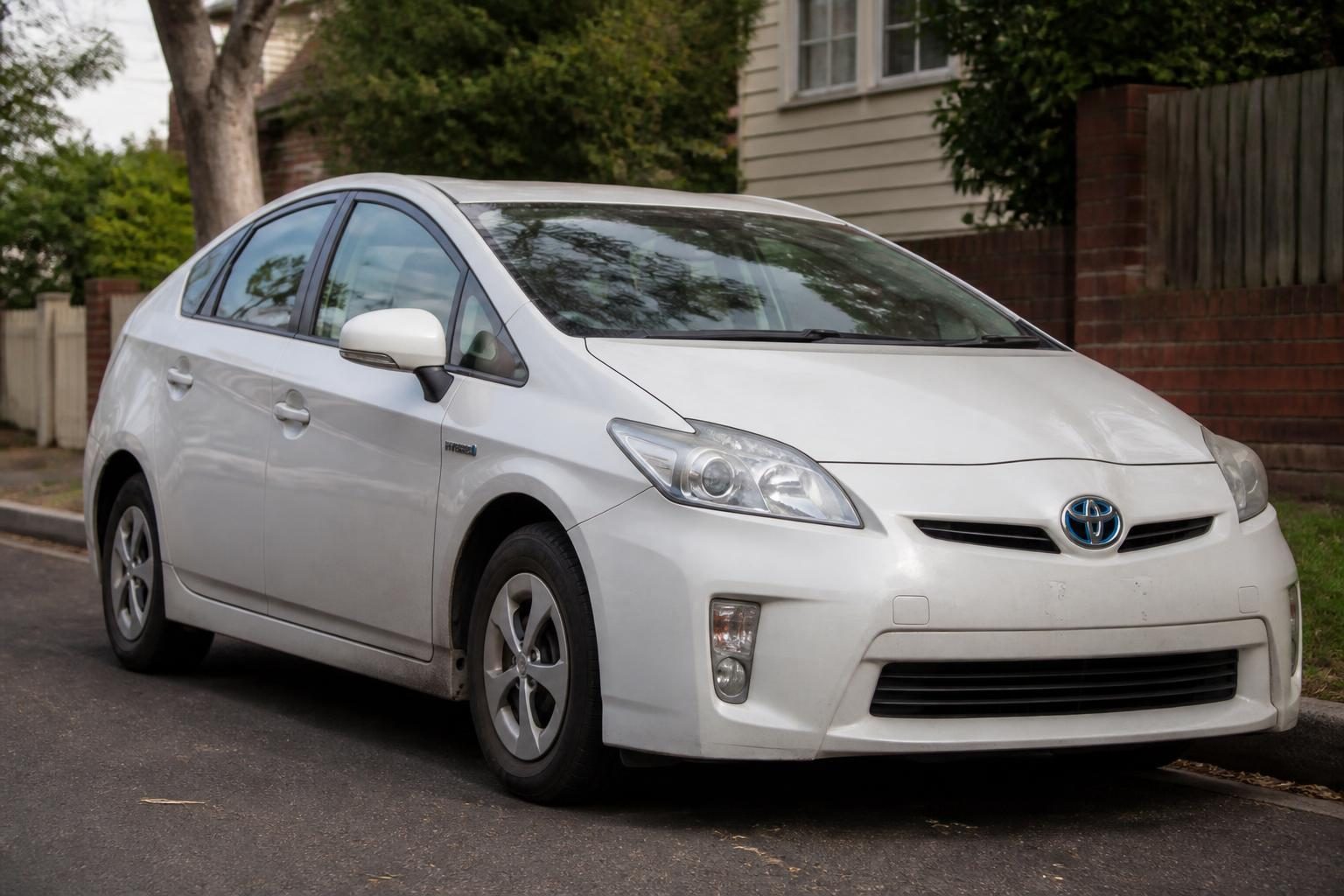 2013 Toyota Prius S Hybrid
On the numbers: 1,797 cc, 73 kW and 142 Nm from the petrol engine, CVT automatic, front-wheel drive, and a combined consumption figure of 3.3 L/100km on the listing record. It measures 4,480 mm long, 1,745 mm wide and 1,490 mm tall, with a 45-litre tank. Equipment runs to eight airbags, EV mode, ECO mode, push-button start with keyless entry, climate control and a multi-function steering wheel. What it does not have is radar cruise, autonomous braking or lane-departure warning. If you want those, stop reading this section.
The ZVW30's weak points are well documented. EGR valve fouling and head gasket leaks are the two that hurt, and specialist workshops report they typically surface from about 160,000 km without proactive cleaning. Brake hydraulic pump wear is the third to check. A good pre-purchase inspection and a documented service history matter more on this generation than on any other Prius. Our hybrid car maintenance guide covers what a proper hybrid service should include.
How Much Does a Gen 3 Prius Battery Cost to Replace in Sydney?
Sydney specialists publish fitted prices, so this is a knowable number rather than a fear. Hybrid Automotives in Sydney lists a reconditioned pack from around $1,600 fitted with a one-year warranty, a new aftermarket pack at $2,660 fitted with a two-year / 100,000 km warranty, and OEM dealer replacement in the $3,800 to $5,500 band.
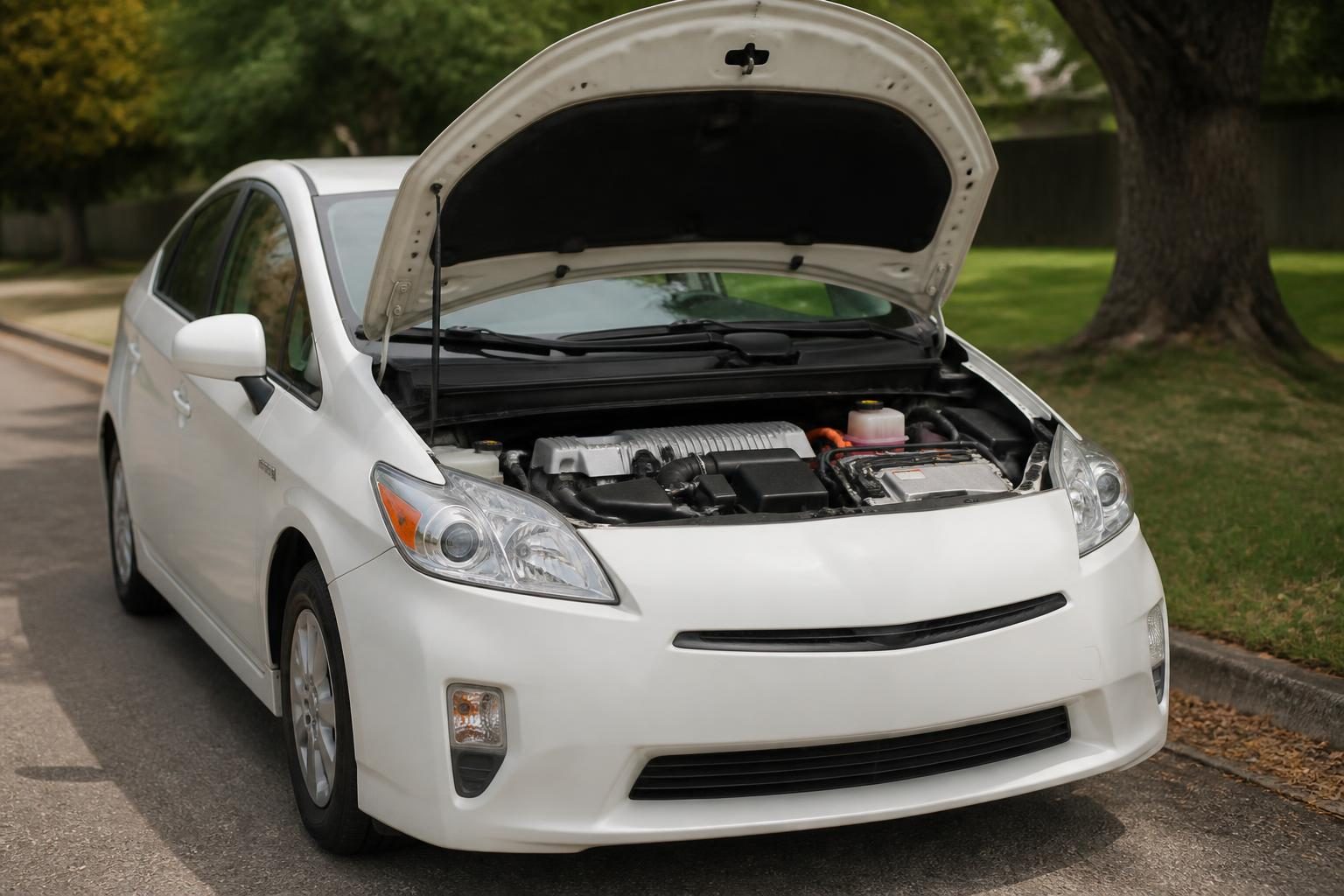 A white Toyota Prius with its bonnet open, revealing the hybrid vehicle's engine bay.
Here's the practical read. A 13-year-old NiMH pack won't necessarily fail next week, but it's living on borrowed time, and a low odometer doesn't protect it. Age and heat degrade these packs as much as kilometres do. Budget the aftermarket figure as a possible cost within your ownership window and the Gen 3 still stacks up. Ignore it and you'll be annoyed later.
Why Is the Gen 4 Prius ZVW55 the Stronger Long-Term Buy?
The Prius ZVW55 is the Gen 4 you can't get any other way: an all-wheel-drive Prius. It runs Toyota's E-Four system, which adds a rear electric motor for low-speed traction, and it's approved for import to Australia under SEVS approval SEV-000919 on the Environmental Criterion, backed by Model Report Entries MRE-000856 and MRE-000880 on the Rover register. Approvals cover builds from January 2018 to December 2022.
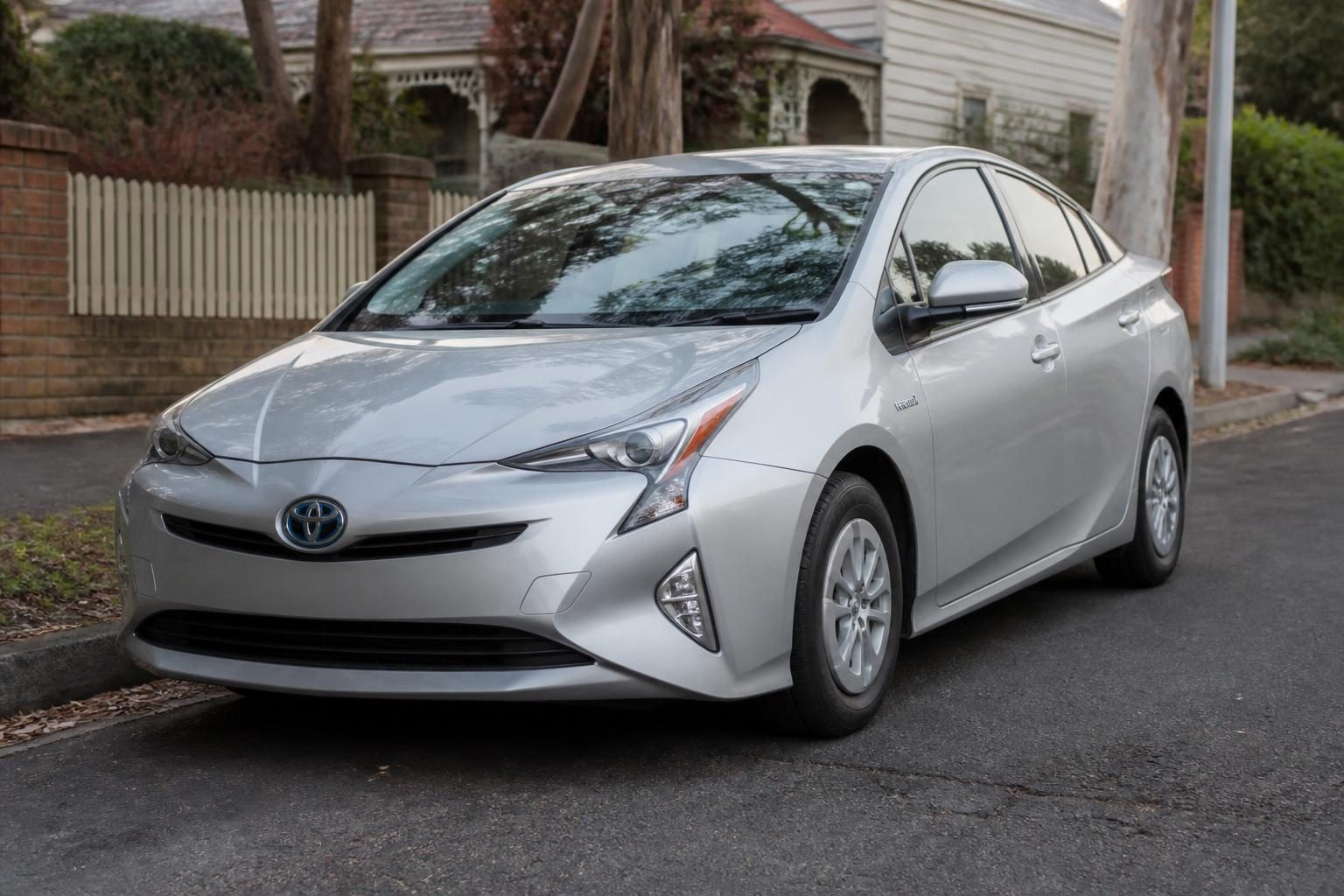 2015 Toyota Prius (Gen 4 FWD)
Mechanically it's the same 1.8-litre 2ZR-FXE, but reworked around a higher-compression, EGR-cooled combustion cycle that Toyota rates at 40% thermal efficiency, the highest of any mass-production petrol engine when it launched. Australian-market Gen 4 cars were quoted at 3.4 L/100km combined on ADR testing at launch. It's a five-seat, five-door hatch on the TNGA platform, which is why it corners flatter and rides quieter than a ZVW30. Most variants carry Toyota Safety Sense P: pre-collision braking, radar cruise control and lane-departure alert. Toyota's own newsroom data attributes a roughly 50% reduction in rear-end collisions to the system, rising to about 90% when paired with Intelligent Clearance Sonar.
Two things to weigh honestly. Japanese auction ZVW55 examples in grades 3 to 4 typically show odometers near 108,000 km, well past the reference Gen 3 car, and the sourcing timeline runs six to ten weeks across auction selection, shipping and Sydney compliance. If you want a plug-in instead, the Prius PHEV ZVW52 is approved under SEV-000764 and SEV-000079 with seven MREs, and auction examples tend to be much fresher at around 54,000 km. Worth reading up on Japanese auction grades before you set a grade floor.
The Real Fuel Difference in Sydney Traffic
Smaller than the brochures suggest. The Gen 3's 3.3 L/100km and the Gen 4's 3.4 L/100km come from different test cycles, so the Gen 3 looks better on paper while being measurably worse in the real world. US EPA combined ratings put Gen 4 about 4% ahead, at 52 mpg versus 50 mpg.
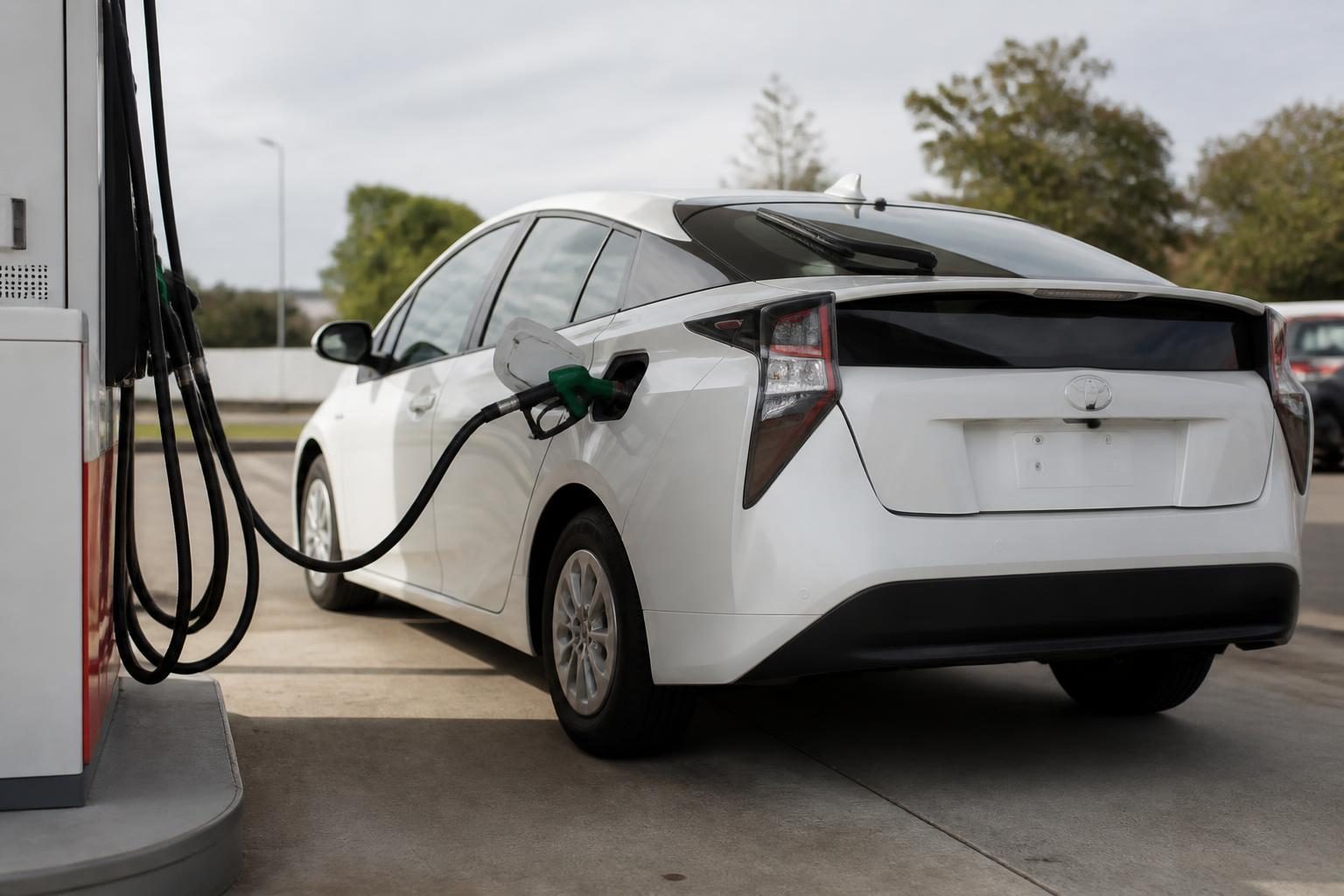 A white Prius is refuelled at a petrol station bowser.
Use real-world equivalents of about 4.7 L/100km for the Gen 3 and 4.5 L/100km for the Gen 4. At 15,000 km a year and Sydney regular unleaded at 201.6 c/L, per the NRMA's Weekly Fuel Report in September 2026, that's roughly $1,420 a year against $1,360. A saving of about $60 a year. It won't pay for the price difference, and that's the useful insight here: choose Gen 4 for the safety gear and the younger battery, not the bowser. Our piece on real-world versus claimed fuel economy found 76% of 141 Australian-tested vehicles used more fuel than their claimed figure.
Which Prius Suits Which Buyer?
Match the car to how you drive, not to the newest badge. Toyota's Prius records an average lifespan of 186,113 miles, about 300,000 km, with a 40.7% chance of passing 200,000 miles, according to iSeeCars' 2026 reliability data. Both generations will go the distance. They just ask different things of you.
The budget commuter. Gen 3, comfortably. Under $20K for a sub-70,000 km hatch that sips fuel around town is hard to beat. Set aside battery money and you're fine. Not right for you if you want modern driver aids or a warranty on the traction pack.
The safety-first family buyer. Gen 4. Toyota Safety Sense P is the single biggest functional upgrade between the two, and the newer battery removes the biggest unknown. Not right for you if you need the car this month.
The AWD buyer. Among SEVS-importable generations, only the Gen 4 ZVW55 answers this, via the E-Four system. Useful if you regularly drive wet mountain roads or unsealed driveways. Overkill for flat suburban Sydney.
The plug-in buyer. The ZVW52 PHEV covers short commutes on electricity alone. It only makes sense if you can charge at home. Without a home charger, you're carrying the extra weight for nothing.
Cross-shopping? Compare against the Corolla Hybrid if you'd rather have conventional styling, or scan our best used hybrids roundup for the wider field.
Buying a Prius in Australia: Local Stock and Japan Imports
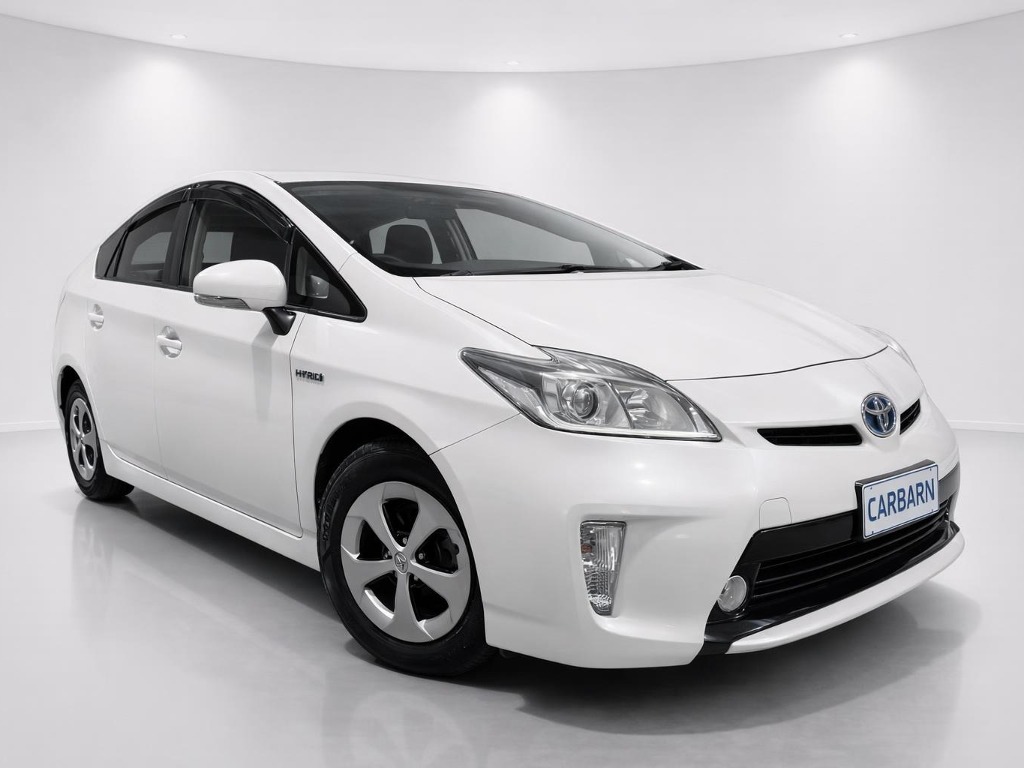 White Toyota Prius hybrid hatchback at Carbarn.
Both routes run through the same place. Carbarn is a licensed NSW motor dealer (MD056471) in Lidcombe, western Sydney, holding locally available Prius stock that can be inspected on site, plus Toyota Aqua, HiAce, Alphard and other Japanese hybrids. Local cars come with a fresh roadworthy certificate, PPSR check, pre-sale service and preparation, an included five-year extended warranty on eligible vehicles, 24/7 roadside assistance, and doorstep delivery across Greater Sydney. Finance and trade-in appraisals are handled in-house, and interstate buyers can inspect by video call. For Gen 4 cars, Carbarn sources through approved Japanese auctions, verifies auction sheets, arranges pre-bid inspection, bids only with your approval, then manages freight, customs and full SEVS compliance at its RAW-certified Sydney workshop before delivering the car ready for state registration.