



Ready to Hit the Road in Style?
Save money and reduce emissions with vehicles designed to deliver exceptional mileage. Visit our inventory and find a car that fits your lifestyle.
Ready to Hit the Road in Style?
Save money and reduce emissions with vehicles designed to deliver exceptional mileage. Visit our inventory and find a car that fits your lifestyle.
You've found a car you want to import. The seller tells you it's a Grade 4, and you have no real idea whether that's good, acceptable, or a quiet warning. You can't test drive it. You can't walk around it in a car park. You can't get your mechanic to put it on a hoist before you commit.
The grade on the auction sheet is the only independent condition signal you'll get before your money moves. If you're planning to import from Japan, understanding what that grade means is the essential first step.
This guide walks through every grade from S to 1, the R and RA grades that trip people up, the separate interior A-E system, how to read the damage diagram, the auction house calibration problem almost nobody talks about, and which grades actually suit different buyer situations.
Key Takeaways
- The overall grade scale runs from S (near-new) down to 1 (poor), with R and RA flagging structural repair or airbag-deployment history.
- Interior condition is scored separately, A to E. Grade B or better is the practical target for most buyers.
- Grades cover cosmetic and structural condition only, not mechanical health. A Grade 5 car can still need a service.
- Grading strictness varies by auction house: a TAA-graded 4.5 is widely considered equivalent to a USS-graded 5 (Provide Cars, 2025).
- Japan's auction network spans 120+ physical venues (Provide Cars, 2025), all using one shared grading language.
The Purpose Behind Japanese Auction Grades
Auction grades exist to give buyers a shared condition language across a market they can't physically attend. Japan operates 120+ active physical auction venues across its major networks (Provide Cars, 2025), and USS is Japan's largest physical auction network — it alone listed 2,331,773 units between April and November 2025, a 12.1% year-on-year increase (Provide Cars, 2025).
At that volume, no buyer, dealer, or importer could inspect even a fraction of the cars on offer. A standardised grade is the only practical way to describe condition at scale.
JAAI is the Japan Auto Appraisal Institute, the body that sets grading standards across Japan's 120+ physical auction venues (JAAI, 2025). A licensed appraiser physically examines each vehicle, marks up the condition diagram, and assigns a grade before the car runs through the lane.
Here's the part worth holding onto. The grade is a professional human assessment, not a machine output. It reflects one car, on one day, judged by one appraiser at one auction house. That's why understanding who graded it, and where, matters as much as the number itself.
One more thing to set up now and return to later: grades don't cover mechanical condition. That's a separate question, and a separate step.
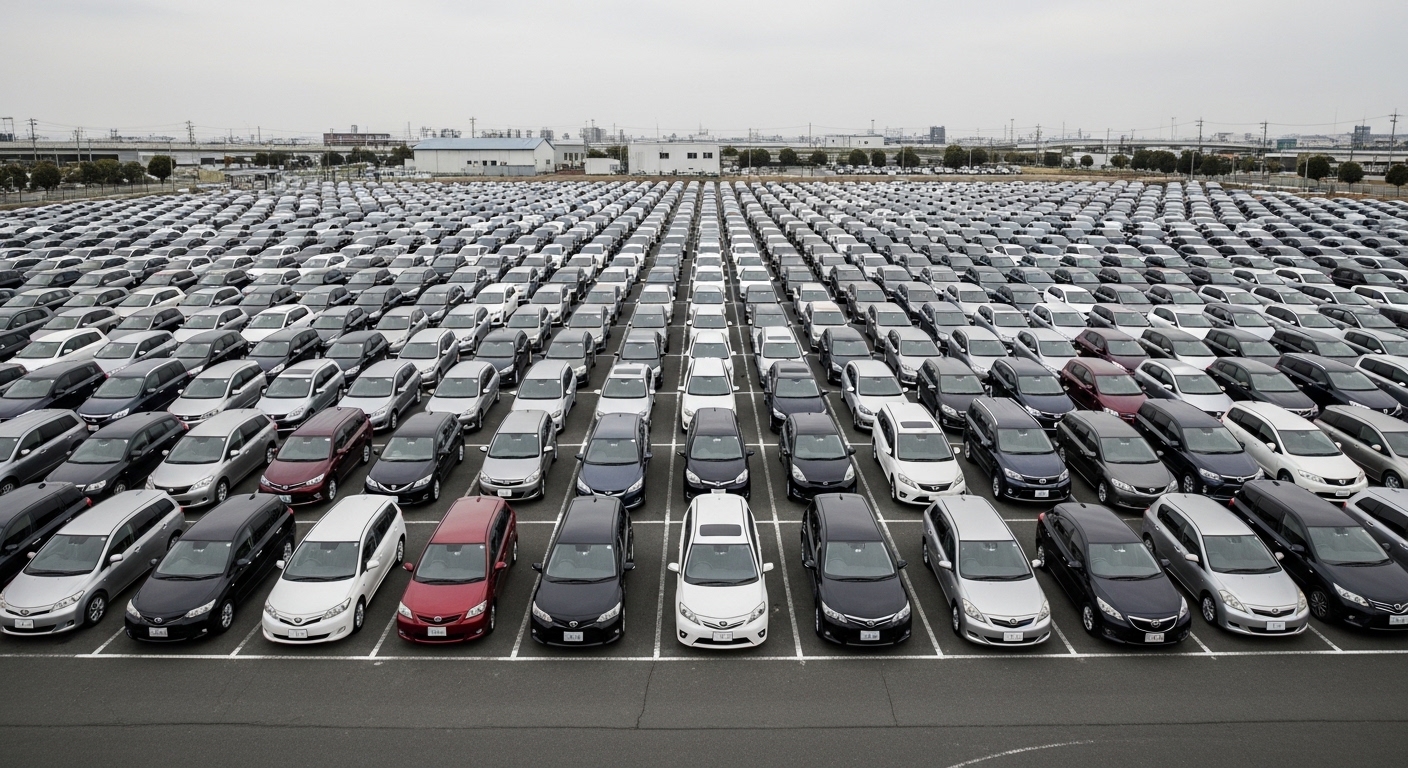 Japan's auction network moves millions of vehicles a year. At that scale, a grade is the only practical condition signal.
The Overall Grade Scale: S to 1 Explained
The overall grade scale runs from S at the top to 1 at the bottom, and the practical range for most Australian buyers sits between grades 3.5 and 5. The scale isn't evenly spaced — the jumps between 4, 4.5, and 5 carry genuine meaning, while the gap from 3 down to 1 mostly reflects severity of damage rather than distinct condition tiers. Grades describe cosmetic and structural condition at inspection, not age and not mechanical state. Grade 4.5 is the most common high grade in the Japanese used market (JDMBUYSELL, 2025), which makes sense — it sits at the practical ceiling for everyday used stock. A high grade on an older car is a genuine result, not an anomaly. A Grade 4 on a 15-year-old car often reflects careful Japanese ownership more than anything else, and a Grade 4.5 on the same car would be exceptional. Read the number first, then read it against the vehicle's age — those two pieces of information together tell you whether a grade is strong, typical, or worth questioning.
Here's the full scale in one place.
| Grade | Condition | Typical odometer | Buyer-fit |
|---|---|---|---|
| S | Near-new; under 10,000 km and under 12 months from first registration | Under 10,000 km | Collectors; condition-first buyers |
| 6 | Excellent; very slight use; under 30,000 km and under 36 months | Under 30,000 km | Late-model buyers wanting near-new without new-car cost |
| 5 | Very good; minor marks only; no structural issues | Under 50,000 km typical | Prestige buyers; long-term keepers |
| 4.5 | Very good; light cosmetic marks; the most common high grade | Under 100,000 km typical | Most buyers, the reliable sweet spot |
| 4 | Good; noticeable minor marks; standard used condition; no structural repair | Under 150,000 km typical | Practical buyers comfortable with used character |
| 3.5 | Average; multiple blemishes; common on older vehicles | Varies | Budget buyers; older cars where 4 is uncommon |
| 3 | Below average; heavy wear; possible surface rust | Varies | Project buyers; parts sourcing |
| 2 to 1 | Poor to very poor; corrosion, heavy damage, flood or fire history | Varies | Avoid for any practical purpose |
| R | Structural repair history; airbags did NOT deploy | Varies | Only with pre-bid inspection and full disclosure |
| RA | Serious accident; airbags deployed; then repaired | Varies | Avoid for daily driving |
| 0 / * | Uninspected; sold as-is; no grade | N/A | Highest risk category |
Now the age nuance, because it changes how you read the whole table. Grade 3.5 is the most common grade on older cars, Grade 4 is achievable but uncommon beyond 15 years, and Grade 4.5 is extremely rare past roughly 15 years (JDMBUYSELL, 2025). So a Grade 4 on a 20-year-old car isn't a compromise. It's a strong result, and often the best you'll realistically find.
What Do the Interior Grades A to E Actually Mean?
The interior grade is a separate letter score, A through E, sitting right beside the overall number. A car can be Grade 4 overall with a B interior, or the same 4 with a C. The two scores measure different things, and the interior grade matters most for families and anyone who spends real hours behind the wheel (JPSheet, 2025).
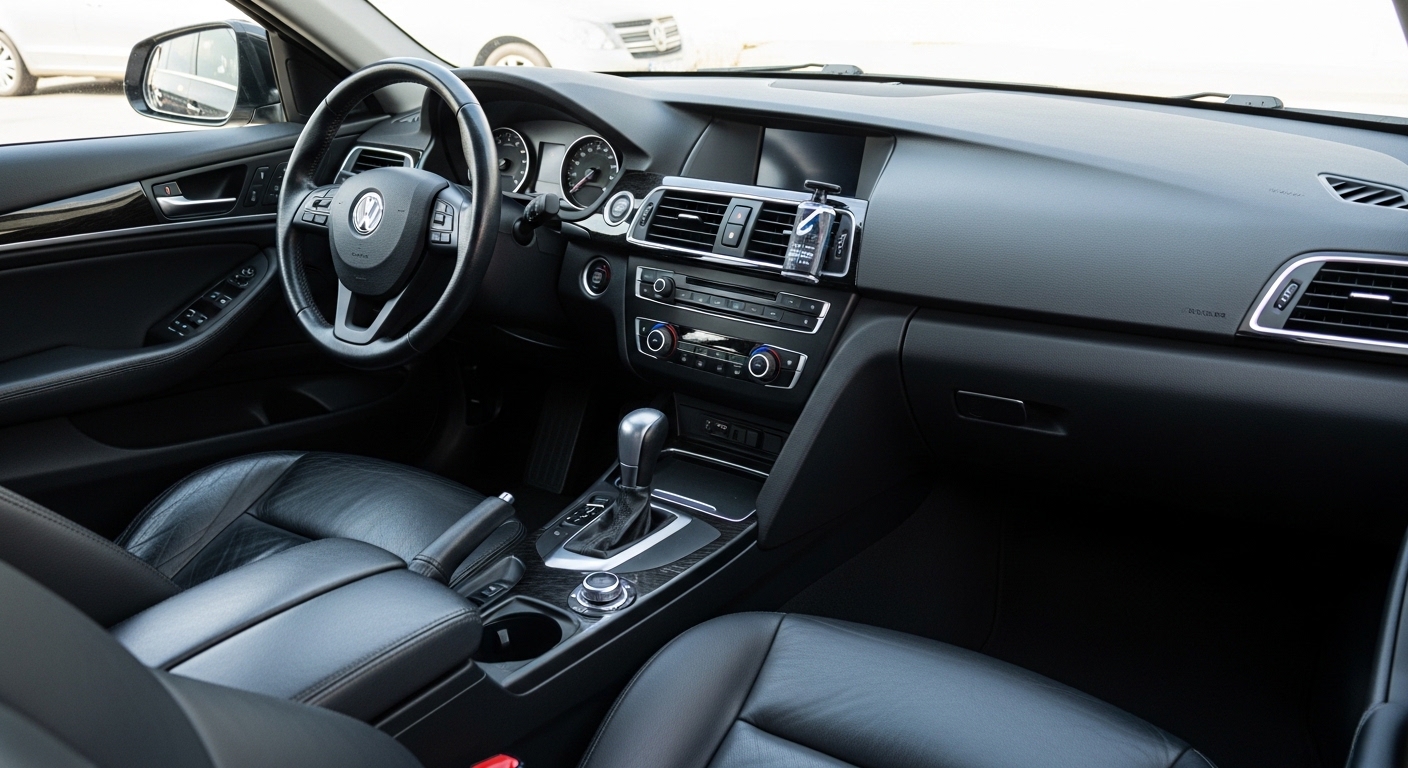 A tidy cabin like this reflects a Grade A or B interior, the practical target for most buyers.
Here's what each letter tells you.
- A: No visible wear, essentially as-delivered. Typically under 50,000 km. Rare beyond 10 years.
- B: Minor wear consistent with careful ownership. 50,000 to 100,000 km typical. Fine for most buyers.
- C: Visible staining, possible cigarette marks, worn trim. Over 100,000 km is common. Often recoverable by a good detailer, so the price should reflect it.
- D: Heavy wear, significant staining, tears, odour, sometimes missing trim. Budget for a re-trim.
- E: Extensive interior damage, salvage-tier. Rarely seen.
One practical note. Staining is often recoverable with professional detailing, but odour is much harder to shift. If a car has been smoked in, no amount of shampooing fully removes it. Factor that in before you bid.
Which Interior Grade Fits Your Situation?
- Daily commuter: B or better. Minor wear is fine, odour is not.
- Family or people mover: B or better. School runs make staining and odour a daily problem.
- Prestige or performance: A or B. Condition is part of what you're paying for.
- Project or restoration: C can work if the price clearly reflects it.
Exterior Grades and the Damage Diagram
The damage diagram shows the location of every recorded mark on the car, while the exterior condition feeds into the overall grade. Reading both together tells you not just how damaged a car is, but where. That distinction changes everything, because ten light marks scattered around are a very different car from three deep creases on one door (JPSheet, 2025).
Multiple minor marks on a single panel tend to compound. A cluster of codes in one area usually means concentrated damage worth a closer look, or a question to your agent.
The diagram itself is a top-down schematic of the car. Each damage code is written at the body position where the appraiser found it. Codes at the corners and edges map to specific panels, so position tells you where to focus.
Here's the symbol legend you'll see most often.
| Symbol | Meaning |
|---|---|
| A | Scratch (A1–A4 by severity) |
| U | Dent (no paint break) |
| W | Wave or ripple in panel |
| X | Replacement required (part flagged for replacement) |
| XX | Already replaced (part was previously replaced) |
| B | Dent with scratch (combined dent and paint break) |
| G | Glass chip / windshield stone chip |
| S | Rust (S1 = small rust spot, S2 = heavy rust) |
| P | Paint peel |
| C | Corrosion (C1 = surface corrosion, C2 = heavy corrosion) |
| Y | Crack or hole (Y1–Y3 by severity) |
Single-letter codes without a number suffix are surface marks the appraiser rated as minor. Any code with a 2 suffix — S2, C2, Y2 — signals serious damage worth specific attention. A cluster of B or X marks on one panel is where a pre-bid question or inspection starts to pay for itself.
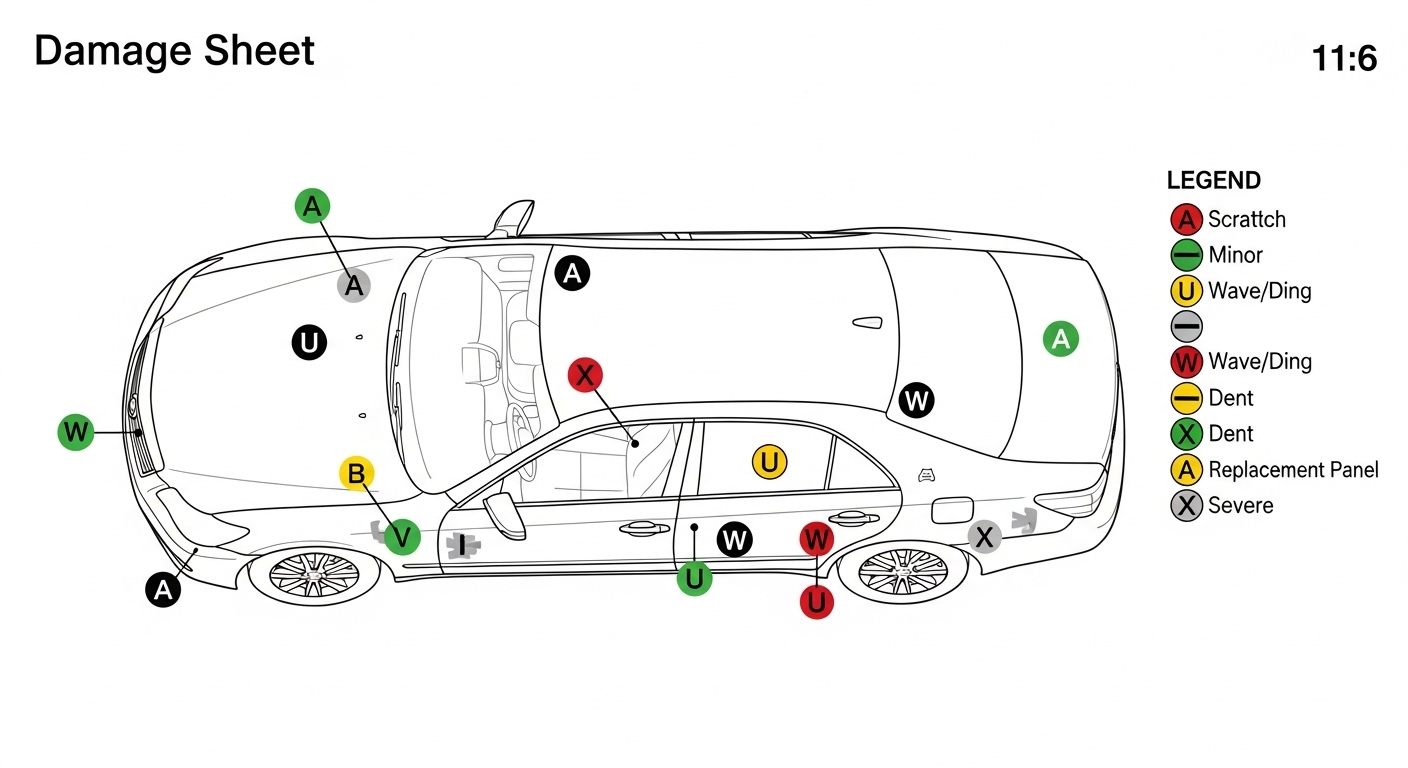 The damage diagram plots each recorded mark by body position, so you can see not just how much damage there is, but where.
R Grade and RA Grade: What's the Difference That Matters Most?
R grade flags structural repair history where the airbags stayed intact; RA grade means airbags deployed and the car was subsequently repaired. That single distinction — whether the airbags fired — is the most consequential line on the sheet for any buyer considering a car with collision history. R and RA sit outside the main numeric scale and appear alongside a number rather than replacing it: a car might be graded R / 3.5 or RA / 3. The additional letter changes the risk profile completely. Airbags in a frontal collision typically deploy at roughly 20 to 30 km/h or above, and that impact threshold is the practical dividing line between the two (JPSheet, 2025). An RA-grade car reached that threshold; an R-grade car did not. Getting them confused is the single most expensive mistake buyers make in the import market, because RA carries compliance and safety implications that R alone does not.
Let's separate them clearly.
R grade means structural repair, airbags intact. One or more structural components were repaired or replaced after damage. That includes floor rails, pillar reinforcements, cross members, the firewall, strut and inner panels, and the core support (JDMBUYSELL, 2025). The airbags did not deploy in an R-grade car.
Here's the rule most people get wrong. Bolt-on panels do not trigger an R grade. Doors, fenders, the bonnet, boot lid, and bumpers that were repaired or replaced are recorded as cosmetic marks, not structural repair, under JAAI standards (JDMBUYSELL, 2025). A replaced bumper is not a structural red flag.
RA grade means airbags deployed, then repaired. The impact was serious enough to fire the airbags, and the car was subsequently repaired. The "A" suffix stands for airbag (JPSheet, 2025). RA is the more serious of the two, combining structural repair with a genuine collision history.
A quick note on sources. Some guides frame R and RA slightly differently, with some auction houses categorising RA as the lighter of the two grades — treating it as accident damage that can be ranked minor in severity. JAAI-convention as used in the Australian import industry generally treats RA as the more serious designation, because airbag deployment implies a higher-energy impact. If you see an RA grade, ask your agent which framing the auction house applies. The damage diagram will usually make the severity clear, regardless of which definition the house uses.
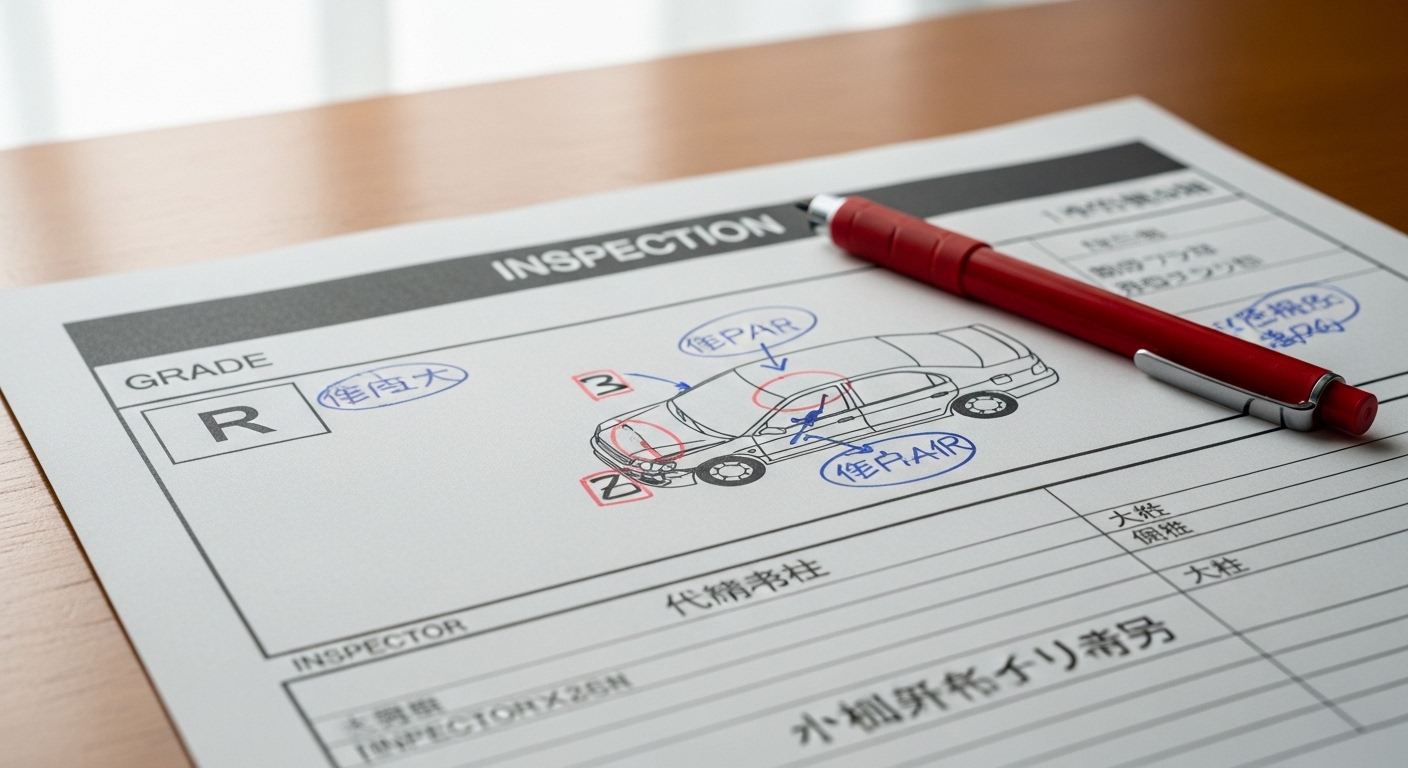 An R grade appears alongside a number and signals structural repair history. Context matters more here than anywhere else on the sheet.
When R can be acceptable: On an older car, where the repair is minor, well documented, and the price clearly reflects the history, some experienced importers will still consider an R-grade vehicle. This is a case for a pre-bid physical inspection, never a blind bid.
When to avoid RA: For most Australian daily drivers, RA is best left alone. Structural repair plus airbag deployment introduces safety and compliance uncertainty that a grade number alone can't resolve.
Why Does the Auction House Change Everything?
The grade number on a Japanese auction sheet only makes full sense in context of which house issued it — grading strictness varies enough that the same car can score half a point lower at a stricter venue. The underlying standard is consistent on paper, set by JAAI and applied by licensed appraisers across all major networks. But each auction house develops its own appraiser culture, and that culture shapes how generously grades are awarded in practice. The clearest documented example: a TAA-graded 4.5 is widely considered equivalent to a USS-graded 5, because TAA's appraisers apply a stricter standard (Provide Cars, 2025). That half-point difference represents real condition variance. A buyer comparing a USS 4.5 with a TAA 4.5 may think they're looking at equivalent cars when they're not. The same physical vehicle can receive grades half a point apart at different venues — which means the auction house name deserves at least as much attention as the grade number itself.
The five major networks each have a distinct footprint. USS is Japan's largest physical auction network, running 19 venues nationally and serving as the standard baseline against which other houses are typically compared. TAA is the Toyota Auction Association, with 11 venues and a reputation for stricter grading. CAA is a major regional auction group with 4 venues, applying a similar standard to TAA. JU is the Japan Used Motor Vehicle Dealers Association network, covering 40+ prefectural venues with broadly USS-comparable grades. AUCNET is Japan's primary online-only auction platform, where remote inspection introduces a slight additional uncertainty compared to physical venues.
| Auction House | Direct venues | Grading tendency | Rough USS-equivalent |
|---|---|---|---|
| USS | 19 | Standard baseline | 1:1 |
| TAA | 11 | Stricter | TAA 4.5 ≈ USS 5 |
| CAA | 4 | Stricter (similar to TAA) | CAA 4.5 ≈ USS 5 |
| JU | 40+ prefectural | Standard | Broadly USS-comparable |
| AUCNET | Online only | Remote / standard | Apply a slight discount |
Source: Provide Cars, 2025
Two things to do with this. First, the auction house name is printed on every sheet, so note it alongside the grade number, not as an afterthought. Second, if you're sourcing without direct auction access, this calibration knowledge is one of the real, practical advantages a specialist importer brings to the bidding table.
What Are the Five Mistakes Australian Buyers Make with Auction Grades?
The grade scale is straightforward once it clicks. The costly errors tend to catch buyers who learned the basics but missed a nuance, and industry guidance consistently points to the same handful (JDMBUYSELL, 2025). Here are the five worth committing to memory before you bid.
1. Treating the Grade as a Mechanical Health Report
Grades cover cosmetic and structural condition at inspection, not mechanical state. A Grade 5 car can still have overdue fluids, worn brakes, or ageing ancillaries. Mechanical assessment is always a separate step, and no grade replaces it.
2. Ignoring the Interior Code
The overall grade speaks to exterior and structural condition. The interior letter is on the same sheet but scored separately. A strong overall grade sitting next to a C interior means staining, wear, and possibly odour, which matters a lot for families and long-distance drivers.
3. Not Noting the Auction House
A 4.5 from USS and a 4.5 from TAA are not the same vehicle. The house is printed right there on the sheet. Read it alongside the grade, not after you've already fallen for the car.
4. Assuming R Means the Car Is Unsafe
R indicates structural repair history, not a structurally compromised car. Bolt-on panel work doesn't trigger it. A well-disclosed R on an older vehicle, priced to reflect the history, can be a sensible buy with a pre-bid inspection. RA, where the airbags deployed, is the bigger concern.
5. Expecting a High Grade on an Older Vehicle
A Grade 4.5 on a 20-year-old car is extremely rare. For vehicles over 15 years old, Grade 3.5 to 4 is usually the top realistic result (JDMBUYSELL, 2025). Calibrate to age, or you'll keep passing on good cars while waiting for a grade that won't turn up.
How Do You Read a Japanese Auction Sheet?
An auction sheet is a single document carrying the grade, the damage diagram, the odometer, equipment codes, and the inspector's notes. Most of it is in Japanese, but you don't need a full translation to pull out the important structural information (CarFromJapan, 2024). Knowing the key sections and a handful of abbreviations does most of the work.
Start with these sections, roughly in order of importance.
- Grade box: overall grade number, usually in a top corner.
- Interior code: the A to E letter, next to the overall grade.
- Damage diagram: the top-down schematic with damage symbols plotted by position.
- Odometer: kilometres. Cross-check against the dashboard photo if you have one.
- Model and year: year of manufacture and registration.
- Equipment codes: abbreviations listed across the sheet.
- Inspector notes: usually Japanese, and worth translating anything handwritten outside the standard boxes.
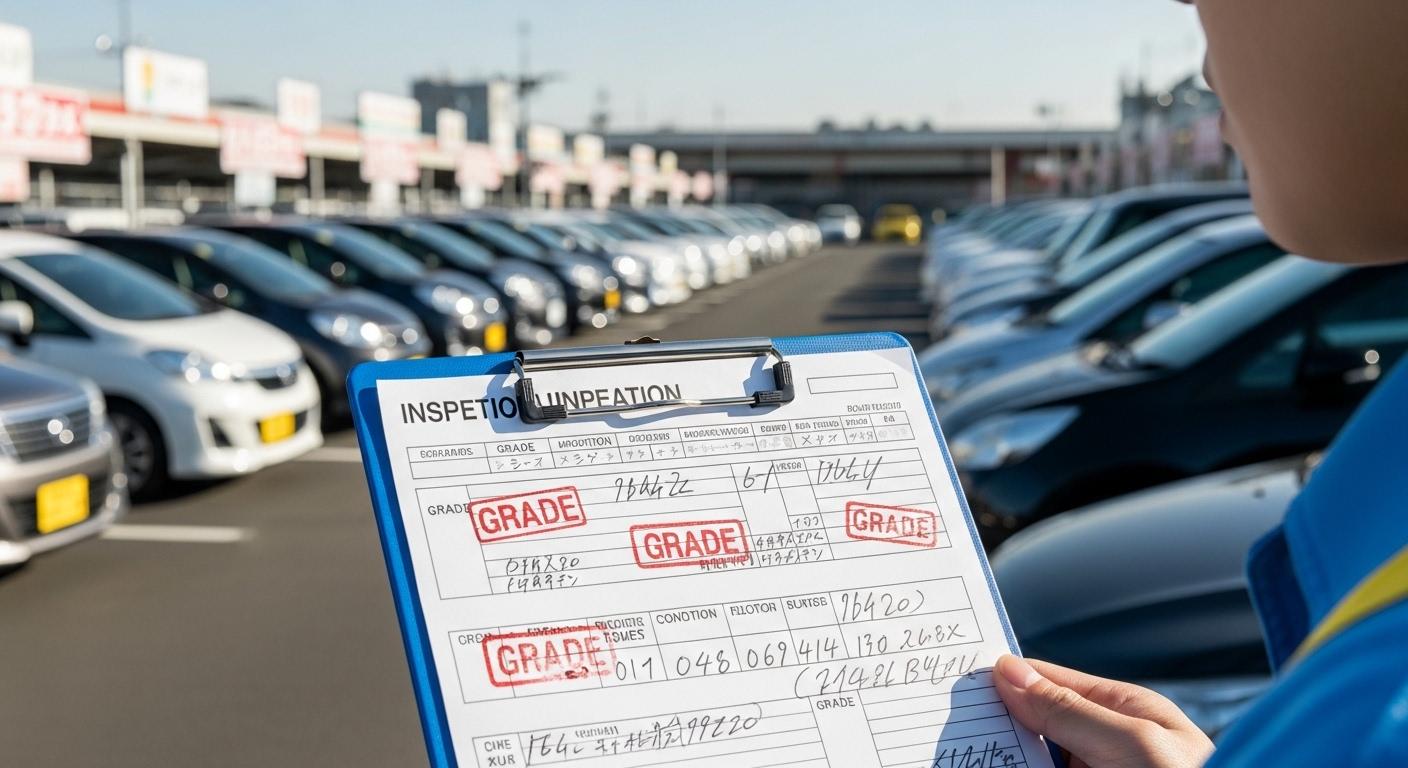
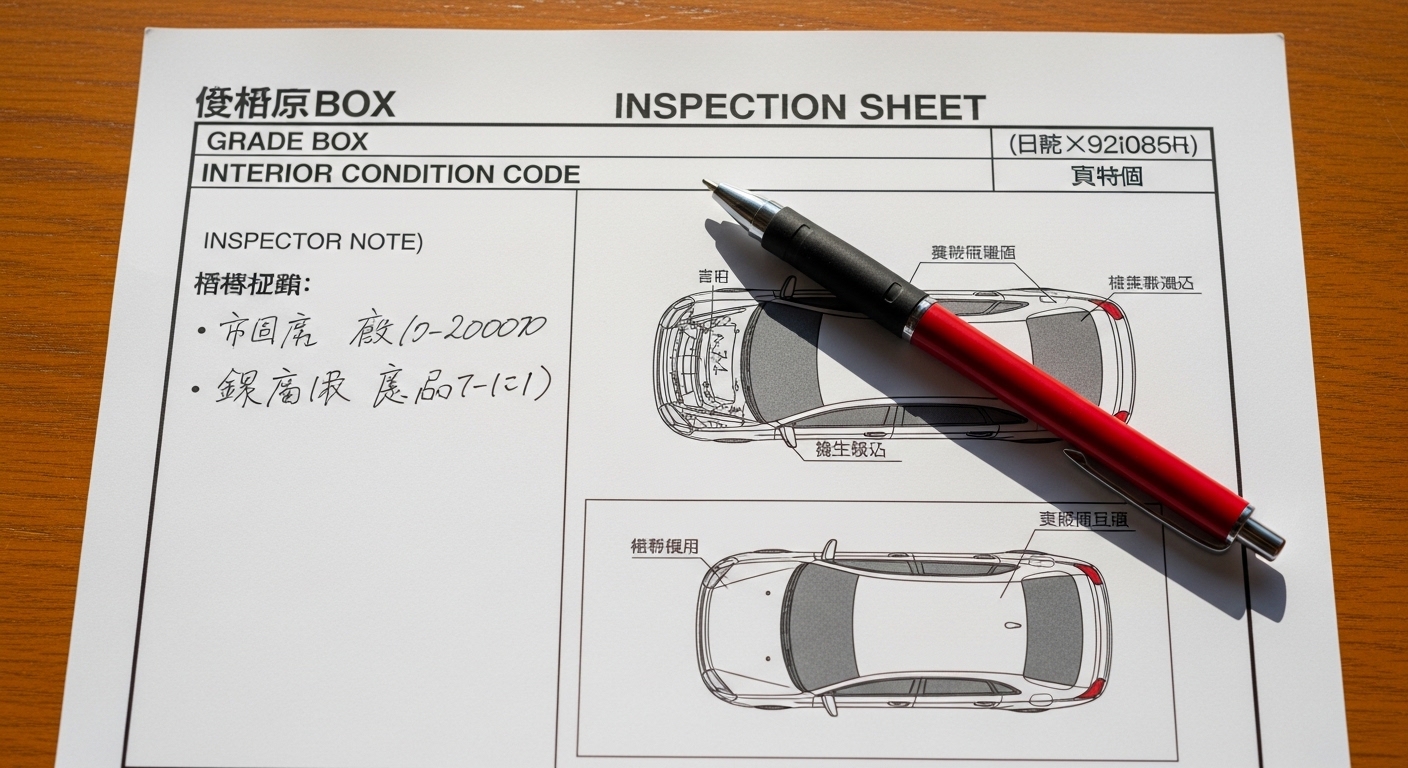 Everything you need is on one sheet: the grade, the interior code, the odometer, the damage diagram and the inspector's notes.
The abbreviations look cryptic at first, then become second nature. Here are the common ones.
| Code | Meaning |
|---|---|
| AT / MT | Automatic / Manual transmission |
| PS | Power steering |
| PW | Power windows |
| AC | Air conditioning |
| EG | Engine notes |
| SRS | Supplemental Restraint System (airbags); note if "SRS deployed" appears |
| 4WD | Four-wheel drive |
| HID | High-intensity discharge headlights |
| NAVI | Navigation system |
| TV | Screen or television fitted |
| LHD / RHD | Left / Right hand drive |
AT, PS, PW, and AC are standard across all auction houses and need no translation. EG and any handwritten notes are the ones to translate carefully — EG entries can flag oil leaks, unusual engine observations, or other mechanical details the inspector chose to record outside the standard codes.
If you take one habit from this section, make it this: any handwritten note sitting outside the printed boxes is worth translating. That's where an appraiser records the things a code can't capture.
Which Grade Should You Target?
There's no single right grade. The right target depends on what the car is for, how old it is, and how much presentation matters to you relative to price. A commuter and a collector should be shopping to different numbers, and matching the grade to the use case is what keeps you from over-paying or under-buying.
Here's a practical starting point by buyer profile.
| Buyer profile | Minimum overall grade | Minimum interior | Notes |
|---|---|---|---|
| Daily commuter | 4 | B | The practical sweet spot |
| Family / people mover | 4 | B | Odour and staining matter for daily use |
| Prestige / performance | 4.5 to 5 | A or B | Condition is part of the purchase |
| Older vehicle (25+ years) | 3.5 | B | Grade 4 is a strong result; calibrate expectations |
| Project or restoration | 3 or R | C acceptable | Price should clearly reflect condition |
How Do Mileage and Grade Work Together?
Grade reflects condition at inspection, not use history on its own. A low-kilometre car that was cared for poorly can grade below a higher-kilometre car that was looked after. So read the grade and the odometer together, and treat a mismatch between them as a prompt to ask more questions.
What's the Practical Floor for Australian Imports?
For most buyers importing a daily driver, Grade 4 with a B interior is the sensible minimum. Go below that and you should budget carefully for detailing, possible repairs, and compliance costs before you decide it's a bargain.
How Does Carbarn Source from Japanese Auctions?
If you're importing from Japan rather than buying locally, the auction sheet is where the condition story starts, but it isn't the whole story. The grade tells you about cosmetic and structural condition. It can't tell you how the engine sounds on a cold start.
Carbarn bids at Japanese auctions on behalf of Australian buyers, and a pre-bid physical inspection is available on request. That inspection is the step that bridges the gap between the grade on the sheet and the car's actual mechanical condition. It's especially worthwhile on R-grade vehicles or older imports, where the sheet alone doesn't give you enough.
The bidding process keeps you in control. You set the budget and maximum bid. Carbarn only bids after you approve, and the team won't exceed your agreed cap. The specialist bidding team works with a Japanese inspector to check condition before any bid, and flags anything important to you first.
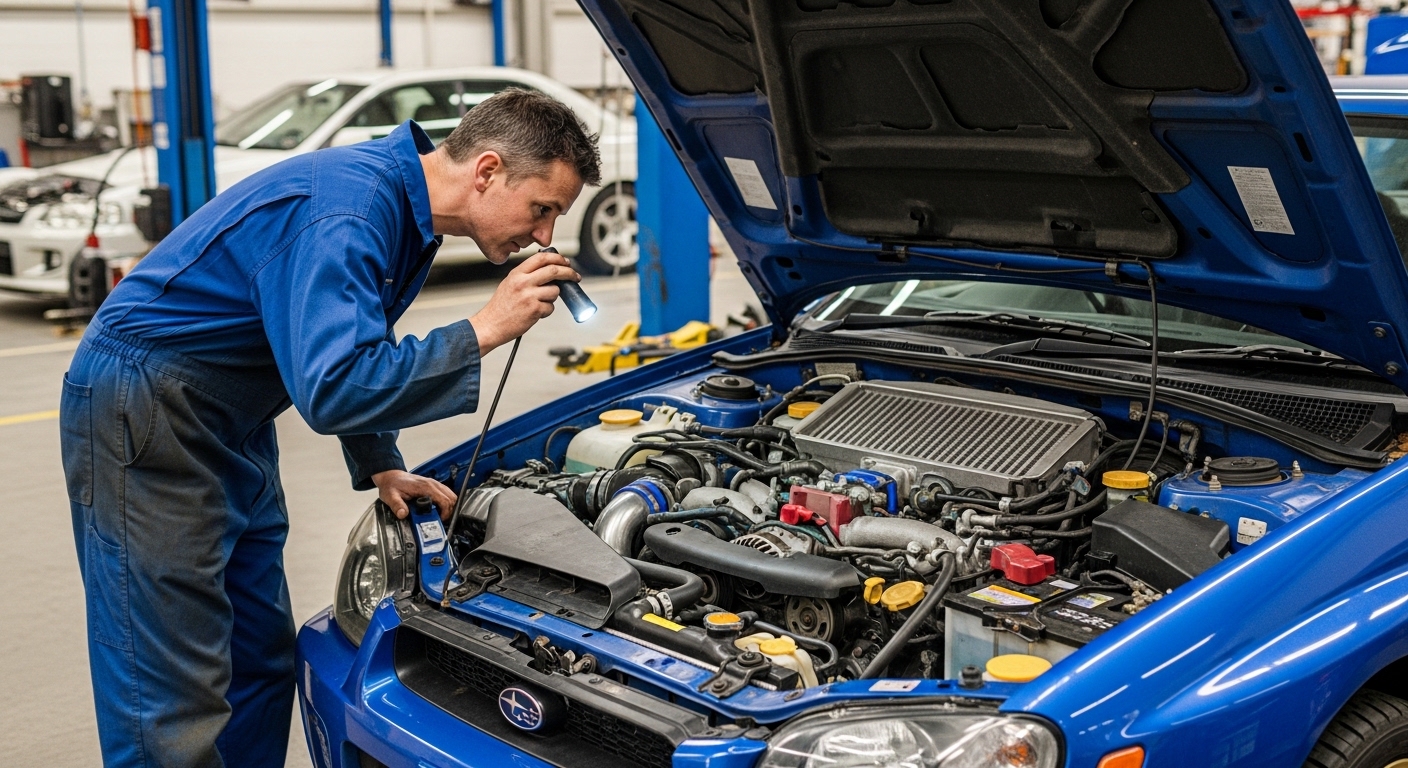 A pre-bid physical inspection bridges the gap between the sheet's cosmetic grade and a car's mechanical condition.
The full journey, from sourcing through shipping, compliance, and delivery, usually runs 6 to 10 weeks across three phases (Carbarn, 2025). The auction sheet travels with the vehicle, and you can request it at any point.
The how importing works page covers the full process, including where auction grades fit into the pre-bid inspection step.