



Ready to Hit the Road in Style?
Save money and reduce emissions with vehicles designed to deliver exceptional mileage. Visit our inventory and find a car that fits your lifestyle.
Ready to Hit the Road in Style?
Save money and reduce emissions with vehicles designed to deliver exceptional mileage. Visit our inventory and find a car that fits your lifestyle.
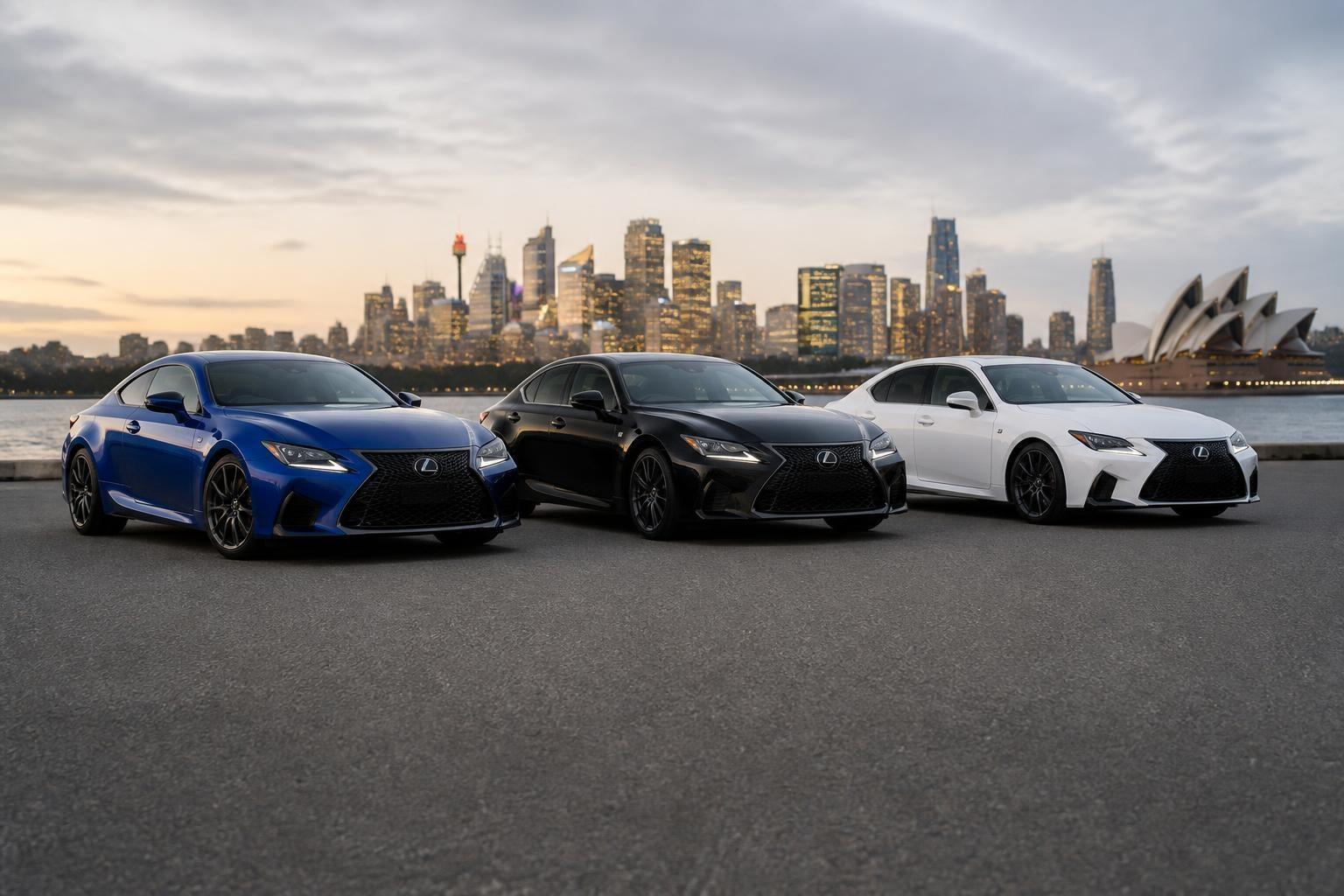
Three badges, one engine. The IS F, RC F and GS F all run the same 5.0-litre naturally aspirated V8, yet they arrive in Australia at very different points on the cost curve. One is a compact sedan from the late 2000s. One is a coupe with two separate approval windows nearly a decade apart. One is a full-size sports sedan built in tiny numbers. If you have been working through the wider Toyota and Lexus V8 import options, this is the tier where the maths starts to matter. Here is how the three compare on eligibility, landed cost, and who each one genuinely suits.
Quick Answer
- All three use the 2UR-GSE 5.0-litre naturally aspirated V8. Body shape, build window and landed cost are what separate them.
- Each model is currently approved under the SEVS Performance Criterion, but only inside narrow build windows recorded on the Australian Government's Rover register.
- Import duty is 0% for Japanese-built cars under JAEPA when proof of origin is filed. GST at 10% applies to every import regardless.
- Luxury Car Tax is 33% of the value above $80,567 for FY2025-26 (AADA citing the ATO, May 2025). No F-car qualifies for the fuel-efficient threshold.
- Sourcing through to delivery runs about 6 to 10 weeks across three phases.
What Do All Three F-Cars Share Under the Bonnet?
Every car in this comparison runs the 2UR-GSE: a 4,969cc naturally aspirated 90-degree V8 with a 94mm bore (2UR-GSE engine specifications (enginecode.uk), 2025). Compression ratio is 11.8:1 in the IS F; Lexus revised it upward in the RC F and GS F to widen the torque band. The badge on the boot changes the body, the seat count and your tax exposure. It does not change the engine.
The detail work is what enthusiasts care about. Cylinder heads were developed with Yamaha, fuelling runs Toyota's D-4S system — dual injection combining both port and direct injectors for cleaner combustion across the rev range — and the inlet cam uses electric VVT-iE rather than hydraulic actuation. That combination is why these engines pull cleanly to a high redline instead of tapering off. No turbos, no supercharger, no assistance. Where the three diverge is body shape, build vintage, and, for import buyers, landed cost.
| IS F (USE20) | RC F (USC10) | GS F (URL10 / RL1) | |
|---|---|---|---|
| Body | Sedan | Coupe | Sports sedan |
| Doors | 4 | 2 | 4 |
| Seats | 4 | 4 | 5 |
| Engine | 2UR-GSE 5.0L V8 | 2UR-GSE 5.0L V8 | 2UR-GSE 5.0L V8 |
| Drive | Rear-wheel drive | Rear-wheel drive | Rear-wheel drive |
| Transmission | 8-speed SPDS auto | 8-speed auto | 8-speed auto |
 A black Lexus LC coupe cruises along a wooded road.
How Does the SEVS Pathway Work for Each F?
SEVS (Specialist and Enthusiast Vehicle Scheme) is Australia's regulated pathway for importing performance vehicles not sold locally in volume. All three F-cars hold current approvals — but only across narrow build windows that exclude most of each model's production run. The IS F is covered from December 2007 to August 2008, the RC F has two separate windows, and the GS F from October 2015 to January 2016.
Here is what the Rover register currently records:
- IS F (USE20): two approvals, SEV-000965 and SEV-000382, covering builds from December 2007 to August 2008. The car was built until 2014, but only that early window is approved.
- RC F (USC10), early cars: SEV-000909, covering September 2014 to January 2015 builds.
- RC F (USC10), late cars: SEV-001084, valid until 13 July 2029, covering December 2021 to December 2025 builds.
- GS F (URL10 and RL1): SEV-000701, covering October 2015 to January 2016 builds, with the RL1 listing valid until 9 November 2027.
Read those dates carefully before you fall in love with an auction lot. A 2010 IS F or a 2017 GS F sits outside the approved window, and the 25-year rule will not help a 2007 car until 2032. Once a compliant vehicle lands, it goes through a Registered Automotive Workshop for compliance work, then an AVV (Approved Vehicle Verifier) inspection and RAV (Register of Approved Vehicles) entry — the federal database confirming the car is cleared for Australian roads. Our full import process guide walks through all thirteen steps.
What Does It Actually Cost to Land an F-Car?
The purchase price in Japan is only the first line item. Duty, GST, Luxury Car Tax, freight and compliance all stack on top. For a V8 Lexus, the tax side can move the number more than the auction result does. Each component follows a published rule, so you can work out your own exposure before bidding.
Import duty. JAEPA (Japan-Australia Economic Partnership Agreement) reduces the standard 5% passenger vehicle duty to 0% for Japanese-built cars (DFAT guide to using JAEPA for imports). That benefit is not automatic. It requires valid proof of origin at customs, either a Statement on Origin from the Japanese exporter or a JAEPA Certificate of Origin. Without the paperwork, the 5% rate applies.
GST. Ten per cent, on every import, no exceptions. The base is the customs value plus international freight, insurance and any duty. Because JAEPA zeroes the duty, the GST base is the customs value plus freight and insurance.
Luxury Car Tax. LCT (Luxury Car Tax) is charged at 33% of the amount by which the vehicle's value exceeds the threshold, which sits at $80,567 for FY2025-26 (AADA citing the ATO, May 2025). No F-car reaches the higher $91,387 fuel-efficient threshold, which since 1 July 2025 requires consumption of 3.5L/100km or less. Drive.com.au recorded a claimed 11.2L/100km for the RC F, so the F-cars are not remotely close.
The deposit ladder. Auction sourcing needs a refundable deposit before any bid is placed, scaled to the expected auction value. It is refunded in full if nothing is secured.
| Auction value range | Refundable deposit |
|---|---|
| Up to ¥1,500,000 | ¥150,000 |
| ¥1,500,001 to ¥3,000,000 | ¥300,000 |
| ¥3,000,001 to ¥5,000,000 | ¥500,000 |
| ¥5,000,001 to ¥8,000,000 | 15% of auction value |
| Above ¥8,000,000 | 20% of auction value |
Two invoices, not one. The shipping invoice is issued when the car reaches Sydney. It covers freight, GST, duty, LCT where applicable, and port and local charges. The compliance invoice is separate, covering workshop compliance work, the AVV inspection, RAV entry and the VIA (Vehicle Import Approval) cost. Any tyres, repairs or ADR-related items are quoted before work starts. Our cost and compliance explainer breaks down how landed cost differs from on-road cost.
 A white sedan rolls off a car carrier as port cranes silhouette the sunset.
Is the Lexus IS F the Right Entry-Level F-Car?
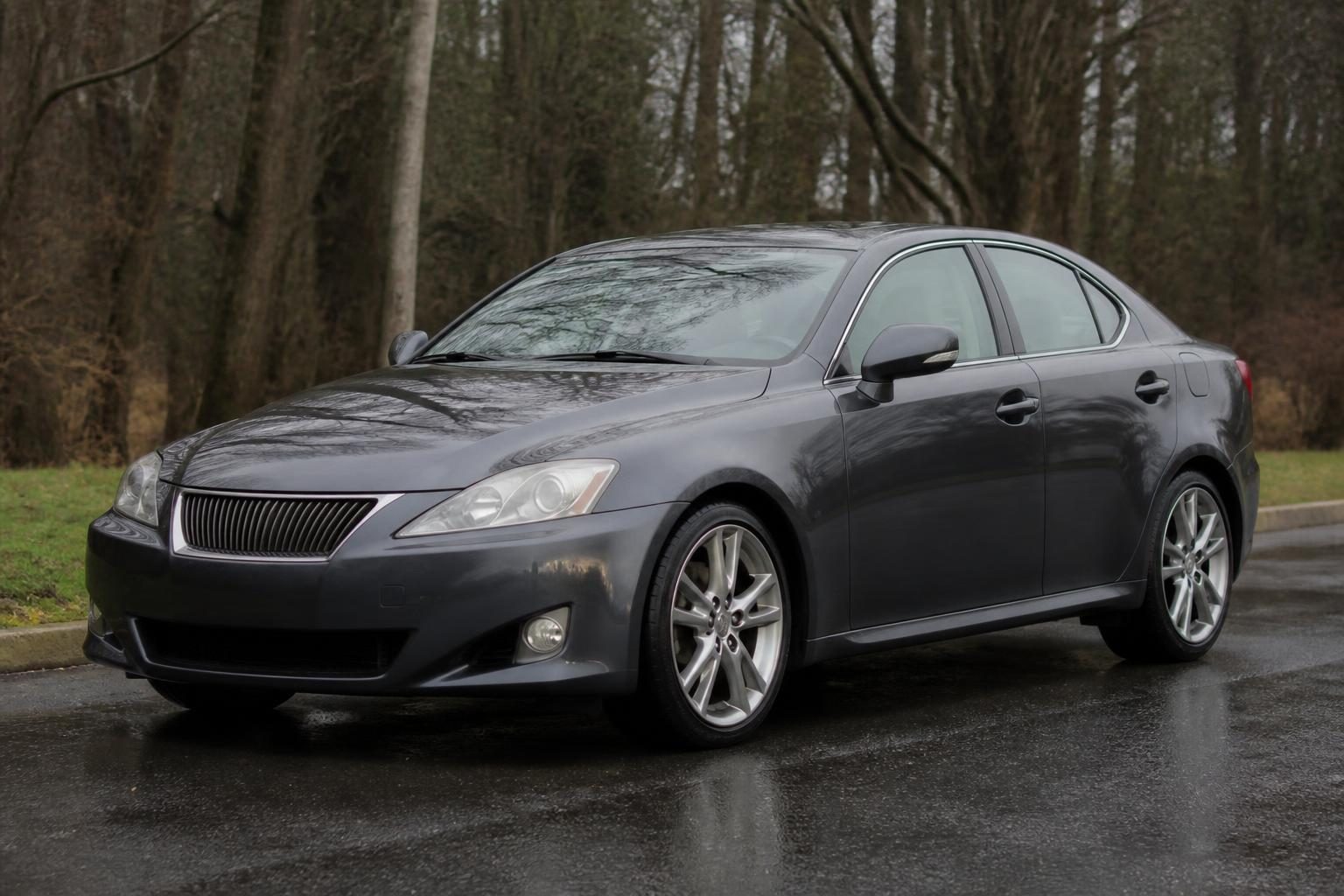
The Lexus IS F (USE20) is covered by SEVS approvals SEV-000965 and SEV-000382, both limited to December 2007 through August 2008 builds — eight months of a production run that stretched to 2014. It is a compact four-door sedan rated at 311 kW and 505 Nm, and it remains the least expensive entry point into the F badge family.
A hand-finished V8 is crammed under a bonnet that was never designed for one, with the bulging power dome as the giveaway. The eight-speed Sport Direct Shift automatic was quick-witted for its era, and the stacked quad exhaust outlets and Brembo brakes were fitted from launch. Kerb weight is modest by modern standards, which is exactly why these cars still feel urgent.
Being honest about age matters here. These are eighteen-year-old performance cars, so the auction sheet, service history and odometer deserve more scrutiny than a newer car would need. A pre-bid physical inspection is worth arranging. Of the three, the IS F is the most likely to land under the LCT threshold, though that depends entirely on the individual car's condition, grade and the exchange rate on the day.
 Gray Lexus IS sedan on rain-slick pavement in a wooded area.
Which Lexus RC F Build Windows Are SEVS-Eligible?
The Lexus RC F (USC10) holds SEVS eligibility across two separate windows: SEV-000909 for September 2014 to January 2015 builds, and SEV-001084 for December 2021 to December 2025 builds — the latter valid until 13 July 2029. It is the only two-door in the group and has the broadest spread of eligible build dates of the three F-cars. A late-build import listing covers the December 2021 to December 2025 window separately.
Output climbed across the model's life. Wikipedia's Lexus RC entry, drawing on Lexus figures, records a 341 to 354 kW range depending on year and market. Drive.com.au's test of the 2021 Track Edition measured 351 kW at 7,100 rpm and 530 Nm between 4,800 and 5,600 rpm. The 1,715 kg kerb weight reflects roughly 80 kg stripped from the standard car through carbon bodywork and a titanium exhaust. The Torque Vectoring Differential fitted to higher grades is the RC F's real party trick, sharpening turn-in in a car that is otherwise front-heavy.
Who it does not suit: anyone who regularly carries adults in the back. Four seats behind two doors is a compromise, and the IS F and GS F both do family duty better. Later cars are the most likely of the three to attract LCT, so choose your build window with the tax rule in mind.
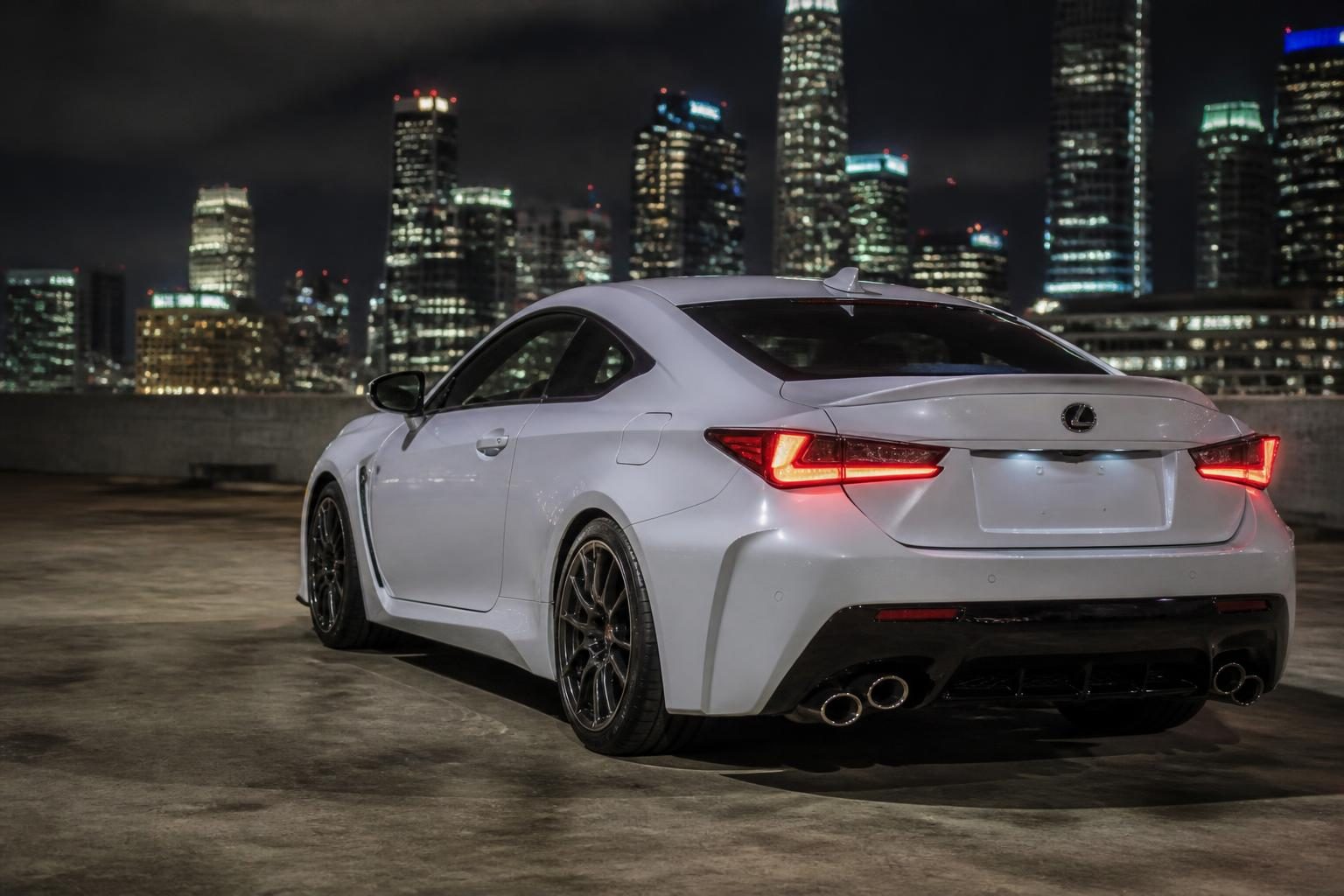 White Lexus RC F on a rooftop car park under city lights.
Is the Lexus GS F the Right Five-Seat F-Car?
The Lexus GS F (URL10) is approved under SEVS SEV-000701 for a single window: October 2015 to January 2016 builds, backed by four Model Report Entries on the Rover register. It is the only five-seat car in this comparison — a proper full-size rear-drive sports sedan with rear legroom and boot space the IS F and RC F cannot match.
Reviews of the car, including Drive.com.au's, put output at 351 kW and around 527 Nm through the eight-speed automatic. The GS F also gets the Torque Vectoring Differential with three selectable modes, adaptive dampers and a chassis tuned harder than the standard GS. Lexus built it for a short window, which is precisely why clean examples are scarce on the Japanese auction floor.
One quirk worth knowing: the GS F appears under two model codes, URL10 and Lexus GS F RL1. Both share the same SEVS approval and the same October 2015 to January 2016 build window, so confirm which code applies to a specific chassis before bidding. Being the newest and rarest of the three, most GS F examples should be planned for with LCT in the budget rather than treated as a surprise at invoice time.
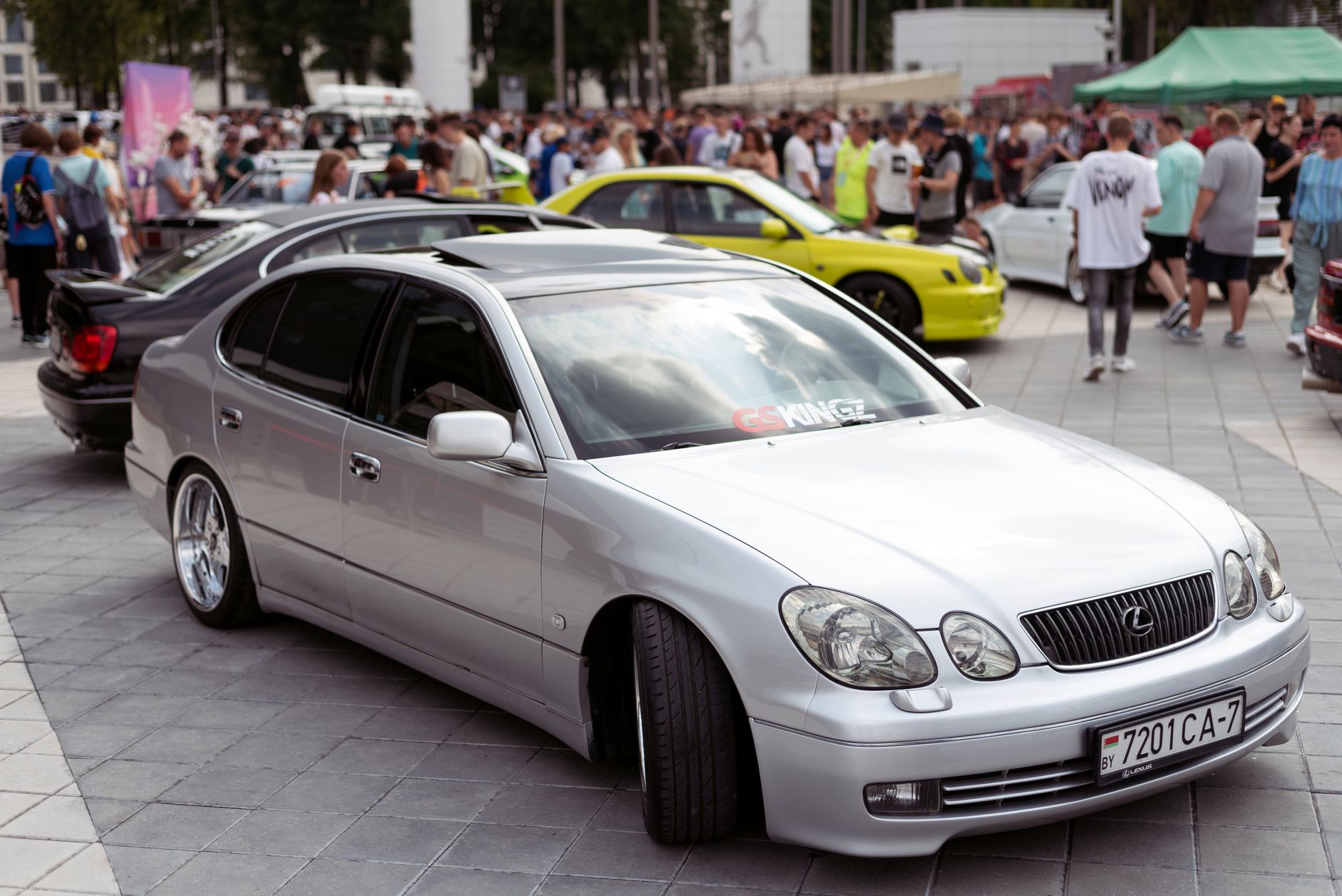 A silver Lexus GS sedan parked among cars and spectators.
| IS F (USE20) | RC F (early USC10) | RC F (late USC10) | GS F (URL10 / RL1) | |
|---|---|---|---|---|
| Body | Sedan | Coupe | Coupe | Sports sedan |
| Approved build window | Dec 2007 to Aug 2008 | Sep 2014 to Jan 2015 | Dec 2021 to Dec 2025 | Oct 2015 to Jan 2016 |
| Doors / seats | 4 / 4 | 2 / 4 | 2 / 4 | 4 / 5 |
| Power | 311 kW (Toyota) | 341 kW+ (Lexus via Wikipedia) | 351 kW (Drive.com.au) | 351 kW (Drive.com.au) |
| SEVS approval | SEV-000965, SEV-000382 | SEV-000909 | SEV-001084 (to Jul 2029) | SEV-000701 (to Nov 2027) |
| LCT exposure | Lowest of the three | Moderate | Higher | Highest |
Which F Fits?
If the lowest entry point to a V8 F-car is the goal, the IS F is worth a close look. It is the oldest and smallest, which usually means the least tax exposure, and the engine character is the same. Just accept that you are buying a car built before 2009 and inspect accordingly.
If a coupe body matters, the RC F is the only option here, and the two approval windows let you choose between an early car and a late one. Earlier builds sit further below the LCT threshold. Skip it if rear-seat access is part of your weekly routine.
If you need four doors and real rear room, the GS F is the pick. It is the rarest and the most likely to attract LCT, so budget for the tax from the start rather than hoping to dodge it.
How Do You Import an F-Car Through Carbarn?
Carbarn sources all three F-cars from Japan through approved auction and pre-sourced channels, and you can specify the model code, build year and grade you are after. The team arranges pre-bid inspection where the auction format allows and bids only with your approval inside your budget cap. They lodge the VIA application, manage freight and customs, then complete compliance work, AVV inspection and RAV entry at the RAW-certified Sydney workshop in Lidcombe. Finance, extended warranty, Blue Slip and NSW registration support, and Australia-wide door delivery can all be added before handover. Carbarn's import service runs about 6 to 10 weeks end to end.