



Ready to Hit the Road in Style?
Save money and reduce emissions with vehicles designed to deliver exceptional mileage. Visit our inventory and find a car that fits your lifestyle.
Ready to Hit the Road in Style?
Save money and reduce emissions with vehicles designed to deliver exceptional mileage. Visit our inventory and find a car that fits your lifestyle.
You already know what a 1JZ is. You've narrowed the choice to two rear-drive Toyota sedans — the JZX100 Chaser Tourer V and the JZX110 Mark II iR-V — that share the same turbocharged inline-six. Now you're stuck. The JZX100 Chaser has been arriving in Australia for years and has the community and parts network to prove it. The JZX110 Mark II is newer, stiffer, and has only recently cleared the eligibility window. Same engine, genuinely different cars. So which chassis is the smarter import?
Quick Answer
- Both run the VVT-i 1JZ-GTE at 280 PS / 206 kW, so the engine argument is a draw
- JZX100 Chaser Tourer V: factory 5-speed manual available, longer Australian import history, deeper local parts and tuning knowledge
- JZX110 Mark II iR-V: stiffer chassis, newer build dates from Japan, automatic transmission only
- Both are approved under the SEVS (Specialist and Enthusiast Vehicle Scheme) Performance Criterion — SEV-000963 and SEV-000378 for the JZX100, SEV-000773 for the JZX110
- Peak torque of 378 Nm arrives at just 2,400 rpm in both cars (1JZ-GTE engine specifications)
One quick clarification before the comparison, because it trips up a lot of searches. Toyota retired the Chaser nameplate when the JZX100 generation ended, and Wikipedia's Toyota Chaser entry records the model being discontinued in 2001 and replaced by the Verossa. There is no factory "JZX110 Chaser." The X110 generation was sold as the Mark II, so the term you want is Mark II iR-V JZX110.
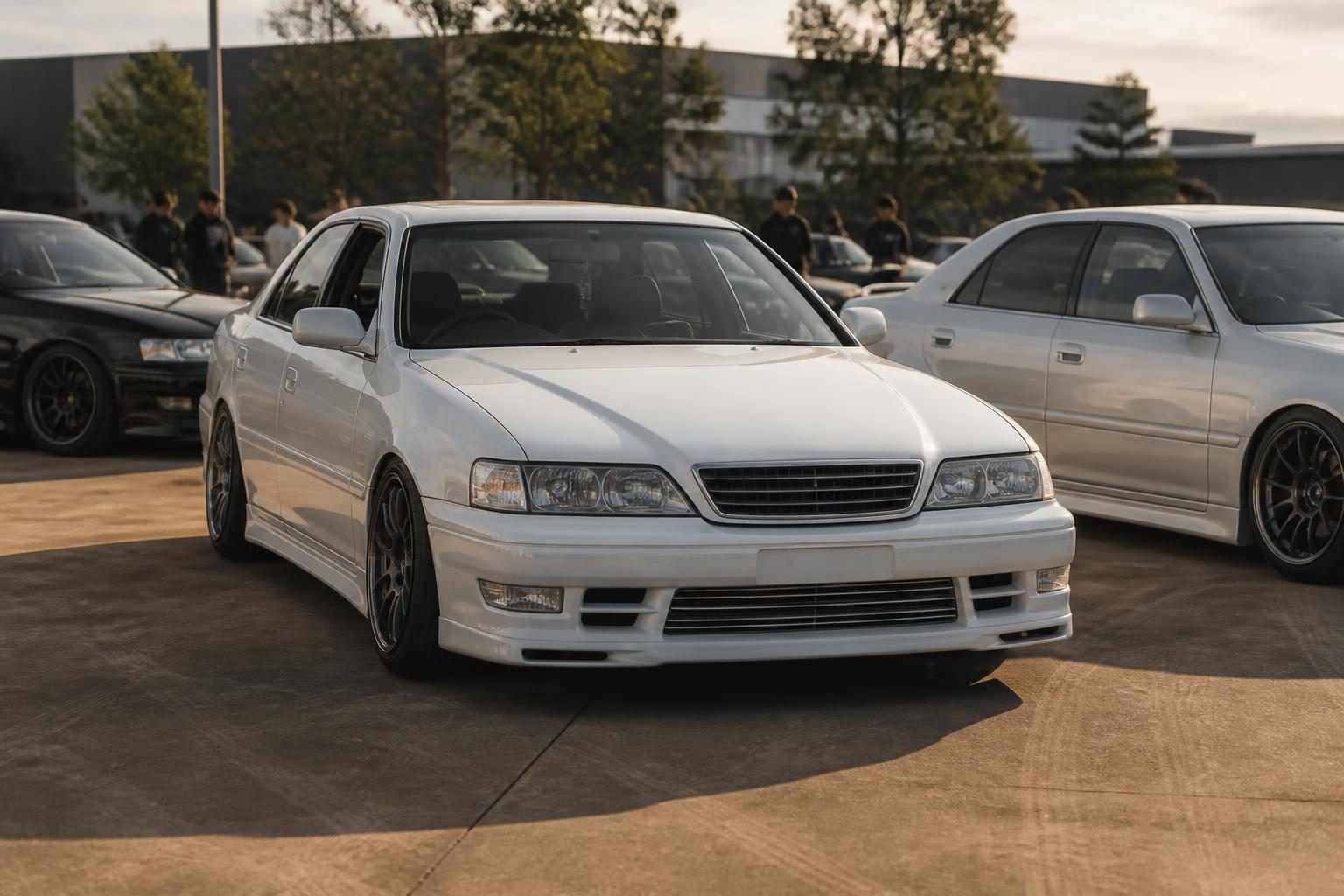 Modified sedans lined up at an evening car meet.
How Do the JZX100 and JZX110 Compare?
The JZX100 Chaser Tourer V and JZX110 Mark II iR-V share one engine: the 2,492 cc 1JZ-GTE, a single-turbocharged DOHC 24-valve inline-six with VVT-i (Variable Valve Timing with intelligence) producing 280 PS / 206 kW and 378 Nm at 2,400 rpm (engine-specs.net). The differences are the chassis, the gearbox, and the eligible build-year windows for Australian import.
| Spec | JZX100 Chaser Tourer V | JZX110 Mark II iR-V |
|---|---|---|
| Eligible build range | Jan 1996 to Jul 2001 | Oct 2000 to Dec 2007 |
| Engine | 2.5L 1JZ-GTE, single CT15B, VVT-i | 2.5L 1JZ-GTE, single CT15B, VVT-i |
| Power | 280 PS / 206 kW at 6,200 rpm | 280 PS / 206 kW at 6,200 rpm |
| Torque | 378 Nm at 2,400 rpm | 378 Nm at 2,400 rpm |
| Gearbox | 5-speed manual or 4-speed auto | Automatic only |
| Drivetrain | Rear-wheel drive | Rear-wheel drive |
| Chassis | X100 | X110, stiffer with revised geometry |
| SEVS approval | SEV-000963 / SEV-000378 | SEV-000773 |
| Import path | Japan-sourced, available to order | Japan-sourced, available to order |
What Makes the Toyota Chaser Tourer V JZX100 Stand Out?
The Toyota Chaser Tourer V JZX100 is the car that built Australia's 1JZ community. Its eligibility covers builds from January 1996 to July 2001 under two separate SEVS approvals — SEV-000963 and SEV-000378 — both verifiable on the ROVER register and granted on the Performance Criterion. Most of the local knowledge sitting behind this platform traces back to that long approval history.
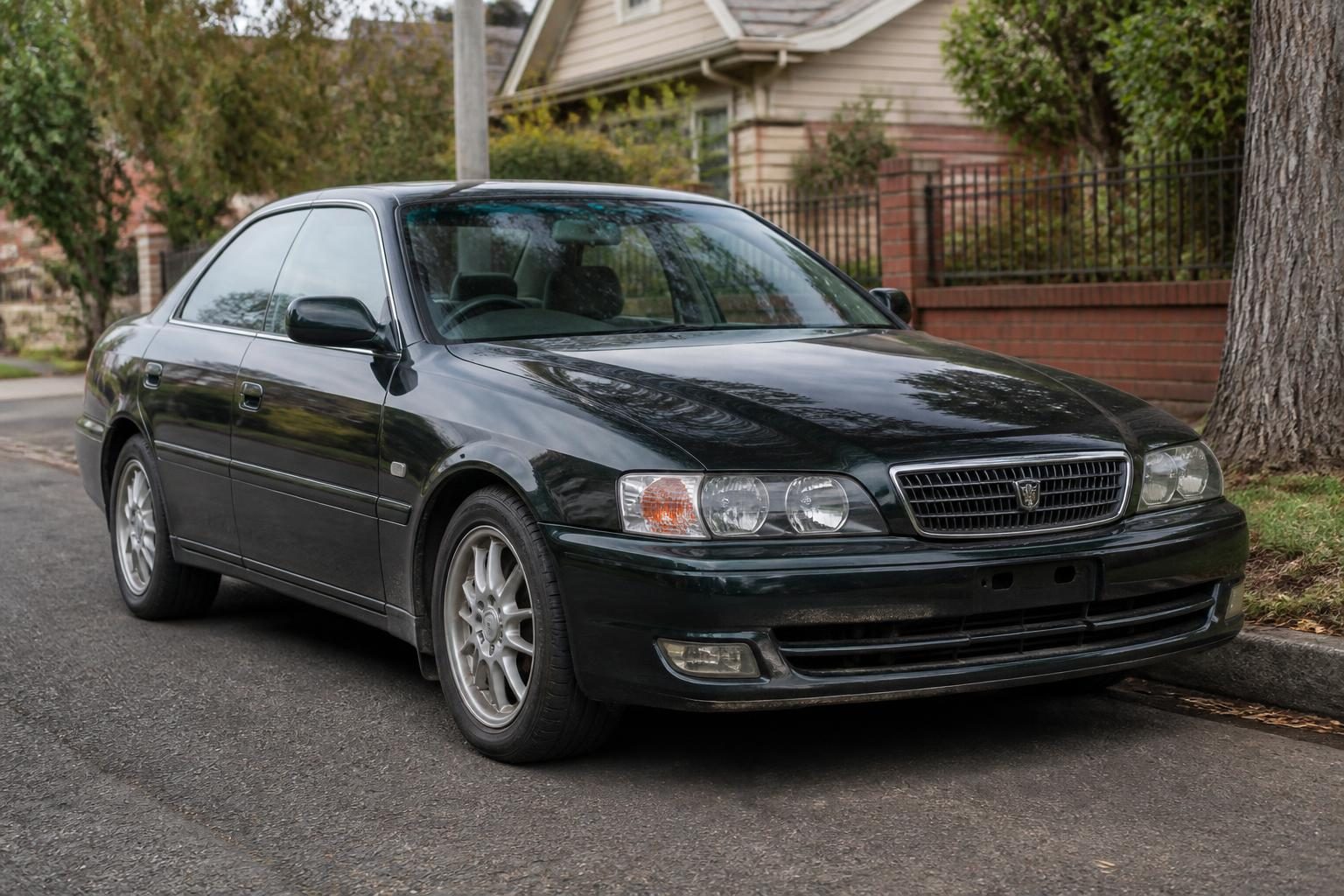 1996 TOYOTA Chaser Tourer V
Mechanically it's the familiar package: a 2,492 cc DOHC 24-valve 1JZ-GTE producing 280 PS at 6,200 rpm and 378 Nm at 2,400 rpm, according to engine-specs.net. That torque peak is the part that matters day to day. You get the shove low in the rev range, which makes the car easy in traffic and predictable when you're feeding power in mid-corner.
The gearbox is the real differentiator. Wikipedia's Chaser entry confirms the Tourer V was offered with a 5-speed manual as well as the 4-speed ECT-iE (Electronically Controlled Transmission with intelligence and Economy) automatic, and it's the only car in this comparison with a factory three-pedal option. Add the low, coupe-like roofline over a 2,730 mm wheelbase and a 4,715 mm by 1,755 mm footprint, and you've got the shape that put this car on so many shortlists.
The trade-offs are honest ones. This is a 1990s shell, so it flexes more than the X110 and every example is now at least 25 years old. Bushes, cooling, and interior trim all need scrutiny before you bid. It suits buyers who want a manual, want a large local community behind them, and are building something street-friendly that also sees the occasional track day.
What Sets the Toyota Mark II iR-V JZX110 Apart?
The Toyota Mark II iR-V JZX110 is the chassis serious build threads keep landing on. It's approved under SEV-000773 on the Performance Criterion — verifiable on the ROVER register — covering builds from October 2000 to December 2007. One thing worth clarifying: the iR-V sedan's production run ended in October 2004, as confirmed in the ROVER register under model report entries MRE-000035 and MRE-000076. The 2005–2007 tail of the SEVS window relates to the Mark II Blit wagon variant, which shares the X110 platform and also runs the 1JZ-GTE, but is a different body style. In practice, the iR-V sedans coming out of Japan are 2000–2004 builds.
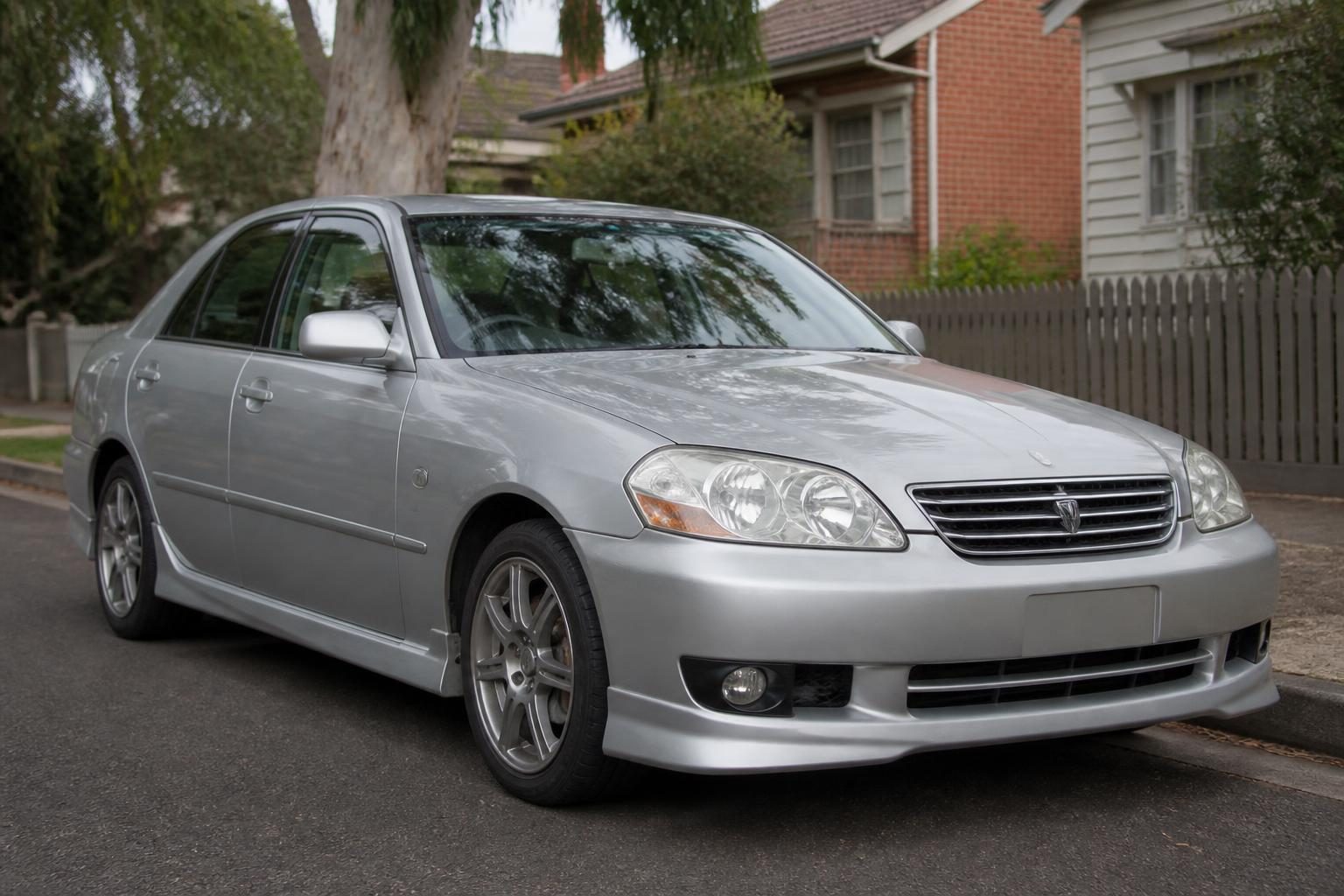 2000 TOYOTA Mark II iR-V
Under the bonnet, nothing changes in a meaningful way. It's the same VVT-i 1JZ-GTE with the single CT15B turbo, rated at 280 PS / 206 kW and 378 Nm at 2,400 rpm, and motorreviewer.com dates that VVT-i version's production run from 1996 through to 2007. What changed is the structure. The X110 shell is noticeably stiffer than the X100 with revised suspension geometry, so turn-in is sharper and the car responds far better to coilovers and a proper alignment. If your end goal is a drift or circuit build, that's a better starting canvas.
Now the part worth saying plainly: the iR-V is automatic only. Carbarn's eligibility data lists the JZX110 iR-V with an automatic gearbox and rear-wheel drive. There was no factory manual in this variant. A conversion is possible, but it means sourcing a gearbox, pedal box, driveshaft, and loom separately, then paying for the labour on top. If a manual is non-negotiable, the JZX100 is simply the shorter road.
The upside of the later build range is condition. Because the X110 only recently entered Australia's import window, the pool coming out of Japan skews younger than the X100 pool. Lower kilometres are more common, and there's less accumulated age-related wear to unwind.
How Do 1JZ-GTE Parts and Tuning Compare Across Both?
Parts compatibility across the JZX100 and JZX110 is nearly complete — both run the same VVT-i 1JZ-GTE, so turbos, clutches, intercooler kits, injectors, and aftermarket ECUs cross over between generations (engine-specs.net). A bolt-on intake, exhaust, and front-mount intercooler is a proven starting point on either chassis, and the single-turbo VVT-i platform responds well to those changes.
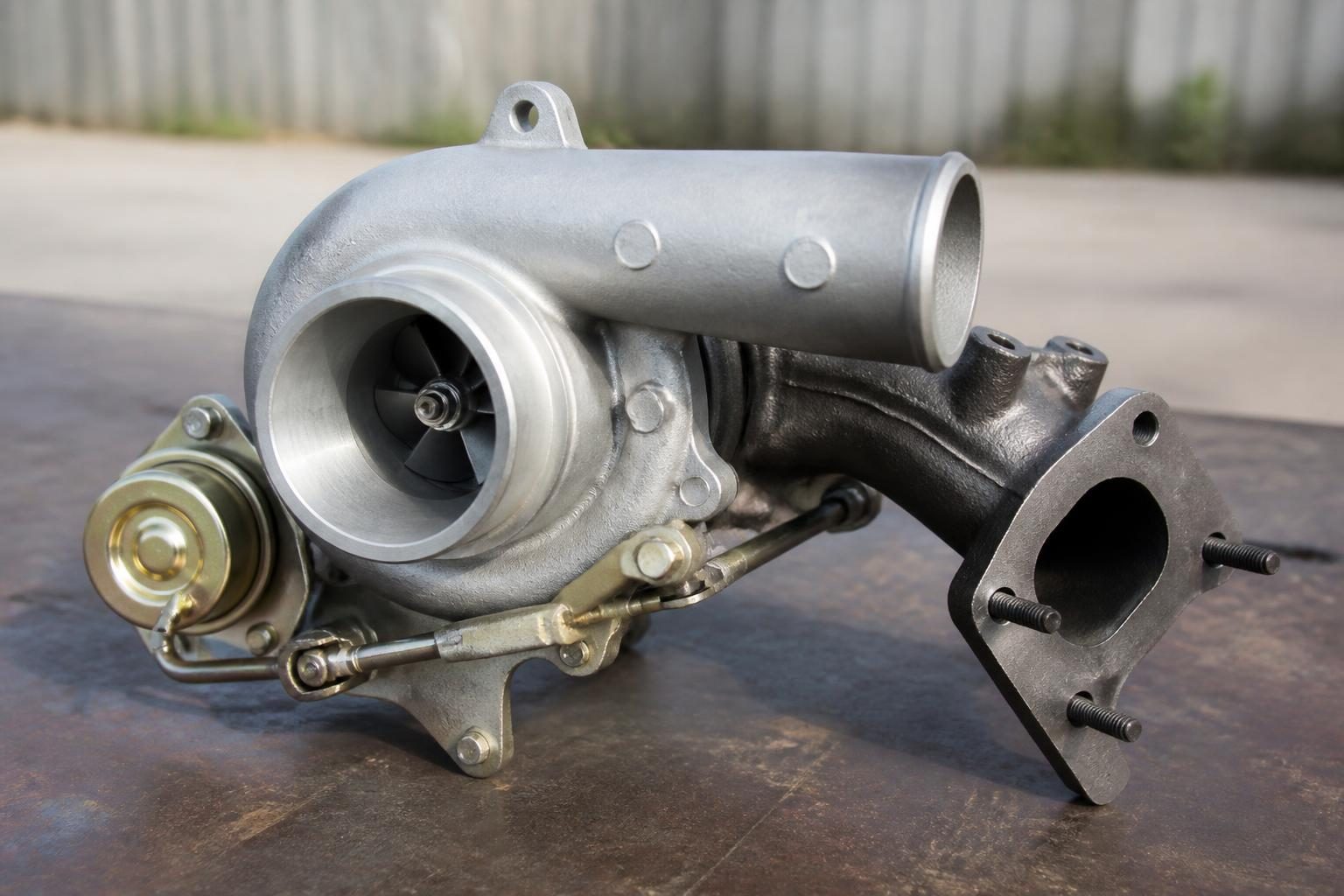 A single turbocharger assembly shown on a work surface.
Worth knowing: the VVT-i generation is the more street-driveable of the two 1JZ families. Engine-specs.net lists the earlier twin CT12A version at 363 Nm arriving at 4,800 rpm, against 378 Nm at 2,400 rpm for the single-turbo VVT-i engine. That's a big shift in where the torque lives, and it's why these later cars feel so relaxed in normal driving.
Where the platforms actually split is suspension. The X110's stiffer shell rewards coilover and alignment work more clearly, while the X100's softer structure can suit a street-biased car where ride quality still matters.
Which JZX100 or JZX110 Makes Sense for You?
Choose the JZX100 Chaser Tourer V if:
- A factory manual gearbox is non-negotiable
- You want the larger, more established Australian community around the platform
- You're building a street-friendly car that handles occasional track time
- Your tuner already knows the X100 inside out
Choose the JZX110 Mark II iR-V if:
- You're comfortable with an automatic, or you've budgeted for a conversion
- Chassis stiffness and suspension geometry are your priority
- You want the newest build dates available in the 1JZ sedan family
- A smaller pool of existing Australian examples doesn't bother you
| Factor | JZX100 Chaser | JZX110 Mark II |
|---|---|---|
| Factory manual option | ✅ Yes | ❌ Auto only |
| Chassis stiffness | Standard X100 | ✅ Stiffer X110 |
| Existing AU pool | ✅ Larger | Smaller |
| Newest build dates | 2001 | ✅ 2004 (iR-V sedan) |
| 1JZ-GTE parts commonality | ✅ Shared | ✅ Shared |
Either way, both clear the same SEVS Performance Criterion and both go through an identical import and compliance process. The engine isn't the deciding factor here. The gearbox and the chassis are.
What Does Importing a JZX100 or JZX110 Involve?
Both of these are sourced to order from Japan rather than bought off a lot, so the process starts with a target rather than a car. You set the model, build year range, budget, and acceptable auction grade. Where the auction format allows, a pre-bid physical inspection is arranged. The auction sheet, photos, and inspector notes are shared before any bid is placed. Bidding only happens with your approval and inside your agreed cap.
From there: Vehicle Import Approval before shipping, then freight to Sydney, customs and biosecurity clearance. Compliance work follows, including an AVV (Approved Vehicle Verifier) inspection and RAV (Register of Approved Vehicles) entry. Plan on 6 to 10 weeks end to end. Auction-sourced cars don't carry the standard 3-month NSW dealer warranty, though a 5-year extended warranty may be available depending on age and condition.
Carbarn's Sydney import service handles all of this from its Lidcombe base. That covers a RAW-certified in-house compliance workshop, licensed NSW motor dealing (MD 056471), auction sourcing and bidding in Japan, VIA and RAV paperwork, finance, warranty, door delivery, and registration-ready handover. Full process detail in our 13-step Japan import guide. Listing pages for both models are on the Chaser Tourer V JZX100 and Mark II iR-V JZX110 pages.