



Ready to Hit the Road in Style?
Save money and reduce emissions with vehicles designed to deliver exceptional mileage. Visit our inventory and find a car that fits your lifestyle.
Ready to Hit the Road in Style?
Save money and reduce emissions with vehicles designed to deliver exceptional mileage. Visit our inventory and find a car that fits your lifestyle.
The mainstream dual-cab ute has grown up, and out. It's wider, heavier and far more expensive than the job most small operators actually need doing. If you run an orchard, a nursery, a lifestyle block or a two-person landscaping outfit, you've probably looked at the ute yard and thought the same thing: this is a lot of vehicle for carting mulch and moving gear between sites.
That's where two Japanese working vehicles keep coming up. This Suzuki Carry vs Toyota Townace comparison comes down to access versus enclosed load space, with one major catch: the current Townace import pathway requires campervan conversion before RAV entry. The Suzuki Carry and the Toyota Townace are not interchangeable, and buyers who treat them that way usually end up with the wrong one. Here's how they actually differ, and which jobs suit each.
The Bottom Line
- The Suzuki Carry DA16T is a kei-class flatbed with a 658 cc R06A three-cylinder and roughly 350 kg of payload. Tiny, frugal, brilliant in tight spaces.
- The Toyota Townace van (sold here as the LiteAce) is a 1.5-litre light commercial van. Toyota lists 750 kg for two-seat 2WD vans and 700 kg for two-seat 4WD vans; five-seat versions are listed at 500 kg.
- The Carry's current Environmental Criterion approval is SEV-000914, covering 3BD-DA16T builds from April 2022. The Townace's Campervans and Motorhomes pathway (SEV-000936, valid to 24 August 2028) requires campervan conversion before RAV entry.
- Japan-to-Australia timing varies with auction availability, shipping and compliance scheduling; ask for a current timeline for the vehicle you're considering.
- Short version: Carry if access is your problem. A Townace needs its campervan conversion and import pathway checked before it can be considered.
 A small work truck stands in a rural field beneath a hazy sky.
What Are You Actually Choosing Between?
These two sit in different vehicle classes, which is the single most useful thing to understand before you shortlist either. The Carry is a kei truck, built to Japan's smallest commercial category: engine capped at 660 cc, body under 3.4 metres long. The Townace is a light commercial van about 650 mm longer with more than double the engine capacity.
One important clarification, because it trips people up constantly. The Townace was sold in Japan as both a van and a flatbed truck. The current Australian pathway covers van body codes S402M, S403M, S412M and S413M under the Campervans and Motorhomes Criterion, and requires campervan conversion before RAV entry. If you specifically want a tray, the Carry is your flatbed option here, not the Townace.
Suzuki Carry DA16T: The Kei-Class Tray Truck
The Suzuki Carry DA16T is the vehicle people picture when they say "mini truck", and it earns that reputation honestly. It's a cab-over flatbed with drop-down sides on three edges, so you load from wherever you're standing rather than reversing into position. On a property with narrow gates, low branches or rows planted close together, that combination of a 3.6 m turning circle and a 1.47 m body (Cult & Classic, August 2024) does things a full-size ute simply cannot.
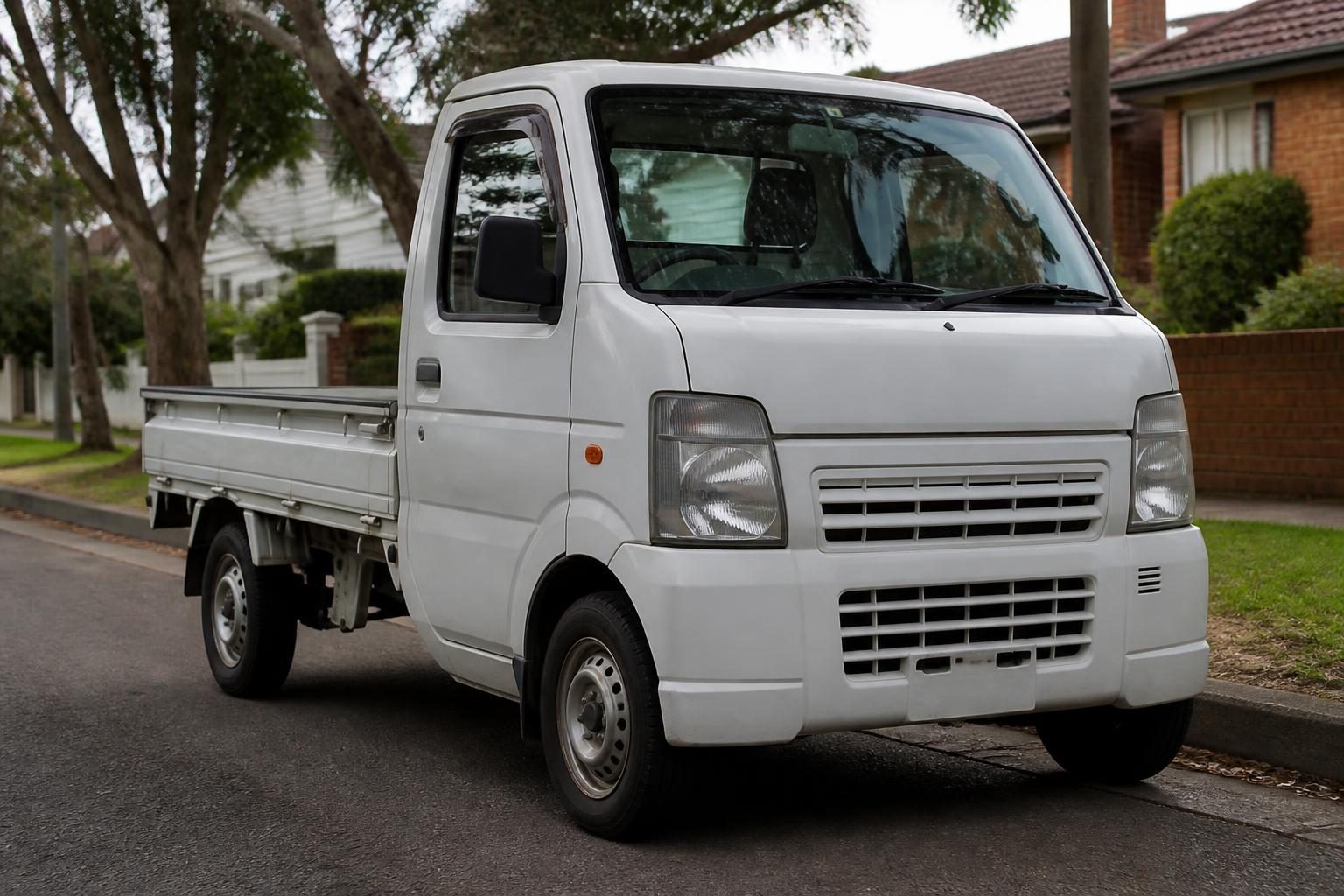 Suzuki Carry
Under the tray sits the R06A 658 cc three-cylinder petrol engine, producing 37 kW and 59 Nm, available in 2WD or part-time 4WD, with two seats (Suzuki, Carry specifications, retrieved 2026-09-01). Tray dimensions vary by grade and model year, so confirm them against the official Suzuki specification for the exact DA16T you are considering. Payload sits at about 350 kg. In practical terms that's eight 40 kg bags of potting mix, or a ride-on mower with your tools alongside it. Kerb weight also varies by year, trim and drivetrain. For 2022–24 3BD-DA16T five-speed manual variants, official Japanese WLTC testing returns 16.7 km/L in urban use and 19.2 km/L suburban, near enough to 5.2 to 6.0 L/100km (Suzuki, Carry specifications, retrieved 2026-09-01).
Be honest with yourself about the limits, though. Highway work is tiring in a 37 kW vehicle with a short wheelbase, and there's no weather protection over the load. Parts come through import specialists rather than a dealer counter, which is manageable but worth planning for. If a tray isn't essential, the closely related Daihatsu Hijet covers similar ground.
Toyota Townace and LiteAce: The Light Commercial Step Up
The Toyota Townace, badged LiteAce on Australian listings, offers more enclosed space than the Carry. It is a light commercial van with sliding side-door access, a sealed cargo bay and five seats in GL Package form, so gear stays dry and locked. That matters more than buyers expect. However, the current import pathway requires campervan conversion before RAV entry, so it is not a straightforward Japan-import work-van option. Tools left on an open tray are a security problem every time you stop for lunch.
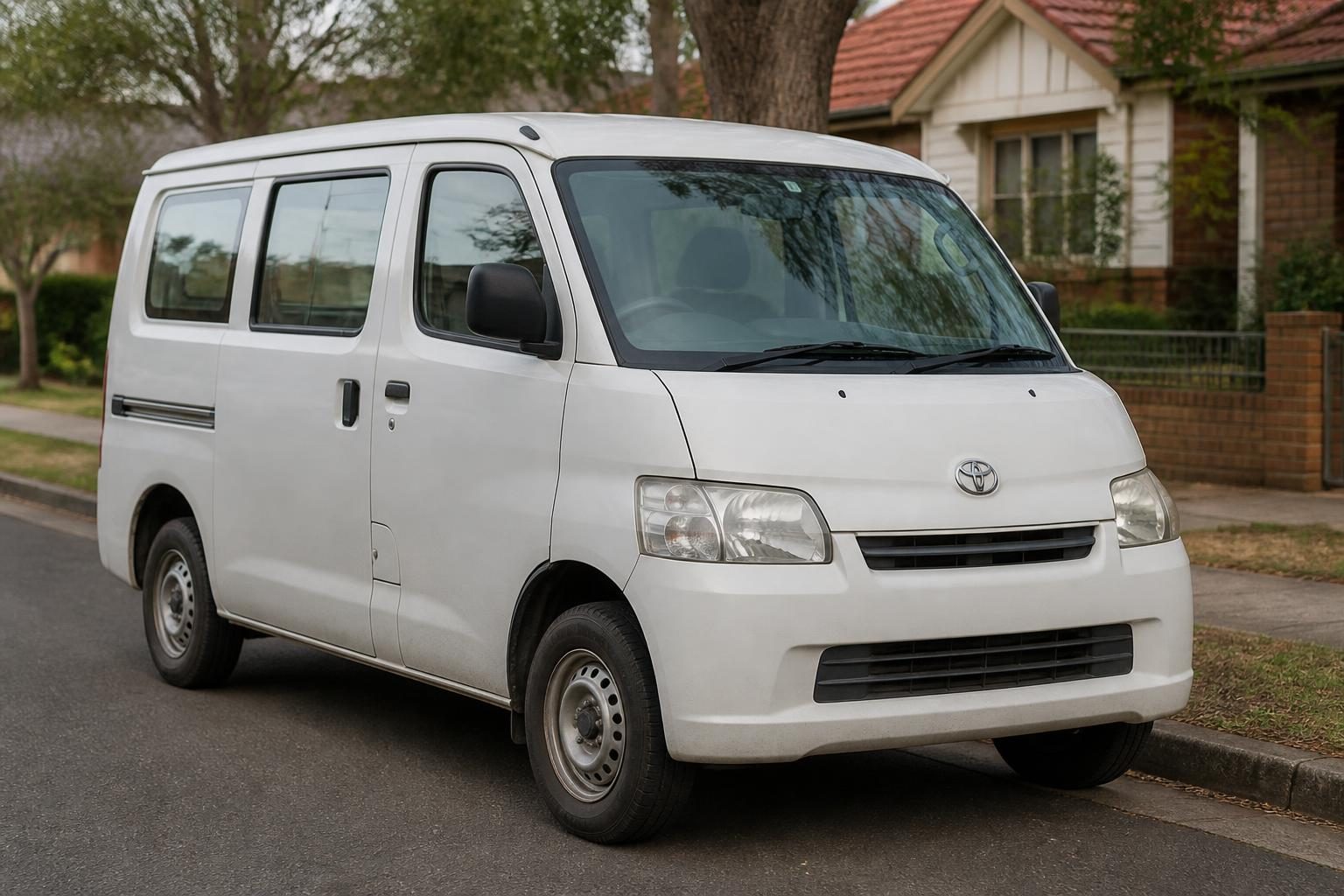 2019 Toyota LiteAce
Pre-facelift S402M and S412M vans run Toyota's 3SZ-VE, a 1,495 cc four-cylinder making 71 kW and 134 Nm. From the June 2020 update, the S403M and S413M switched to the 2NR-VE, 1,496 cc, 71 kW and the same 134 Nm (Toyota, TownAce Van specifications, retrieved 2026-09-01). Toyota lists payload at 750 kg for two-seat 2WD vans and 700 kg for two-seat 4WD vans; fitting the rear seats reduces the listed payload to 500 kg. That is useful capacity, but load weight must include passengers, tools and accessories. Official WLTC economy for 2020 2WD vans is 12.0 km/L with the four-speed auto and 12.6 km/L with the five-speed manual, around 7.9 to 8.3 L/100km (Toyota, TownAce Van specifications, retrieved 2026-09-01). The 4WD figures are lower.
Toyota Australia did not sell this Japan-market S400-series van locally, so confirm parts availability, VIN support and body-panel lead times before committing. Check the live listing for the current price rather than relying on a general market band. Where it gives ground to the Carry is access. It's longer, wider and won't thread the gaps a kei truck shrugs at. Buyers who want more room again should compare it against the alternatives in our guide to the best small commercial van in Australia.
How Do the Two Compare on Paper?
| Feature | Suzuki Carry DA16T | Toyota Townace / LiteAce |
|---|---|---|
| Engine | 658 cc R06A, 3-cyl petrol | 1,495 cc 3SZ-VE or 1,496 cc 2NR-VE, 4-cyl petrol |
| Power / torque | 37 kW / 59 Nm | 71 kW / 134 Nm (3SZ-VE) |
| Payload | ~350 kg | 750 kg (two-seat 2WD), 700 kg (two-seat 4WD), 500 kg with rear seats |
| Body style | Flatbed tray, three-way drop | Van, sliding side door |
| Length / width | 3.39 m / 1.47 m | About 650 mm longer |
| Fuel (WLTC) | ~5.2 to 6.0 L/100km for specified 2022–24 3BD-DA16T 5MT variants | ~7.9 to 8.3 L/100km for 2020 2WD variants; 4WD is higher |
| Turning circle | 3.6 m | Wider |
| Seats | 2 | 5 (GL Package) |
| SEVS criterion | Environmental | Campervans and Motorhomes, with campervan conversion required before RAV entry |
| Parts in Australia | Confirm supply by part and vehicle | Confirm VIN support and parts supply before purchase |
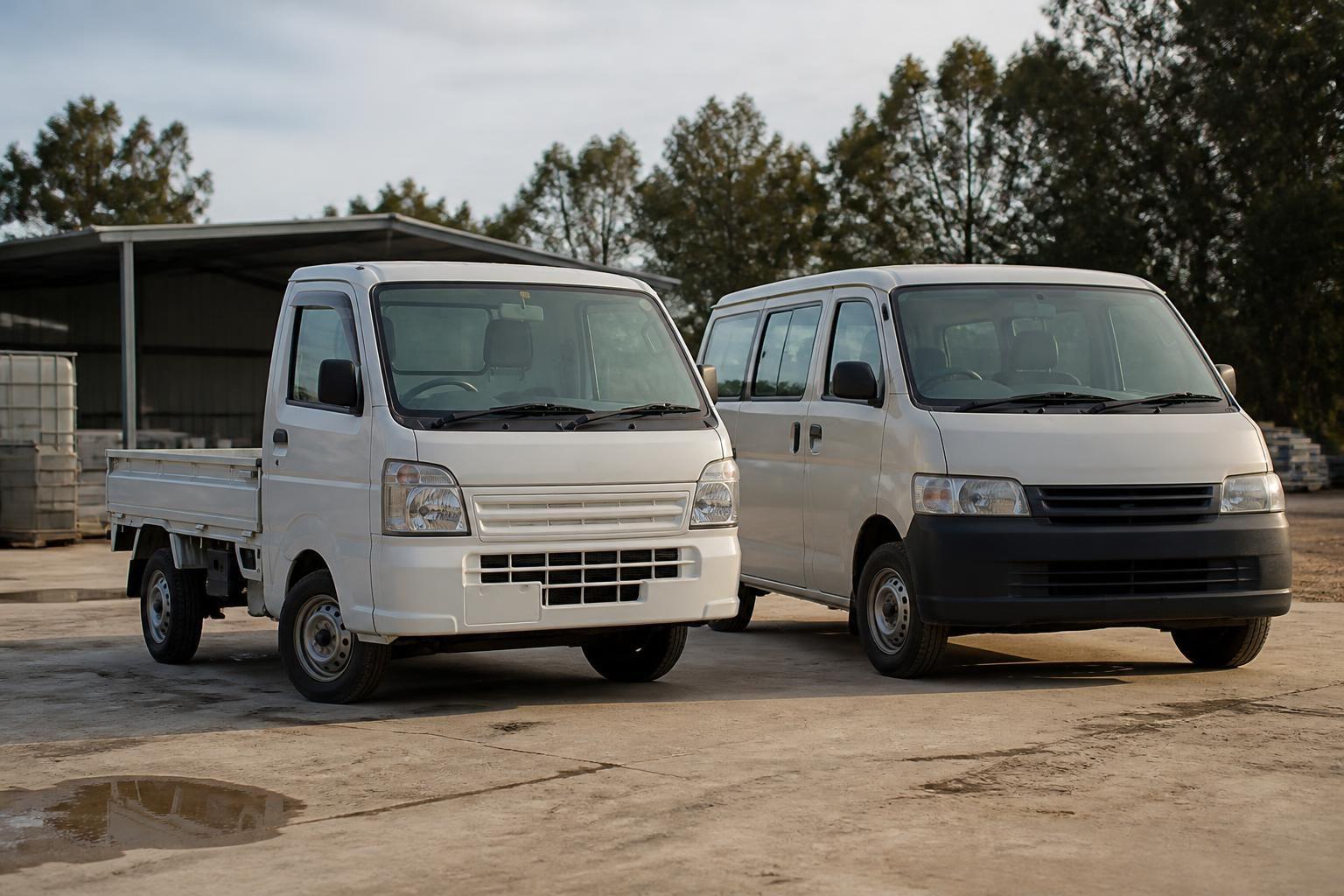
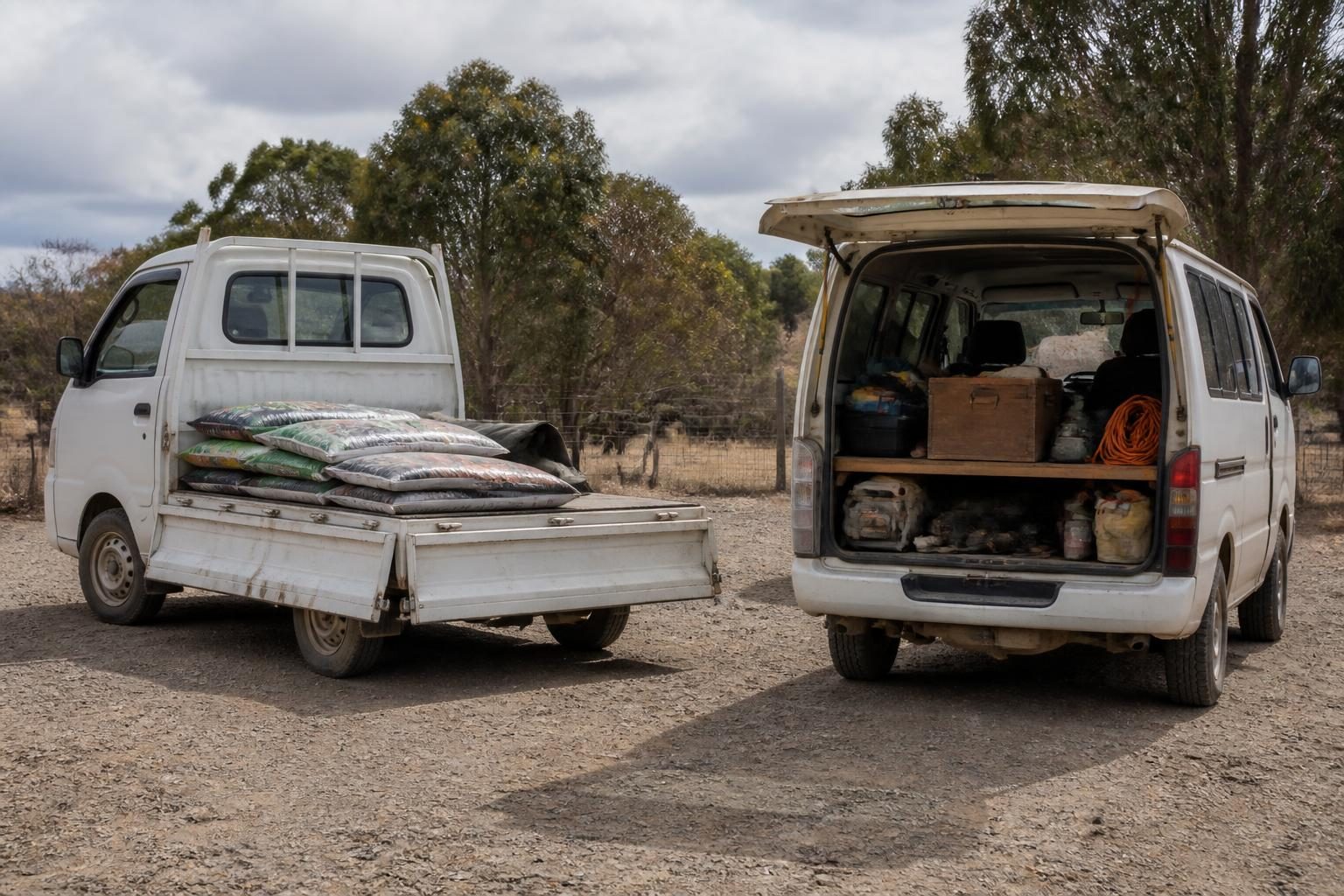 Loaded kei truck and open work van in a rural gravel yard.
Which One Fits Your Situation?
Choose the Carry if your constraint is space rather than weight. Orchard rows, glasshouse aisles, caravan parks, campgrounds, narrow inner-city laneways: the Carry gets in, turns around and gets out. On a laboratory-test comparison at 15,000 km a year, using 5.5 L/100km for the Carry and 8.3 L/100km for a 2WD Townace, the figures are roughly 825 litres and 1,245 litres respectively, a 420-litre difference. Actual use varies with load, route, transmission and drivetrain.
A Townace offers more enclosed space and seating than the Carry, but the current Japanese-import pathway requires campervan conversion before RAV entry. It is therefore not a straightforward choice for buyers seeking a standard imported work van. Two seats become a genuine problem the moment you take on a second worker, and the Carry only has two.
The Carry is not right for you if most of your kilometres are highway kilometres or you tow. The Townace is not right for you if the whole reason you're shopping is that nothing else fits down the track. In this Suzuki Carry vs Toyota Townace comparison, the Carry makes more sense when access is the priority; a Townace only makes sense after its campervan conversion and import pathway are confirmed. And if a small van appeals but you want something smaller again, the kei-van route is worth reading about in our Suzuki Every vs Daihatsu Atrai comparison, or on the Suzuki Every import page.
What Does Importing Either One Involve?
Import eligibility depends on the exact model, build date and current approval conditions. The current Carry Environmental Criterion approval, SEV-000914, covers 3BD-DA16T vehicles from April 2022; its associated model-report pathway includes builds through December 2025 with an under-80,000 km condition. The Townace Campervans and Motorhomes pathway under SEV-000936 requires conversion to a campervan before RAV entry. Its odometer conditions differ by engine and build: 2NR-VE examples from November 2016 must be under 80,000 km, while 3SZ-VE examples have a separate under-147,134 km condition (Australian Government, ROVER approval records, retrieved 2026-09-01). Kei eligibility has moved around in recent years, with several models suspended, so always confirm the specific build against the current published approval rather than assuming the badge is enough.
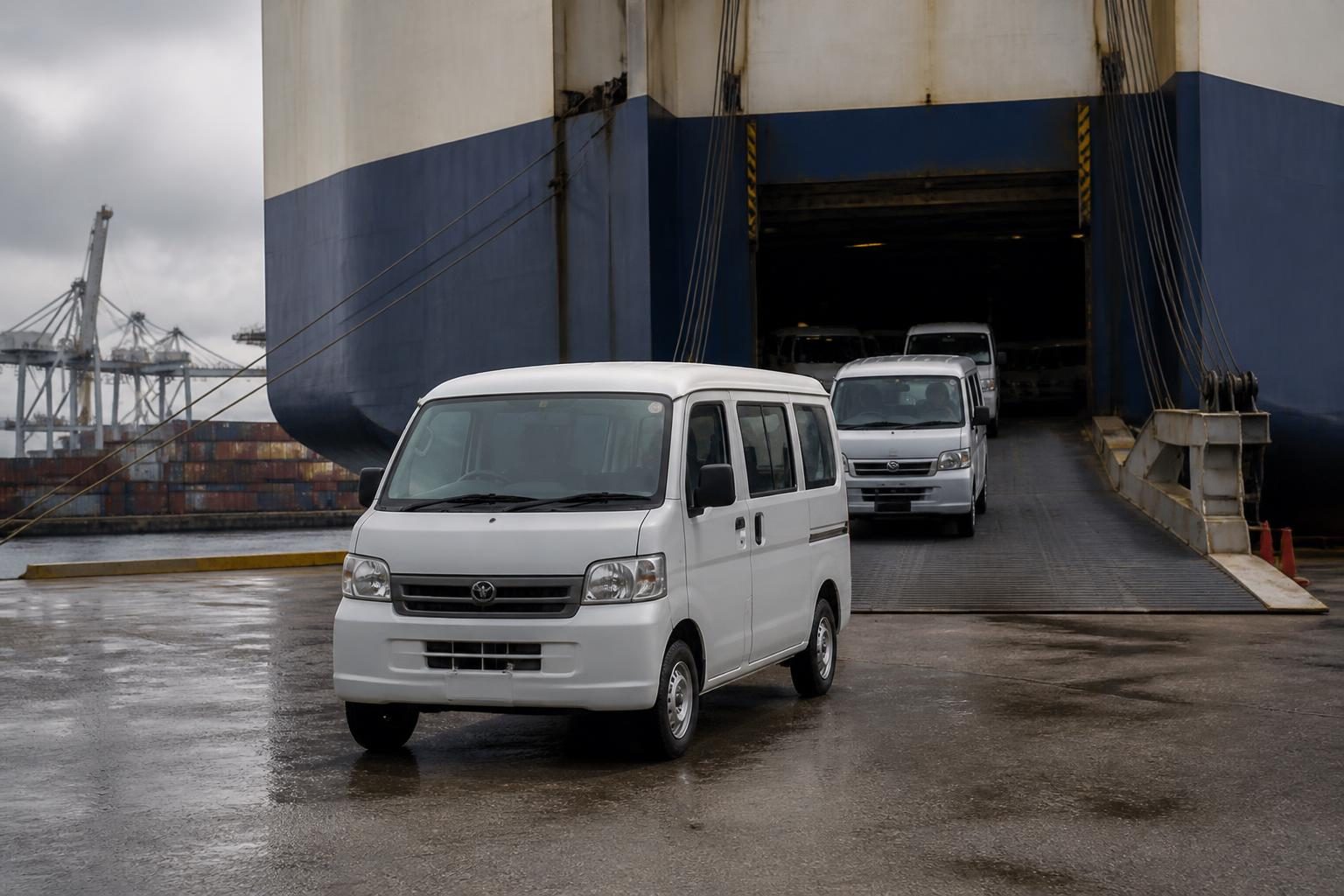 Compact vans disembark a RoRo ship at a wet container port.
The cost side is made of components, not one number. Import duty is 0% for qualifying Japanese-origin vehicles under JAEPA with proof of origin (Department of Foreign Affairs and Trade, Japan-Australia Economic Partnership Agreement, retrieved 2026-09-01). GST is 10% of the value of the taxable importation, which can include customs value, applicable duty, and international transport and insurance (Australian Taxation Office, GST on imports, retrieved 2026-09-01), followed by roll-on roll-off shipping, port and customs charges, and the compliance program. Auction results, exchange rates and vehicle condition move the total every week, so use Carbarn’s current Japan import cost guide for current figures.
How Can You Source Either One in Australia?
Carbarn can assist with approved Japanese-auction sourcing, including pre-bid physical inspection where possible, bidding with your approval and inside your budget cap, Vehicle Import Approval, ocean freight, customs and biosecurity clearance, SEVS compliance work, AVV inspection and RAV entry at the RAW-certified Lidcombe workshop, then delivery with registration-ready paperwork. Townace imports must meet the campervan-conversion requirement before RAV entry. Finance, warranty and door delivery Australia-wide are available, and vehicles already in Sydney can be inspected in person at Unit D3, 128 Frances Street, Lidcombe, open daily from 8am to 5pm.