



Ready to Hit the Road in Style?
Save money and reduce emissions with vehicles designed to deliver exceptional mileage. Visit our inventory and find a car that fits your lifestyle.
Ready to Hit the Road in Style?
Save money and reduce emissions with vehicles designed to deliver exceptional mileage. Visit our inventory and find a car that fits your lifestyle.
In the 12 months to October 2025, 1,361 people died on Australian roads (BITRE, October 2025). That is a rate of 4.9 deaths per 100,000 people. Road deaths have risen roughly 21% since 2021 (AAA, Q2 2025), while the National Road Safety Strategy requires a 50% reduction by 2030. The trend is heading the wrong way.
Defensive driving is not about paranoia. It is about habit. Passive safety, like airbags and crumple zones, protects you during a crash. Defensive driving is what you do before the hazard is on top of you.
Australian conditions make these defensive driving tips specific to where you actually drive: long distances, rural limits up to 110 km/h, wildlife, sudden weather, and big utes sharing lanes with small hatches. Here is how to drive for all of it.
Quick Answer
- Australia recorded 1,361 road deaths in the 12 months to October 2025, up around 5% on the prior year (BITRE, October 2025).
- Keep a minimum 3-second gap in dry conditions; extend to 4 to 5 seconds in rain or heavy traffic (NRMA).
- Drivers on fewer than 5 hours of sleep are 4 times more likely to crash (TAC, 2024).
- Mobile phone fines range from $390 in Tasmania to $1,295 in Queensland, with AI cameras now enforcing this in four states.
- On rural roads, dusk and dawn are peak wildlife collision times. Brake straight and don't swerve.
What Does Defensive Driving Actually Mean?
Defensive driving is the practice of anticipating hazards before they develop, giving you response time rather than reaction time. National road deaths rose across 2025 (BITRE, October 2025), and much of that risk is about how road users drive, not just what they drive.
It sits between two bad habits. Aggressive driving means speed and tailgating. Passive driving means switching off and reacting late. Defensive drivers do four things consistently:
- Scan well ahead, not just at the car in front, but 12 to 15 seconds down the road.
- Keep buffers of time and space at all times.
- Assume other road users will make mistakes, because some will.
- Adapt to the conditions, not just the posted limit.
Hazard perception is the skill of reading the road ahead for developing risks — a merging truck, a wet patch, a pedestrian stepping off the kerb — before they become emergencies. It is built into Australia's graduated licensing system. Most adults have not reviewed it since their L-plates. Consider this a practical refresh. The collision avoidance principles apply on the Bruce Highway as much as the Hume.
How Do You Keep a Safe Following Distance?
The simplest collision avoidance habit is space. Reaction time is the gap between seeing a hazard and your foot reaching the brake — typically 1.5 seconds for an alert driver. At 100 km/h, that alone puts 42 metres behind you before braking begins. Keep at least a 3-second gap to the vehicle ahead in dry conditions, and extend it to 4 or 5 seconds in rain, heavy traffic, or at highway speed (NRMA). Following too close is the fastest way to erase that buffer. To measure it: pick a fixed point — a sign or a tree — and count from when the vehicle in front passes it to when you do. Under three seconds means you're too close. The rule holds at every speed: even in urban traffic at 60 km/h, 3 seconds gives you about 50 metres of decision room.
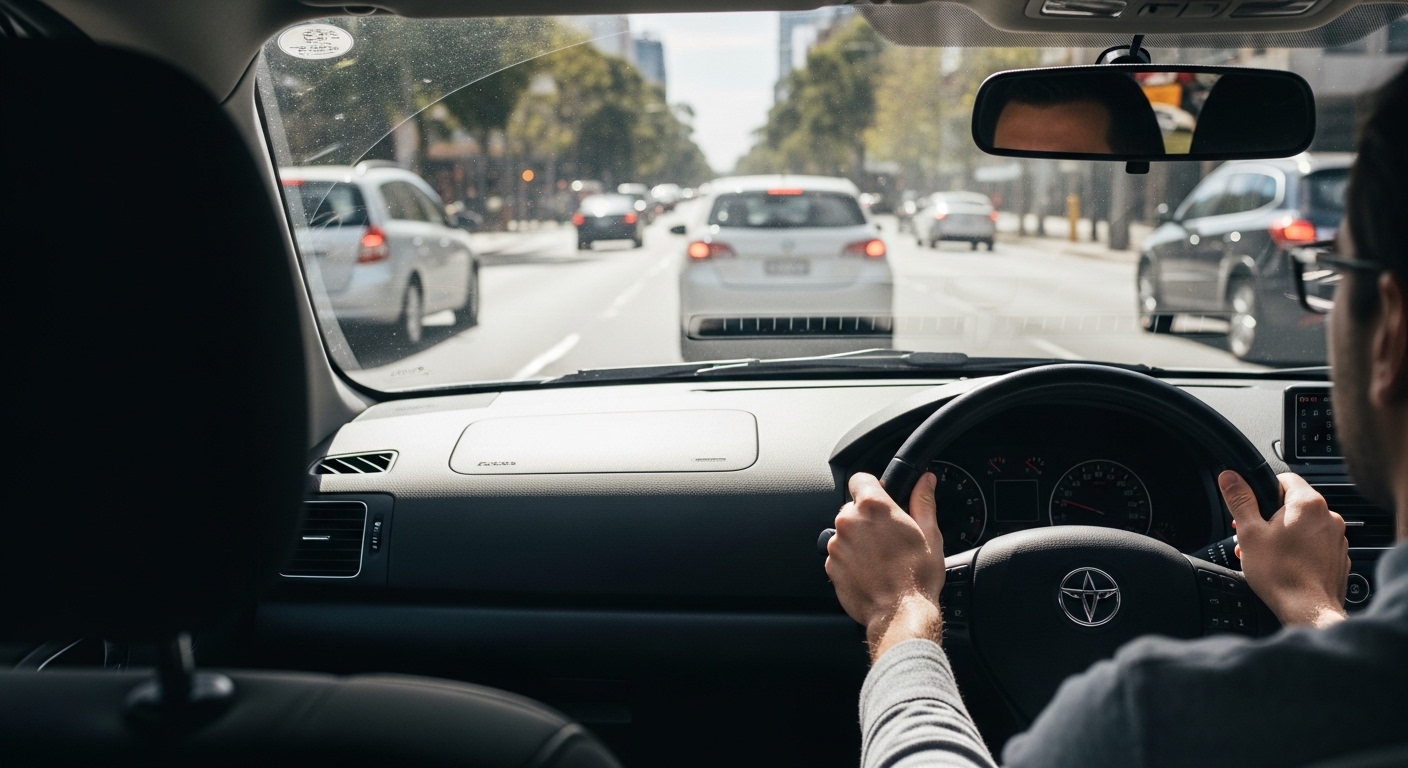 View from inside a right-hand-drive car following traffic on a sunlit urban road.
Rural limits demand more space, not less. Wet or gravel surfaces cut your braking grip, so adjust to what the road allows rather than what the sign permits. Dropping from 100 to 80 km/h reduces braking distance by around 36% (NRMA).
Trucks and large SUVs block your view of the road ahead. Drop back further so you can see around them, not just avoid hitting them. A good rule: if you can't see a truck's mirrors, the driver can't see you.
How Do Phones and Fatigue Put Drivers at Risk?
Distraction and tiredness are quietly among the biggest killers on Australian roads. Drivers on fewer than 5 hours of sleep are 4 times more likely to crash (TAC, 2024), and phone use remains illegal in every state, even at a red light.
Phones. AI-powered detection cameras now operate in New South Wales, Victoria, Queensland, and Western Australia. Fines vary widely by state.
| State | Mobile phone fine |
|---|---|
| Queensland | $1,295 |
| Western Australia | up to $1,000 |
| ACT | $632 |
| Victoria | $611 |
| South Australia | $556 |
| Northern Territory | $500 |
| New South Wales | $423 ($562 in school zones) |
| Tasmania | $390 |
Source: SpeedCam.com.au / Finder.com.au, 2025–26 figures.
The cameras are effective. Queensland issued around 114,000 phone fines in 2024 after human review of AI-flagged cases (WhichCar, 2025). Hands-free is not risk-free either, because the cognitive load persists even over Bluetooth. For a full state-by-state breakdown, see our guide to state-by-state fines and AI camera enforcement.
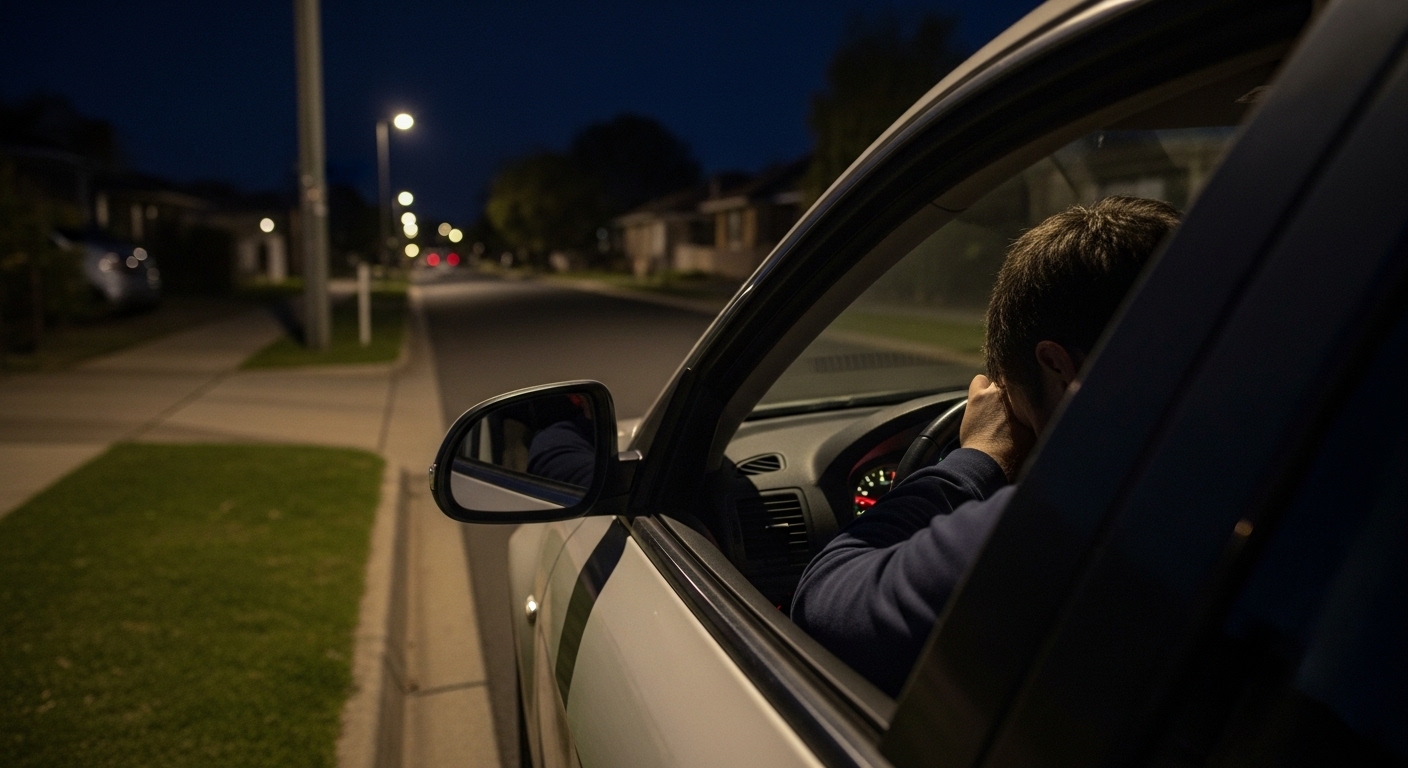 A fatigued driver sits in a parked car at night, when tiredness is hardest to fight.
Fatigue. Being awake for 17 hours or more produces impairment similar to a 0.05 blood alcohol reading, the legal limit in most states. Fatigue contributes to roughly 16 to 20% of Victorian fatal crashes each year (TAC, 2024), and 37.8% of surveyed Australians admitted a microsleep behind the wheel (Budget Direct, 2023). It's worst on long regional drives, where stimulation is low and autopilot creeps in.
Build these habits: stop at least every 2 hours on a long trip. Remember that four-wheel drive does nothing for fatigue. If you're yawning, blinking heavily, or drifting, pull over. Eating, fiddling with audio, or turning to talk all count too. Hands on the wheel, eyes on the road, is the minimum.
How Do You Handle Hazards at Intersections and Blind Spots?
Intersections sit consistently among Australia's highest-risk zones in crash data, which is why national road deaths climbed through 2025 (BITRE, October 2025). Approach every one assuming the other driver may not stop. Check both ways on a green light, and give way even when you have right of way if the alternative is a crash.
Before every lane change, run the sequence: mirrors, blind spot, mirrors again. Modern SUVs and utes carry big left-rear blind spots. If you're not certain the lane is clear, don't move. Certain enough isn't certain.
On motorways, match the speed of traffic before you merge, not after. Forcing others to brake for you starts a chain reaction behind. Signal early and hold your intention clearly.
At roundabouts, give way to anyone already in it, and indicate when you leave. Plenty of road users skip that, which leaves pedestrians and cyclists guessing at the kerb.
School zones run at 40 km/h during marked hours in most states. South Australia uses a presence-based rule instead: 25 km/h whenever children are visible. Pedestrians at marked crossings always have right of way, so slow well before the crossing, not as you reach it.
How Do You Drive Safely Around Wildlife and Australian Weather?
Australia has one of the highest rates of wildlife-vehicle collisions in the developed world. Insurers logged 23,840 wildlife collision claims between July 2024 and June 2025, averaging $8,000 in damage, with one in five vehicles written off (Suncorp/AAMI, 2025). Around 10 million native animals die on Australian roads each year (Australian Geographic, December 2024). Peak risk is dusk, dawn, and overnight — especially June to August when commute hours overlap with low light. Kangaroos, wallabies, wombats, and livestock can all appear on rural roads without warning. The cardinal rule: do not swerve. At 100 km/h, swerving to avoid an animal is more likely to cause a serious crash than holding your line is. Brake firmly in a straight line, hold the wheel, and stay in your lane. Dropping from 100 to 80 km/h cuts your braking distance by about 36% (NRMA), which matters most at dusk when visibility drops fast.
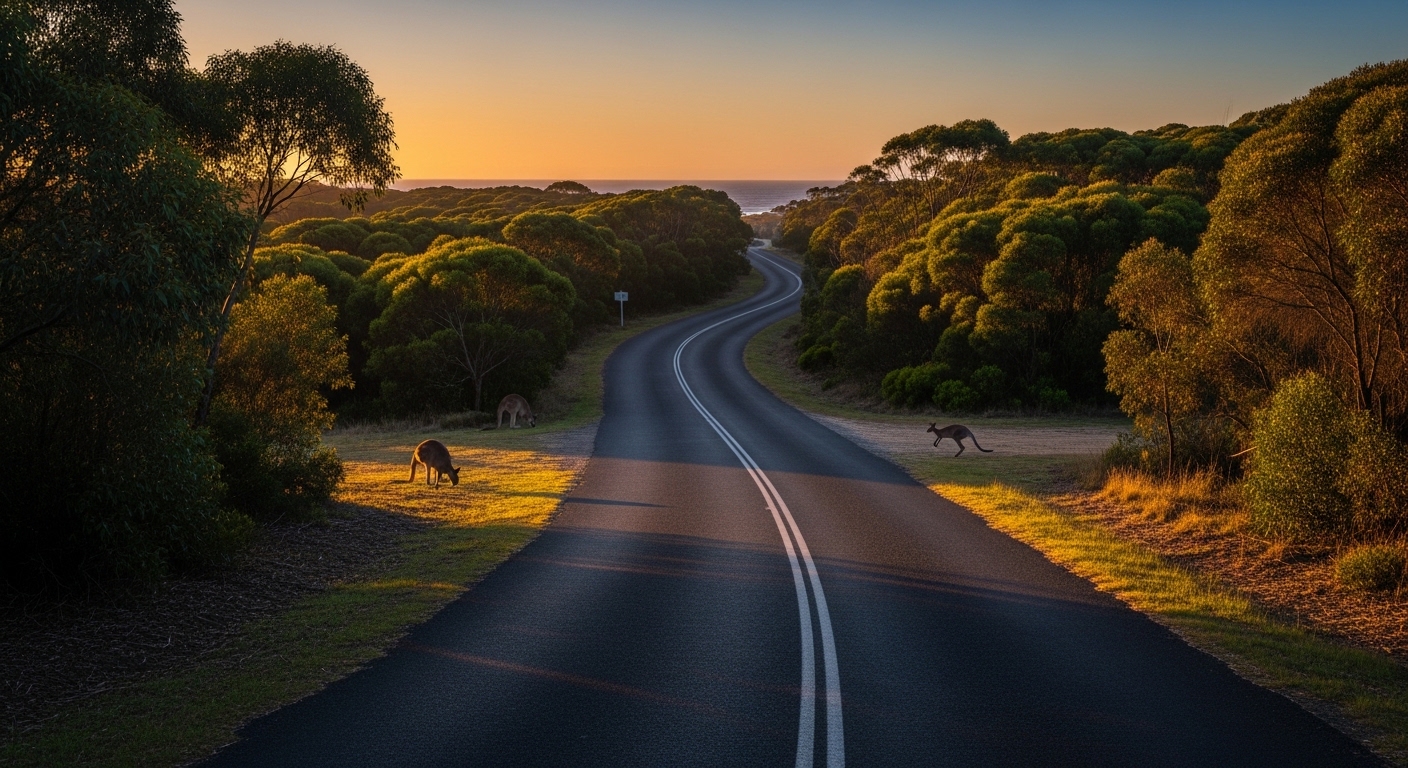 A winding bush road at dusk, when kangaroos and wallabies move closest to the road.
If you only drive inner-city at low speed, this risk is minimal. Regional and country road users face it most.
At night on country roads, use high beam when there's no oncoming traffic and drop it early for approaching cars. Scan the road edges, not just the centre line, and slow down so your stopping distance matches what you can see.
Wet weather brings its own hazard. Aquaplaning occurs when a film of water builds between your tyres and the road surface, reducing grip to near zero. It can start at speeds as low as 70–80 km/h on worn tyres in wet conditions, so reduce speed, avoid sudden steering, and double your following distance. Gravel and outback roads need lower speeds again. Dust hides oncoming traffic, and corrugations at speed can pull you off line.
Prepare Your Vehicle Before You Leave
A car in poor condition limits what any driver can do. Tyres, brakes, lights, and mirrors are the foundation, and worn tyres are the clearest example: at the legal minimum tread, wet-weather stopping distances can increase by up to 50% versus new tyres (Tyroola, 2024).
Tyres. Check tread depth and pressure monthly. The legal minimum in Australia is 1.6mm, but it's worth replacing well before that, and many experts suggest around 3mm. Under-inflated tyres lengthen braking distance and burn more fuel.
Brakes. Any sponginess, grinding, or pulling to one side means an inspection now, not later. Don't defer brake work.
Mirrors. Adjust them before every drive, not once at purchase. The centre mirror should frame the full rear window. Side mirrors should show just a sliver of your own car on the inner edge, with the rest covering the road.
Wipers and lights. A dead headlight at dusk or streaky wipers in a downpour are preventable failures. Check them.
Route planning. On long trips, know your stops and check the forecast. Avoid driving between midnight and 6am where you can, since crash rates run disproportionately high then. Our guide on how to prepare your car for a road trip covers the full pre-trip checklist.
The Car You Drive Also Plays a Role
Defensive driving skills reduce risk a lot. So does the vehicle underneath you. Modern active safety technology reinforces every habit in this guide: automatic emergency braking, lane departure warning, blind-spot monitoring, and adaptive cruise control all act as a second set of eyes.
Many Japanese-market vehicles from the late 2010s onward included these systems as standard fitment, often at price points below equivalent Australian-delivered cars. Toyota Safety Sense and Honda Sensing, for example, rolled out across mid-range Japanese models years ahead of local equivalents.
If safety is a priority when you're buying used, it makes sense to check what active safety features a specific car actually has, not just its ANCAP star rating. Two cars of the same model and year can differ.
Carbarn sources used cars locally in Australia and directly from Japan. You can browse used cars at Carbarn to see what's there and check the safety features listed on each vehicle.