




Ready to Hit the Road in Style?
Save money and reduce emissions with vehicles designed to deliver exceptional mileage. Visit our inventory and find a car that fits your lifestyle.
Ready to Hit the Road in Style?
Save money and reduce emissions with vehicles designed to deliver exceptional mileage. Visit our inventory and find a car that fits your lifestyle.
If you have been wincing every time you pull into the servo lately, you are not imagining it. Sydney unleaded averaged $2.255 per litre in early April 2026 (NRMA Weekly Fuel Report, 6 April 2026), and a typical petrol hatch is now costing the average Aussie driver well over $1,700 a year just in fuel.
So it makes sense that more buyers are walking past the shiniest badge on the lot and asking a much simpler question: which used car will actually leave more money in my pocket each fortnight?
This guide is built around an answer to exactly that question. Instead of pointing you at a brand-new Corolla or RAV4 you cannot realistically afford, the picks below are used Japanese-market hybrids that make real sense on the Australian used market, organised by budget, with fuel-economy figures pulled from official manufacturer data.
Key Takeaways
Sydney petrol hit $2.255/L in April 2026 (NRMA) - switching from a 7L/100km petrol hatch to a 3.4L/100km used hybrid saves an estimated $900+ per year in fuel alone.
The strongest under-$25K used hybrid picks are the Toyota Yaris Hybrid (30.2km/L WLTC) and Nissan Note e-POWER (29.5km/L WLTC), both typically sitting in the low-$20K range on the Australian used market.
For families needing seven seats, the Toyota Noah Hybrid still saves an estimated $1,200+ per year compared to a typical petrol people mover, even though it sits at the larger end of the shortlist.
In this guide you will find:
a budget-organised shortlist of used cars that genuinely cut fuel costs
official WLTC fuel-economy figures verified against Toyota and Nissan spec data
a real annual fuel cost estimate for each model at current Sydney pump prices
buyer-fit notes so you can match a model to how you actually drive
Why Fuel Economy Matters More Than Ever in Australia Right Now
At current Sydney prices, switching from a 7L/100km petrol car to a 3.4L/100km used hybrid saves an estimated $900 per year in fuel alone, before you even start counting cheaper servicing or lower wear on brakes. That is real money, not a marketing line.
The pump number is the easy bit. Sydney unleaded averaged $2.255 per litre in early April 2026, and earlier in the year it spiked above $2.30 per litre on Middle East supply pressure. Budget Direct's most recent driver survey put the average refuel cost at $73.10 in 2023 (Budget Direct Survey of Australian Drivers, 2023), and that number has only headed in one direction since.
Now layer on how far we actually drive. The most recent ABS Survey of Motor Vehicle Use puts the average Australian passenger car at around 11,100 kilometres a year. Multiply that by today's pump prices and you can see why fuel cost is now the single biggest running expense for most household cars.
It hits even harder in Sydney. Long commutes, limited public transport in many outer suburbs, and a sprawling metro area mean a lot of households cannot just "drive less" their way out of the problem. Cutting your fuel bill in half means choosing a more efficient car, full stop.
That is why this guide leans hard on hybrids. At the price tiers most buyers are working with, $20K, $30K, $40K, there is no diesel and no petrol option that comes close to the running cost of a well-chosen used hybrid.
If you want a broader look across the new-car market too, our guide to the most fuel efficient cars in Australia covers the wider field.
How We Picked These Cars (And What "Fuel Savings" Actually Means)
This shortlist is built around official WLTC fuel-economy figures pulled from Toyota and Nissan Japanese specification documents, the cleanest apples-to-apples benchmark for comparing used Japanese-market hybrids. Real-world numbers will always vary a bit, but the WLTC test is the most consistent baseline you can use across different models.
A few ground rules for this list:
Every pick is a hybrid. At these price tiers, no petrol or diesel option comes close on running cost.
Realistic Australian availability. Every pick is a model that genuinely turns up on the Australian used market at the price band quoted, whether through local supply or Japanese import.
Three budget tiers. Under $25K covers compact commuters. $25K to $35K opens up small SUVs and family vans. $35K to $45K adds newer, lower-kilometre hybrids and larger people movers.
No new cars, no EVs. The new-car market and full EV buyer guides are covered separately. This guide focuses on used hybrids because that is where the fuel-savings maths currently lands hardest.
One more thing worth being upfront about. WLTC numbers are test-cycle figures, not guaranteed real-world results. Most owners see real-world economy that is roughly 15 to 20 per cent worse than the official figure, which is normal. The relative ranking between cars still holds, which is what matters when you are comparing options.
What Does Each Model Actually Cost to Run Per Year?
Before diving into the picks, here is a table that puts the WLTC numbers into the language most buyers actually care about, dollars per year. The figures use the ABS average of 11,100km per year and the NRMA Sydney average of $2.255 per litre.
Our calculation, in plain English: A used Yaris Hybrid driven the average Australian distance saves around $920 a year in fuel compared to a typical petrol hatch, about $77 a month back in your pocket. For a family stepping out of a petrol people mover into a Toyota Noah Hybrid, the saving climbs to roughly $1,238 a year. These are estimates based on official WLTC figures, ABS average kilometres, and the current NRMA Sydney pump price. Real driving will vary.
These numbers are not theoretical. They are the reason fuel-savings buyers keep ringing in asking the same question: which one of these will actually give me the biggest bite out of my fuel bill?
Which Used Cars Under $25,000 Save the Most Fuel?
The two clearest picks under $25,000 for fuel savings are the Nissan Note e-POWER X (29.5km/L WLTC) and the Toyota Yaris Hybrid X (30.2km/L WLTC), both typically sitting in the low-$20K range on the Australian used market. Both are easy to recommend if your driving is mostly commuting and errands.
Nissan Note e-POWER X (E13)
The Nissan Note e-POWER X is the easiest entry point into hybrid running costs without stretching the budget. Clean 2021 examples typically sit in the low-$20K range, and it is the cheapest way into this entire shortlist.
.png)
Nissan's official WLTC figure for the FWD E13 Note is 29.5km/L, or about 3.4L/100km. That works out to roughly $848 a year in fuel at current Sydney prices and average annual kilometres, which is around $900 less than a typical older petrol hatch.
The e-POWER setup is part of why it works so well around town. The petrol engine acts as a generator while an electric motor actually drives the wheels, so the car feels smooth and EV-like in traffic without ever needing to be plugged in. For stop-start city and suburban driving, that is exactly the kind of system that puts the biggest dent in your fuel bill.
Best for: budget commuters, first-time hybrid buyers, urban drivers stepping out of an older petrol hatch.
Toyota Yaris Hybrid X (MXPH15)
The Toyota Yaris Hybrid X is the strongest official-economy figure in this entire guide. Toyota lists the MXPH15 Yaris Hybrid X at around 30.2km/L WLTC, which is roughly 3.3L/100km, a very strong number for a practical five-door hatch.
.png)
A 2020 example typically sits in the low-$20K range, with 2022 4WD variants in the mid-$20K range if wet weather grip matters in your area. Estimated annual fuel cost at average Australian kilometres? About $830 a year.
What makes the Yaris Hybrid the easy recommendation is balance. Sensible price, very strong economy, easy to park, easy to live with day to day. It is a car that quietly does its job and stops you from thinking about petrol.
Best for: commuters who want the absolute lowest running costs, drivers who want a no-fuss small car that just gets on with it.
Toyota Sienta Hybrid G
If you want a compact seven-seater at this price, the Toyota Sienta Hybrid G is worth flagging. It is a hybrid mini people mover with sliding rear doors, and clean imported examples typically land in the low-$20K range before on-road costs.
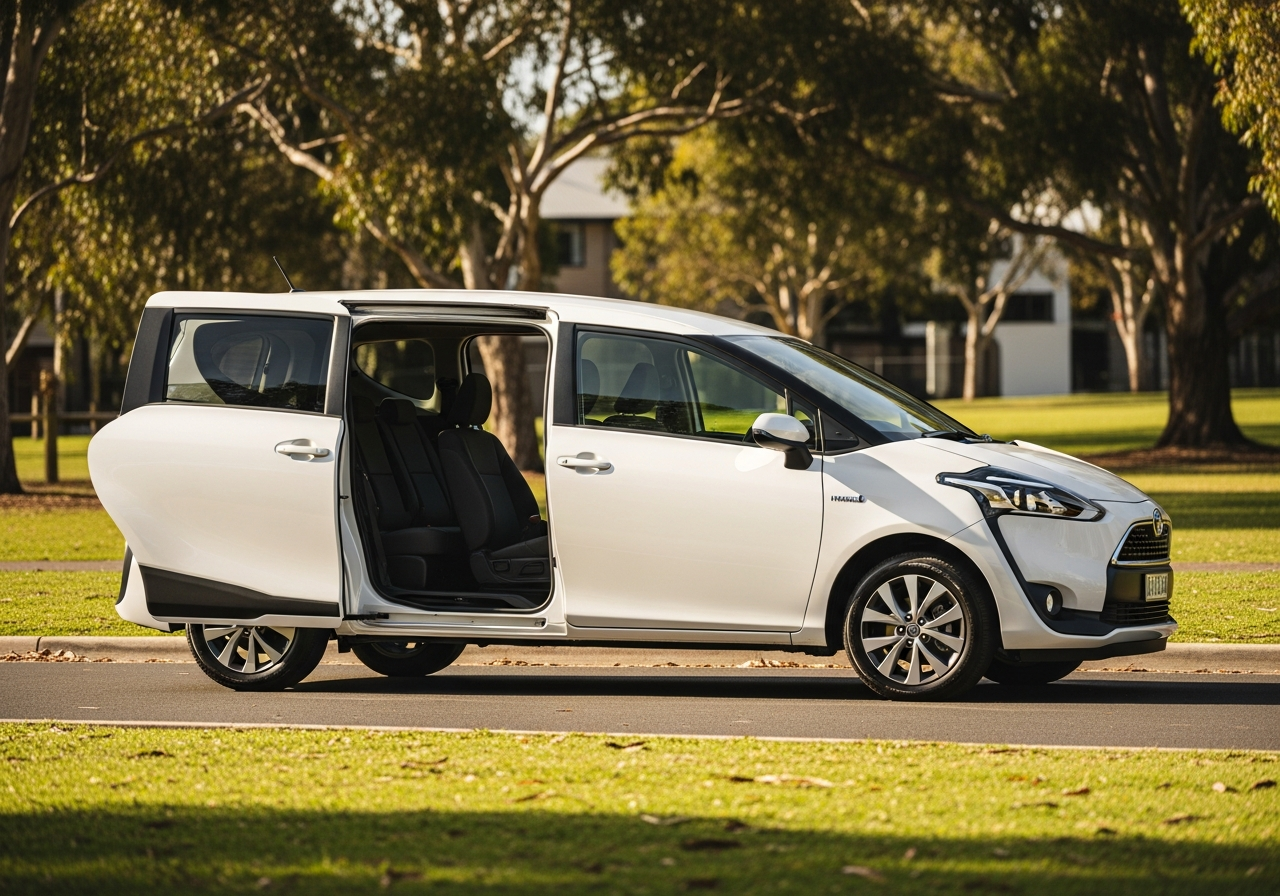
The Sienta does not show up often on Australian dealer lots, so it is usually a Japan-import shortlist candidate rather than a walk-in buy. If you want a small seven-seat hybrid and you are not in a hurry, it is one of the most interesting under-$25K options on the broader market.
What Are the Best Fuel Savers Between $25K and $35K?
Step into this budget and the shortlist opens up. You can move into a fuel-efficient small SUV, a more polished compact hybrid, or a genuine seven-seat family van, all with official fuel economy that comfortably beats anything petrol can offer at the same price.
Toyota Raize Hybrid G / Z (A202A)
The Toyota Raize Hybrid is the standout pick in this tier if you want the higher seating position and SUV practicality of a small crossover without giving up at the pump. Toyota lists the hybrid A202A Raize at 28.0km/L WLTC, or about 3.6L/100km.
.png)
A 2022 G variant typically sits in the high-$20K range, and a newer 2023 Z grade lands just under the $30K mark. Estimated annual fuel cost? Roughly $895 a year, barely more than a Yaris Hybrid, in a car that drives and feels noticeably more like a small SUV.
For a lot of buyers, that is the sweet spot. You get the upright driving position, the higher view of the road, and the "small SUV" practicality without slipping back toward the kind of fuel use a petrol crossover would punish you with.
Best for: buyers who want SUV feel and visibility without the petrol-SUV running costs.
Nissan Aura G Leather Edition (FE13)
The Nissan Aura G Leather Edition is the more upmarket pick in this group. It is essentially a more polished, better-equipped version of the Note e-POWER, with a cabin that feels noticeably more grown-up.
.png)
Nissan lists the FE13 Aura G at 27.2km/L WLTC, or about 3.7L/100km. That works out to roughly $921 a year in fuel at current Sydney prices. 2023 Aura G Leather Edition examples typically sit in the low-$30K range, with Nismo variants in the mid-$30K range.
The trade-off versus the cheaper Note is straightforward: a bit more money up front for a car that feels noticeably nicer to spend time in. If you do a lot of kilometres and want your daily driver to feel a little more substantial, the Aura makes a strong case.
Best for: buyers who want a small hybrid that feels polished and well-equipped, not budget-basic.
Toyota Noah Hybrid X (ZWR80G)
Need seven seats? This is where the conversation changes. The Toyota Noah Hybrid (and its mechanical twin, the Voxy) is one of the few honest fuel-saving picks for families that need a real people mover.
.png)
Toyota's official WLTC figure for the ZWR80G Noah Hybrid is 19.8km/L, about 5.1L/100km. (You may see older sources quoting 23.8km/L for the same car, but that is the older JC08 cycle figure. WLTC is the current standard and the more conservative number.)
At $2.255 per litre and 11,100km a year, that works out to around $1,264 a year in fuel. That is more than the smaller cars in this guide, but the comparison that matters here is against a typical petrol people mover at around 10L/100km, which would cost an estimated $2,502 a year. In other words, choosing the Noah Hybrid over a petrol people mover saves a family around $1,238 every year, every year you own it.
A 2020 Noah X typically sits around the $30K mark, with higher-spec examples in the high-$30K range. The Voxy variant usually lands in the mid-$30K range. All three give you eight seats, sliding rear doors, and the kind of cabin space families actually need.
Best for: growing families who need genuine seven-seat space without paying petrol-people-mover fuel costs.
If a family hauler is what you are after, our guides on used 7-seater hybrids and the wider 7-seater used cars range are worth a read alongside this one.
Honda Vezel and Toyota C-HR — Worth a Look
Two more cars in this tier are worth a brief mention even if they are not the headline picks.
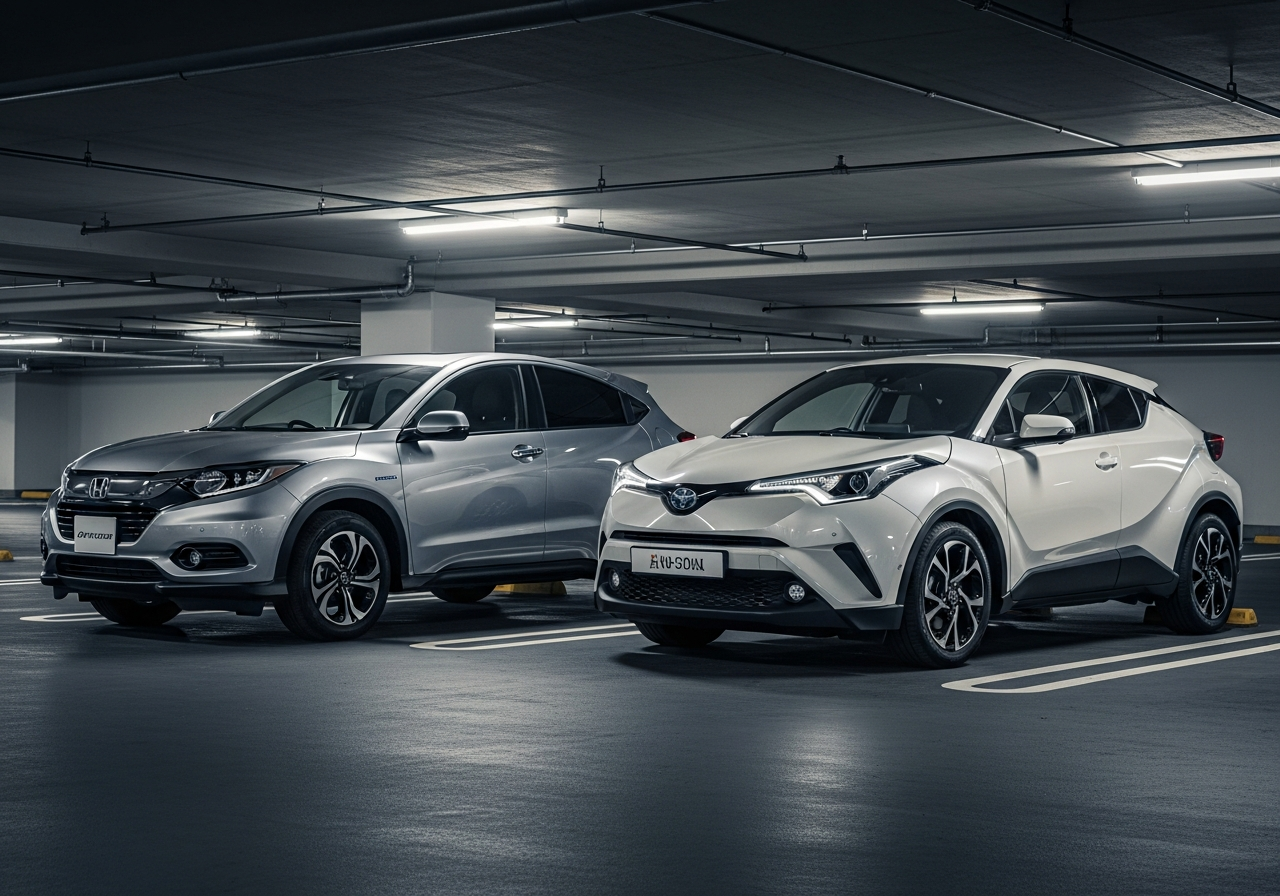
The Honda Vezel Z Honda Sensing (RU3) is a small hybrid SUV with Honda's full safety suite, typically in the high-$20K range. The Toyota C-HR S Hybrid (ZYX10) is the design-led small SUV, usually landing in the high-$20K range too. Both are honest fuel-saving small SUVs and either is a sensible step up from a petrol crossover. Always worth checking the specific economy figures with us before you commit, since trim and year affect the official numbers.
$35,000 to $45,000 — When Budget Allows Newer, Lower-Kilometre Hybrids
Push the budget into the upper bracket and the shortlist shifts toward newer cars with lower kilometres, more modern features, and in some cases more space. You are not chasing the absolute best km/L figure here. You are chasing a better overall package while still keeping running costs sensible.
Toyota Prius G 4WD (MXWH65)
The Toyota Prius G 4WD is the headline pick in this tier. A 2024 example with just 5,881km on the clock typically sits in the mid-$40K range, effectively a near-new hybrid at a used price.
.png)
Toyota lists the MXWH65 Prius G E-Four at 26.7km/L WLTC, or about 3.7L/100km. That works out to around $939 a year in fuel at current Sydney prices. The E-Four AWD system is the unusual touch here, you very rarely get all-wheel drive at this kind of efficiency.
It is not the outright km/L winner in this guide, and it does not pretend to be. What it offers instead is a current-generation Prius with very low kilometres, a more substantial feel than the smaller hatchbacks, and real-world running costs that still embarrass anything petrol-powered at this price.
Best for: high-kilometre drivers who want the most modern hybrid package without paying new-car money.
Nissan Serena e-POWER Highway Star V (HFC27)
The Nissan Serena e-POWER is the eight-seat people mover option in this tier, typically in the high-$30K range. It uses Nissan's e-POWER hybrid system in a full-size family van body, which is a relatively rare combination. If you have the budget and you need eight seats with sliding doors, it is worth having on the shortlist alongside the Noah and Voxy.
.png)
We always recommend checking the specific WLTC figure with us for the exact car, since e-POWER people movers vary a bit by spec.
Toyota Noah X (Higher Spec, ZWR80G)
A higher-spec Toyota Noah X typically sits in the high-$30K range. Same 19.8km/L WLTC figure as the cheaper Noah, but a step up on equipment and condition. If you wanted the family-van pick from the previous tier but in a tidier example, this is the natural step up.
.png)
For a deeper look at the broader category, our used hybrid cars guide covers the full hybrid lineup beyond just fuel-savings picks.
Which One Actually Suits You?
Picking the right used fuel saver is less about choosing the one with the best official number and more about matching the car to how you actually drive. Here is the short version.
Solo commuter or couple, mostly urban driving → the Nissan Note e-POWER or Toyota Yaris Hybrid, both under $25K and both around 3.3 to 3.4L/100km.
Small family that wants a higher driving position → the Toyota Raize Hybrid, $27K to $30K, 3.6L/100km, small-SUV practicality without the fuel penalty.
You spend a lot of time behind the wheel and want a more polished cabin → the Nissan Aura G, around $31K to $34K, 3.7L/100km.
Family of five plus, sliding doors, real seven-seat space → the Toyota Noah Hybrid in the $29K to $38K range, still saving roughly $1,200 a year against a petrol people mover.
You want a near-new hybrid with the most modern feel → the Toyota Prius G 4WD, around $43K, very low kilometres, AWD efficiency.
Open to ordering from Japan and want a compact seven-seater → the Toyota Sienta Hybrid, available through our import service.
If two cars feel close, the tiebreaker is usually how the car fits into your life, boot space, parking, who is in the back seat, not the last 0.2km/L on a spec sheet.
What to Check Before Buying a Used Hybrid for Fuel Savings
A used hybrid with a tired battery will not deliver its official fuel economy figures. That single point is the most important thing most first-time hybrid buyers skip past, and it is the easiest way to get burned. The good news is that the checks are not complicated.
Battery health. Ask about the hybrid battery state of health and any reports the seller has on hand. A healthy hybrid battery is the difference between living up to that WLTC number and watching your fuel bill quietly creep back toward petrol territory.
Service history. Hybrids share most of their service items with regular cars. A clean book and consistent intervals are a strong signal.
Odometer versus year balance. A 2021 car with 80,000km has had a different life to a 2021 car with 12,000km. Neither is automatically better, just match it to your expectations.
Real-world expectation. Plan for real-world economy roughly 15 to 20 per cent worse than the official WLTC figure. That still leaves these cars miles ahead of petrol.
Pre-purchase inspection. Always worth it for a used hybrid. Worth it twice over for an older one.
For hybrid-specific upkeep tips once you have bought, it is worth checking service intervals, battery condition reports, and brake wear patterns before handover.
Buying One Without the Usual Headache
Once you have worked out which fuel-saver shape suits you best, the next step is finding a car that is actually available, clearly priced, and easy to enquire on. That is where we can help.
Carbarn is a Sydney-based used car business based in Lidcombe that specialises in Japanese-market hybrids, exactly the kind of cars that dominate this guide.
Two things make buying through us a bit different to most:
Inspected, compliance-ready hybrids. Our used hybrid range is online with live pricing, so you can browse models like the Yaris Hybrid, Note e-POWER, Raize Hybrid, Aura, Noah Hybrid and Prius, compare them, and enquire on a specific car.
Models we can source from Japan. If you have your heart set on a Sienta Hybrid, a newer Note, or a variant that is harder to find locally, we can source it through our Japan import service. Pricing depends on spec, year, and auction grade, but it means your shortlist is not limited to what happens to be on the Australian market today.
If you are not sure which path makes sense for you, that is exactly the conversation we are happy to have. Most of the buyers we talk to start by telling us their budget and how they actually drive, not a model name.