


Ready to Hit the Road in Style?
Save money and reduce emissions with vehicles designed to deliver exceptional mileage. Visit our inventory and find a car that fits your lifestyle.
Ready to Hit the Road in Style?
Save money and reduce emissions with vehicles designed to deliver exceptional mileage. Visit our inventory and find a car that fits your lifestyle.
Toyota Australia lists the current LWB HiAce at 5,265mm long, while the SLWB stretches to 5,915mm (Toyota Australia spec sheet, 2025). Most people searching those numbers are not doing it for fun. They want to know if the van will fit a garage, a pallet, a bed platform, or a camper plan without an expensive mistake.
Quick Answer
- Current Australian HiAce sizing is mainly a choice between LWB at 5,265mm and SLWB at 5,915mm.
- The SLWB adds 650mm in both overall length and wheelbase.
- Cargo volume jumps from 6.2m3 to 9.3m3.
- Standard, middle and high roof usually refer to imported H200 naming, with current overall heights spanning about 1,980mm to 2,285mm depending on variant.
- Toyota says its dimensions are approximate, so confirm before fitting accessories.
Sources: Toyota Australia spec sheet, 2025; Toyota Japan HiAce van spec PDF, 2026.
Here is the big source of confusion: Australian buyers often mean two different things when they say "HiAce dimensions". This guide focuses first on the current Australian H300, sold here as LWB or SLWB. It then translates the imported H200 roof language that still shows up in ads and forum chats. That split keeps the intent clear, then explains what the numbers mean in real life.
At-a-glance: current Australian HiAce dimensions
| Variant | Length | Width | Height | Wheelbase | Load length | Internal height | Cargo volume | Best fit |
|---|---|---|---|---|---|---|---|---|
| LWB | 5,265mm | 1,950mm | 1,990mm | 3,210mm | 2,530mm | 1,340mm | 6.2m3 | Easier day-to-day work, tighter parking, lighter camper plans |
| SLWB | 5,915mm | 1,950mm | 2,280mm | 3,860mm | 3,180mm | 1,615mm | 9.3m3 | Pallets, taller fit-outs, roomier camper builds |
Source: Toyota Australia spec sheet, 2025.
Quick H200 naming reference
| H200 language buyers still see | Typical height range |
|---|---|
| Standard roof | around 1,980mm |
| Middle roof | around 2,105mm |
| High roof / extra high roof | around 2,240mm to 2,285mm |
Source: Toyota Japan HiAce van spec PDF, 2026.
[CHART: Grouped bar chart comparing current Australian HiAce LWB and SLWB for overall length, height and wheelbase. Source: Toyota Australia spec sheet, 2025.]
What are the official Toyota HiAce dimensions in Australia?
Toyota Australia’s August 2025 spec sheet puts the current LWB HiAce at 5,265mm long, 1,950mm wide and 1,990mm high, while the SLWB measures 5,915mm long, 1,950mm wide and 2,280mm high (Toyota Australia spec sheet, 2025). For Australian buyers, those are the numbers that should lead the conversation.
That matters because a lot of older pages still mix H200 and H300 figures together. If you are checking garage clearance, carpark height, roof racks, shelving or a camper fit-out, start with the current local H300 figures first. Toyota also notes that dimensions are approximate, so it is worth confirming the exact vehicle before ordering accessories or booking custom joinery.
The wheelbase figures are just as important as the overall length. The LWB sits on a 3,210mm wheelbase, while the SLWB stretches to 3,860mm, according to the same Toyota Australia source. Why does that matter? Because wheelbase usually tells you more about usable layout space than the badge does.
The current Australian range is best thought of as LWB, LWB Crew and SLWB. The LWB Crew shares the same broad current-shape context, but its second row changes the usable rear area, so most size shoppers are really choosing between the standard LWB van footprint and the taller, longer SLWB body.
Why do buyers still see standard, middle and high roof HiAce terms?
Toyota Japan’s current H200 HiAce material spans roughly 1,980mm to 2,285mm in overall height, depending on roof, body and drivetrain (Toyota Japan HiAce van spec PDF, 2026). That is why standard roof, middle roof and high roof labels still show up everywhere, even when an Australian buyer is really asking about the newer H300.
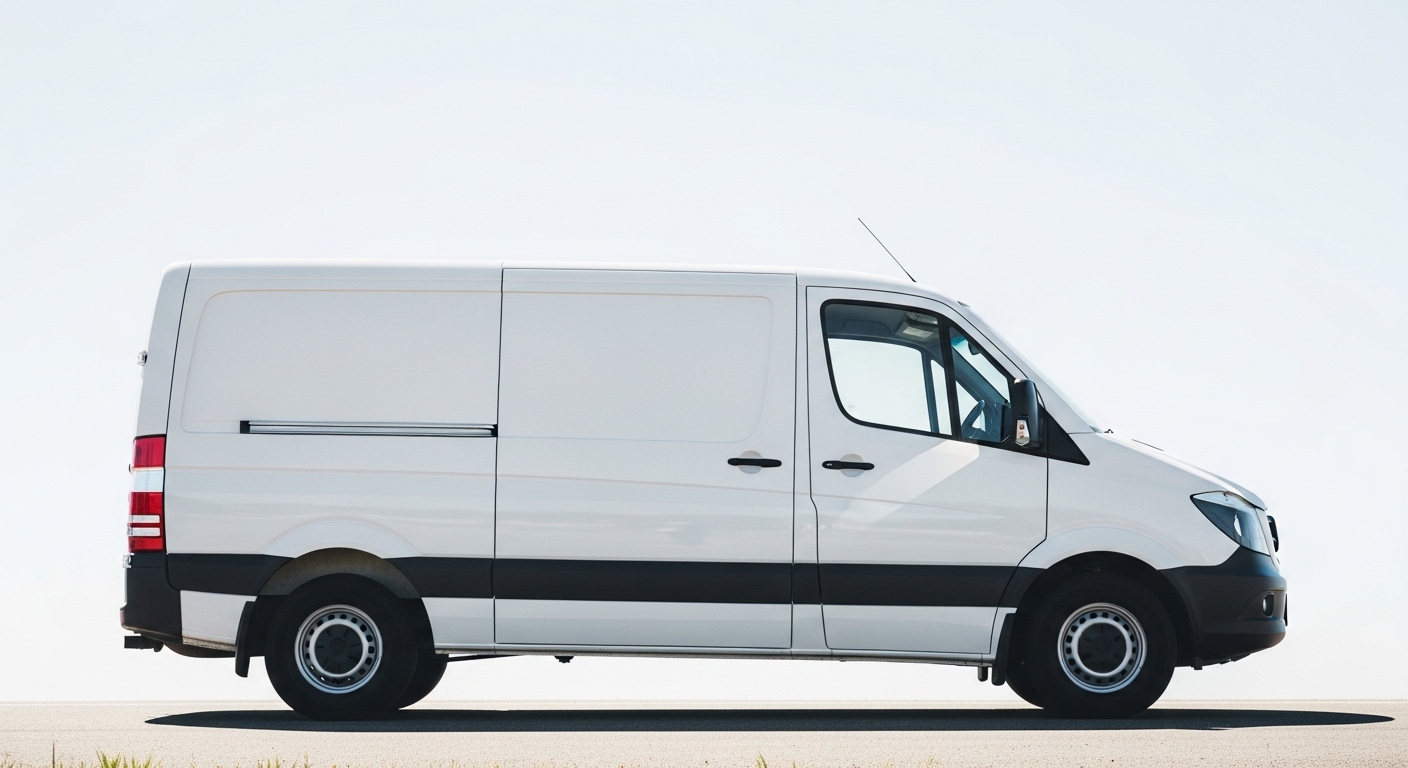 White cargo van parked in side view against a plain background
Current local HiAce talk is cleaner if you use LWB and SLWB. Imported H200 talk is cleaner if you use standard roof, middle roof and high roof. Mix those together, and buyers end up comparing different generations as if they are the same van. That is where bad garage-fit and camper-fit assumptions usually start.
If you are cross-shopping model-code imports, pages like the Toyota HiAce KDH201 import guide and Toyota HiAce GDH201 import guide are more useful than generic roof labels, because the code tells you which family you are actually looking at. If the import process itself is new to you, this plain-English piece on Japan car imports explained helps.
In our experience with HiAce enquiries, the most common mix-up is simple: buyers use H200 roof language to answer an H300 parking or fit-out question. Sounds harmless, right? It is not. One wrong generation can throw your height assumption out by hundreds of millimetres.
Toyota HiAce LWB vs SLWB, what changes in real life?
The step from LWB to SLWB is bigger than it sounds, because Toyota’s own figures show a 650mm jump in overall length, a 650mm jump in wheelbase and a 290mm jump in height (Toyota Australia spec sheet, 2025). In practice, that means a very different parking, loading and build-out experience.
The LWB is usually the easier all-rounder. At 1,990mm tall, it is the friendlier choice if height limits worry you. It also feels more manageable if most of your life is suburban streets, loading bays and regular commuting. Plenty of buyers do not need more van than that.
The SLWB earns its keep when your plan depends on volume, standing room, longer cargo, or pallet logic. Toyota’s figures show the SLWB load length also grows by 650mm, from 2,530mm to 3,180mm. That is the difference between "I can make this work" and "this layout finally makes sense".
[CHART: Delta chart showing the increase from LWB to SLWB in overall length, wheelbase, height and load length. Source: Toyota Australia spec sheet, 2025.]
Toyota’s 2025 brochure adds one especially practical note: standard Australian pallets fit the SLWB only (Toyota Australia brochure, 2025). If that is part of your work life, the decision gets easier very quickly.
What are the internal cargo dimensions of a Toyota HiAce?
Toyota Australia lists the LWB at 2,530mm of cargo length, 1,760mm of internal width, 1,340mm of internal height and 6.2m3 of cargo volume, while the SLWB grows to 3,180mm, 1,760mm, 1,615mm and 9.3m3 (Toyota Australia spec sheet, 2025). Those are the key numbers for shelves, drawers, bikes, beds and work gear.
The biggest trap is treating brochure space as fully usable space. It rarely is. Once you add wall lining, cabinetry, a cargo barrier, flooring, batteries or a bed frame, the van shrinks quickly. That is why maximum internal width is helpful, but not the whole story.
[CALLOUT: CarsGuide measured width between the current-shape HiAce wheel arches at 1,268mm, far less than the 1,760mm maximum internal width. Source: CarsGuide, 2019.]
That wheel-arch number matters more than many buyers expect. If you are loading sheet goods, building drawers or planning a bed platform, the pinch point often decides the layout. For a deeper camper-focused view, this Toyota HiAce campervan guide is a useful next read.
Can you fit a queen mattress in a HiAce?
An Australian queen mattress is 153cm by 203cm in common consumer guides, with Sealy listing the exact standard as 152.5cm by 203cm (Koala, 2026; Sealy, 2026). On paper, both current HiAce cargo lengths are long enough, but width is the part that catches people out.
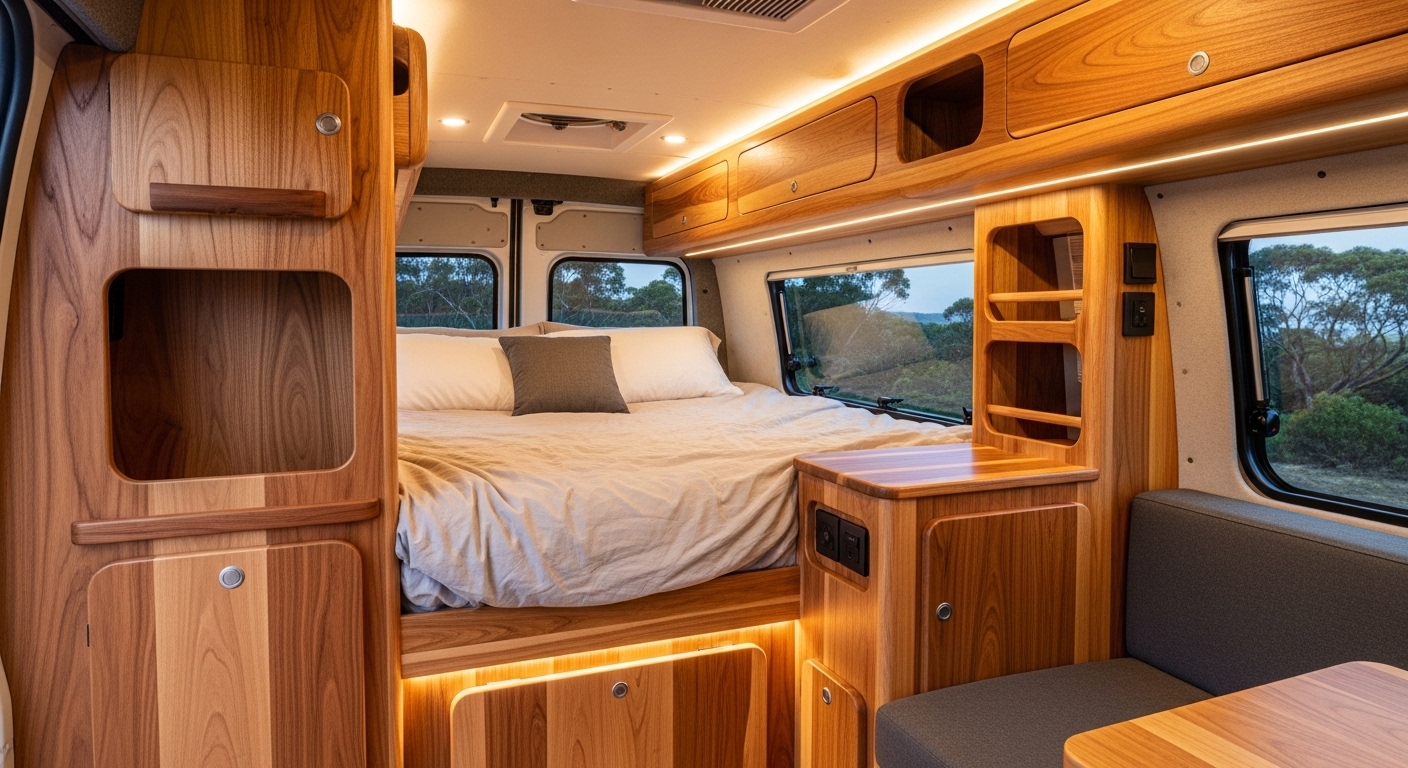 Wood-lined camper van interior with bed platform and built-in storage
Length is actually the easy part. A 2,030mm queen leaves about 500mm spare in the LWB and about 1,150mm spare in the SLWB, based on Toyota’s official load lengths (Toyota Australia spec sheet, 2025). The problem is width. Against the HiAce’s 1,760mm maximum internal width, a queen leaves only about 230-235mm total margin before you account for trim, wall lining or cabinets.
That is why a flat floor mattress plan often looks easier in a brochure than in a real van. The wheel arches narrow the practical width to 1,268mm in CarsGuide’s cargo table (CarsGuide, 2019). So if you want a queen, a raised platform or a side-to-side compromise usually makes more sense than assuming it will sit neatly on the floor.
Standing room needs the same honesty. Toyota lists current internal height at 1,340mm in the LWB and 1,615mm in the SLWB before added floor and lining (Toyota Australia spec sheet, 2025). Many adults still will not fully stand upright in a standard build. If full standing room is the dream, a pop-top or a different layout often matters more than the mattress itself.
Which HiAce size makes the most sense for work, travel or camper use?
Toyota’s own material points buyers in a pretty clear direction: the LWB is the easier everyday van, while the SLWB is the stronger fit if your plan depends on pallet use, longer cargo, more internal height or a roomier camper layout (Toyota Australia brochure, 2025). That is the simple version most buyers actually need.
Choose the LWB if you mostly drive in town, need a van that is easier around carparks, and do not need every last millimetre of load length. Choose the SLWB if the van is a tool first, or if your fit-out depends on that extra 650mm and taller load space. If you are cross-shopping imported H200s, keep roof labels and body codes front of mind so you do not compare the wrong generation.
[CHART: Decision matrix comparing best fit for city work, pallet use, camper layout, garage-sensitive parking and 4WD touring. Sources: Toyota Australia brochure, Toyota Australia spec sheet, Toyota Japan H200 spec PDF.]
Used HiAce listing pages as a shape reference
The used Toyota Hiace cars for sale in Australia page is still a useful real-world reference because it lets you browse HiAce listing photos and basic vehicle details in one place. Use it as a broad comparison page, not as proof of one fixed year, fuel type or odometer reading.
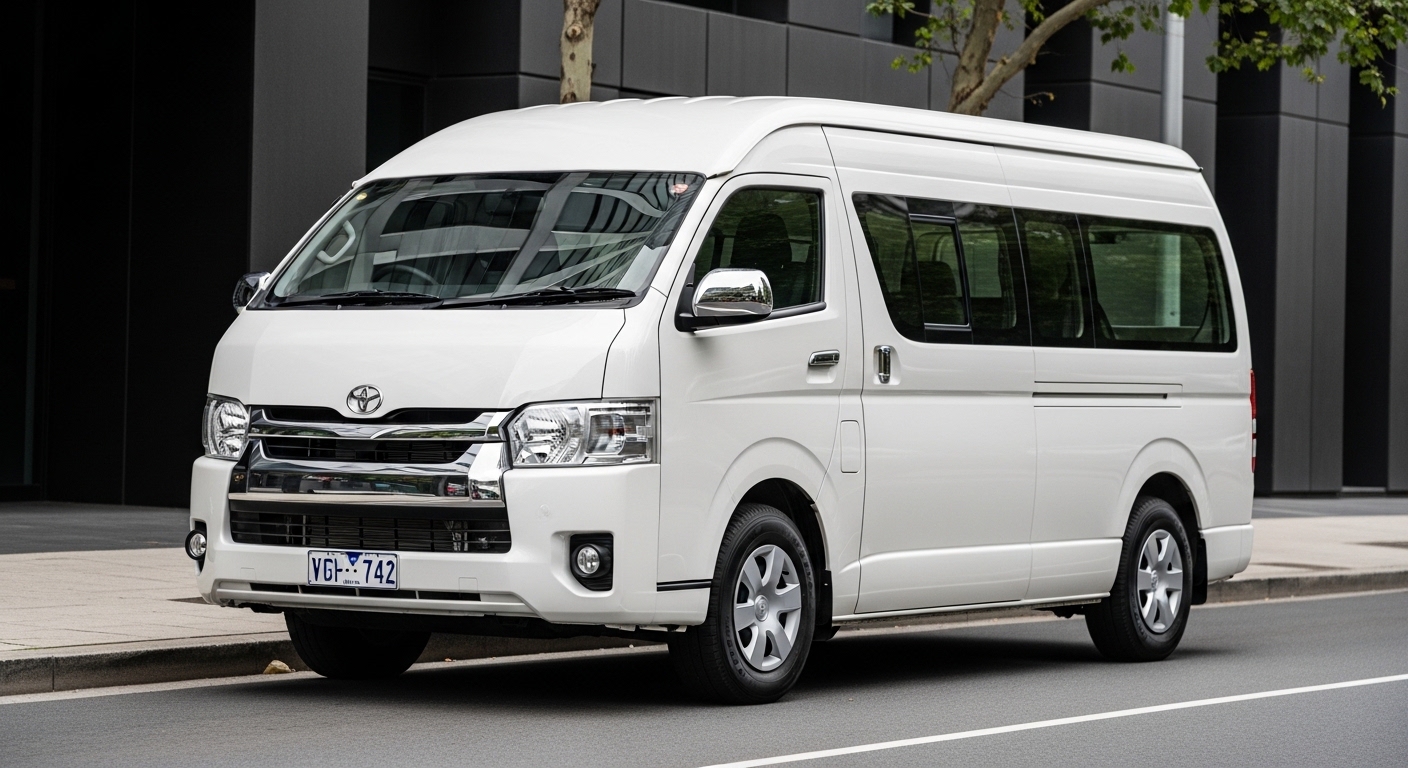 Toyota HiAce example image
What makes that page useful in this guide is not a sales pitch. It is the context. Listing pages can help you separate broad HiAce body shapes before you get too deep into roof labels or camper plans. If you are comparing older roof-language imports, the Toyota HiAce KDH206 import guide is a useful model-code reference.
Where should buyers look if they want a HiAce in Australia?
Public import guidance often puts auction-sourced vehicles at roughly 6-10 weeks, and code-specific HiAce import pages often allow 1-4 weeks for VIA approval before shipping. Once you know the height, wheelbase and cargo space you actually need, the buying path becomes much easier.
If you already know a locally available HiAce body style suits you, start with live browsing pages such as used Toyota Hiace cars for sale in Australia or Toyota HiAce 4WD vans in Australia. That is the simplest path if you want to compare body shape, fuel type and practical fit without first learning model codes.
If the right version is more likely to come from Japan, use importing a Toyota HiAce from Japan as the broad starting point, then narrow down with the relevant code pages. It also helps to understand the import, compliance and road-registration steps before you commit.
If you want one team to handle both paths, Carbarn can help with locally available used vehicles, Japan-sourced model searches, pre-bid inspection where possible, customer-approved auction bidding, import approval support, shipping coordination, in-house compliance through its Sydney workshop, AVV and RAV processing support, finance, warranty options on eligible vehicles, and nationwide delivery guidance. The key is to bring your real dimension needs first: garage height, pallet fit, bed platform width and whether you are comparing H300 or H200.