



Ready to Hit the Road in Style?
Save money and reduce emissions with vehicles designed to deliver exceptional mileage. Visit our inventory and find a car that fits your lifestyle.
Ready to Hit the Road in Style?
Save money and reduce emissions with vehicles designed to deliver exceptional mileage. Visit our inventory and find a car that fits your lifestyle.
Sydney fuel prices sat at 202.8 cents a litre for regular unleaded in the week to 24 August 2026, according to the NRMA Weekly Fuel Report. Add Parramatta Road at 8am and a petrol-only small car starts to feel expensive in a way that has nothing to do with the purchase price.
That's the gap the Toyota Aqua was built for. In Japan it isn't a curiosity, it was the country's number one best-selling car in 2013 with 262,367 units, ending four straight years of Prius dominance (Best Selling Cars Blog, January 2014). Because it was never sold new here, most Australians have never seen one on a dealer lot. That's changing.
 Stop-start traffic is exactly where a hybrid earns its keep, and where a petrol-only car burns the most.
Quick Answer
- What it is: A five-seat, five-door hybrid hatch with a 1.5-litre petrol engine and an electric motor. No plug, no charging.
- Two generations: NHP10 (2012–2021) and the Gen 2 MXPK11 / MXPK15 (2021–2025).
- Fuel economy: Gen 2 MXPK11 X-grade returns 35.8 km/L, or 2.79 L/100km (WLTC, official Japan spec, everycar.jp, 2021). Gen 1 NHP10 was rated 35.4 km/L, or 2.83 L/100km (JC08, official Japan spec).
- Who it suits: City commuters, first-time hybrid buyers, and small families who don't need seven seats.
- How to get one: Gen 1 NHP10 examples are already in Australia. Gen 2 comes from Japan on request.
Why Did the Aqua Outsell Every Car in Japan?
Volume is the short answer. The Aqua sold 262,367 units in Japan in 2013 to take outright first place, and in its debut year of 2012 it managed 266,567 units for second place, described at the time as the most successful nameplate launch in Japan in 20 years (Best Selling Cars Blog, January 2013).
Toyota got there by pricing it under the Prius and aiming squarely at ordinary commuters rather than enthusiasts. That decision mattered more than any spec sheet. Millions of examples went into daily service. The 1NZ-FXE is Toyota's 1.5-litre four-cylinder petrol-electric hybrid unit — the same engine family that powered the first-generation Prius — and it has now been road-tested across more than a decade of school runs, taxi shifts and city crawls.
For someone buying used in Australia, that track record is the point. You're not gambling on an unproven drivetrain, you're buying into one of the most heavily sampled hybrid systems Toyota ever built.
Is the Toyota Aqua NHP10 a Good Used Buy?
Yes — the Toyota Aqua NHP10 is a strong used buy for city drivers, and the most accessible way into a proven Toyota hybrid. It's the generation you'll find on the ground in Australia right now, sitting below Prius money and backed by a well-documented service history on most examples. Carbarn's listing data puts a 2019 hybrid hatch at 72,990 km on the clock, silver over black, five doors and five seats, with a full odometer history recorded back to 27,500 km in June 2022. Cars like this one sit in the high-$10K to low-$20K range on the local used market.
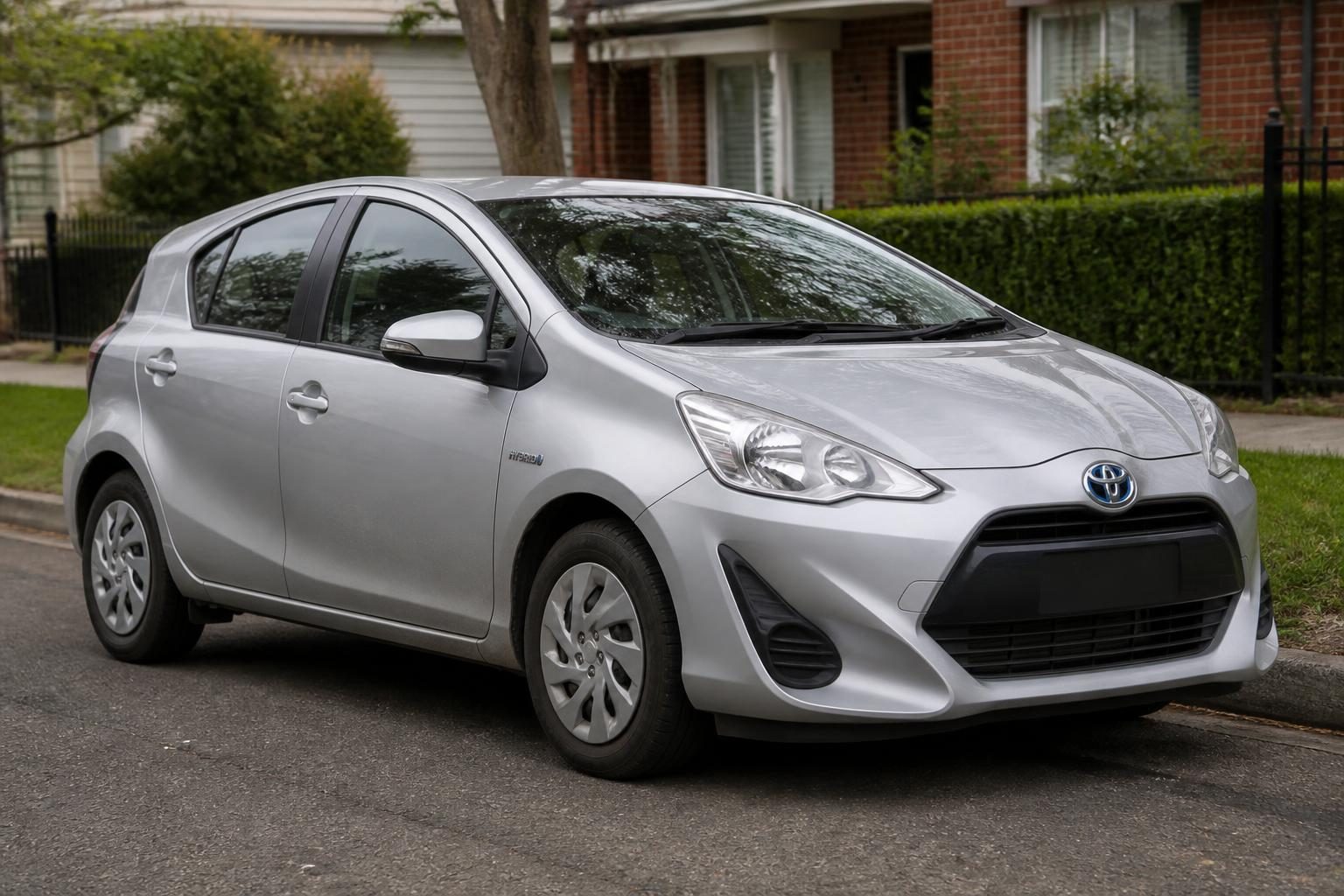 2019 Toyota Aqua
The mechanical package is identical across the range. A 1.5-litre four-cylinder petrol engine (1,496 cc) produces 54 kW and 111 Nm — those are engine-only figures — paired with an electric motor. Drive goes to the front wheels through an eCVT, which is a continuously variable transmission that uses the electric motor in place of a torque converter, eliminating gear hunting and removing the clutch from the equation entirely. Official economy is 35.4 km/L, or 2.83 L/100km (JC08, official Japan spec).
Be honest about what JC08 is, though. It's an older, optimistic test cycle. Real-world data from a New Zealand review put the NHP10 at 3.3–3.4 L/100km over a 26 km Auckland commute, climbing to about 4.6 L/100km at 100 km/h (Sterling Cars NZ). That pattern is the whole story of this car: it's brilliant in traffic and merely good on the motorway, because regenerative braking only pays you back when you're actually braking.
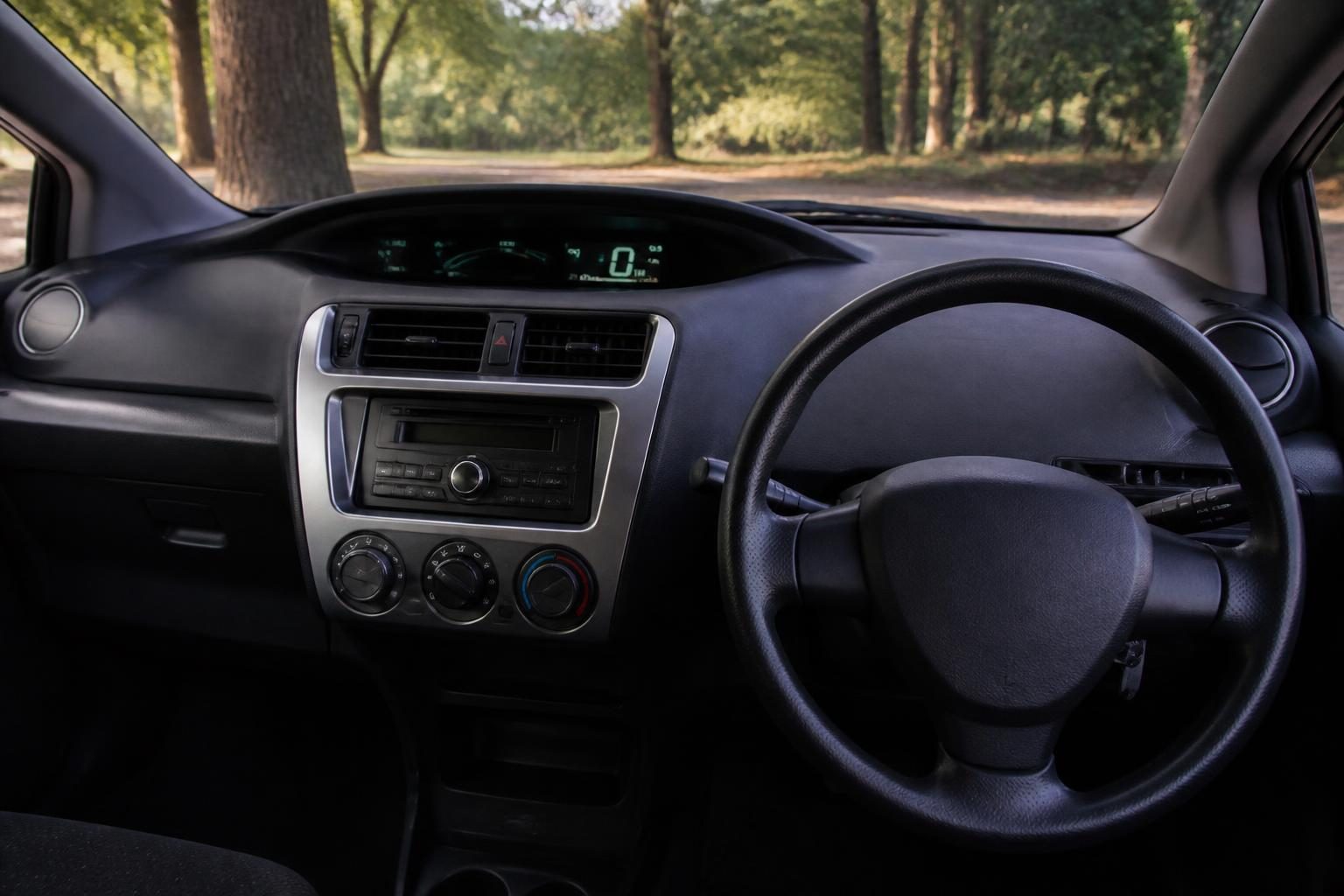 The NHP10 cabin is basic but logical, with the hybrid eco gauge front and centre.
Size, Variants and the Welcab Question
At 3,995 mm long, 1,695 mm wide and 1,445 mm tall (all grades; some GS crossover variants with roof antenna measure 1,455 mm) with a 36-litre tank, the NHP10 is a genuinely small car. It parks where a Corolla won't, which matters in Newtown or Chatswood. Trim grades run L, S, G and GS, and they change equipment rather than the drivetrain. Better-equipped examples like the 2019 pick up a reversing camera, push-button start, cruise-friendly multi-function wheel, lane departure warning, forward collision warning and EV mode.
One quirk worth understanding: a good number of Australian-landed Aquas are Welcab variants. Welcab is Toyota's factory accessibility line, built on the production line rather than converted afterwards, and the most common Aqua fitment is a swivelling front passenger seat that rotates towards the kerb for easier entry and exit. It's genuinely useful if mobility is a consideration in your household, and harmless if it isn't, but check the listing so you know which you're looking at.
The Trade-offs
The honest downsides are age and technology. Infotainment is basic by 2026 standards. There's no all-wheel-drive option on Gen 1. Most importantly, the earliest packs are now well past ten years old, so ask for a hybrid battery health report before you commit. Later 2018–2021 cars are the lower-risk end of the range. Factor in an independent inspection either way.
Is the Toyota Aqua MXPK11 Worth the Upgrade?
For buyers who want modern safety tech and a more current interior, the Toyota Aqua MXPK11 is worth the upgrade — particularly if stop-start city driving is your daily reality. It's the second-generation car, sourced from Japan on request, and the changes run deeper than a facelift. Out goes the four-cylinder. In comes the M15A-FXE — Toyota's 1.5-litre three-cylinder hybrid engine — paired with a bipolar nickel-metal hydride battery. Toyota described it as the world's first of its type used as an in-vehicle driving battery, with roughly double the output of the conventional NiMH pack it replaced (everycar.jp, 2021).
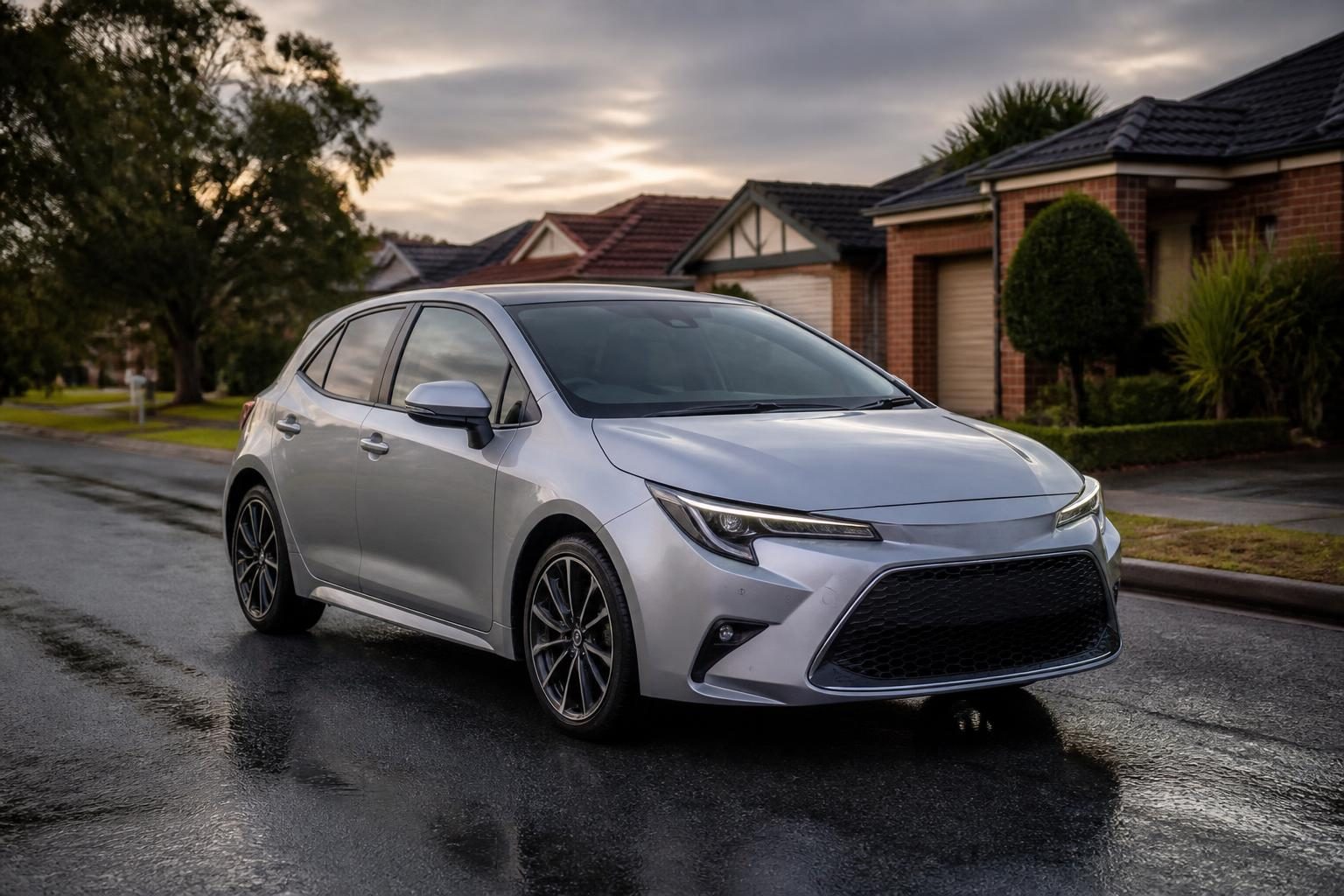 The second-generation Aqua looks contemporary rather than dated, with a sharper nose and a longer wheelbase.
That battery change is the bit you feel. Higher output means the electric motor responds faster from a standstill, so crawling traffic feels smoother than in an NHP10. Economy improves too: the X-grade is rated at 35.8 km/L, or 2.79 L/100km (WLTC, official Japan spec, everycar.jp, 2021). Across the grade range the figure runs from 33.6 to 35.8 km/L. WLTC is a tougher, more realistic cycle than JC08, so the two generations are closer than the raw numbers suggest.
The body grew to 4,050 × 1,695 × 1,485 mm on a 2,600 mm wheelbase — 50 mm longer between the axles than Gen 1, which shows in the rear legroom. Grades run B, G, X and Z. G and X are the volume sellers; Z is the top spec, on 17-inch alloys with a head-up display. A seven-inch touchscreen is standard from X-grade up. Toyota Safety Sense adds pre-collision braking, lane departure warning and automatic high beam as standard. That safety package is the single biggest reason to stretch past an NHP10.
The MXPK10 covers the B grade in front-wheel drive. The MXPK11 covers the G, X and Z grades — plus the later GR Sport — also in front-wheel drive. A separate model code, the MXPK15, is the B-grade E-Four variant — Toyota's electric all-wheel-drive system, pairing a rear electric motor with the same M15A-FXE three-cylinder up front. The MXPK16 is the equivalent E-Four system applied to the G, X and Z grades. If you want AWD, MXPK15 and MXPK16 are the codes to look for; both carry a slightly lower official economy figure than the equivalent 2WD grades. Confirm the exact model code and build before bidding. The trade-off for all of Gen 2 is simple: newer and better, but Japan-sourced on request. Allow six to ten weeks and accept that you're buying on an auction sheet and inspector notes rather than a test drive.
How Do the Fuel Economy Numbers Stack Up?
| Vehicle | Official economy | Test cycle | Fuel at 15,000 km/yr |
|---|---|---|---|
| Aqua NHP10 (Gen 1) | 2.83 L/100km | JC08, Japan | ~$861 |
| Aqua MXPK11 X-grade (Gen 2) | 2.79 L/100km | WLTC, Japan | ~$849 |
| Yaris Hybrid (AU-new) | 3.3 L/100km | WLTP | ~$1,004 |
Costs are calculated at 202.8 c/L, the Sydney regular unleaded figure in the NRMA's report for the week to 24 August 2026, and the Yaris Hybrid figure comes from CarsGuide. The cycles differ, so read the column labels rather than comparing bare numbers. The practical takeaway: even measured against a modern AU-new hybrid like the Yaris, the Aqua's official figure is lower — and either car puts you well under $1,100 a year in fuel at 15,000 km. Our own view, having watched a lot of buyers work through this maths, is that the gap only justifies itself if your kilometres are mostly urban.
Who Should Buy One?
It makes a lot of sense if you're covering 10,000 to 20,000 km a year, mostly in traffic. That's the profile where the hybrid system does its best work and where the fuel saving is large enough to notice on the credit card statement. First-time hybrid buyers get Toyota's proven mechanicals without paying Prius money, and small families get five seats and a car that fits in a standard Sydney garage. Rideshare drivers should check current eligibility rules, since a compact hybrid is usually a strong fit on running costs alone.
It's the wrong car for a few people, and worth saying plainly. If you're doing regular country runs or long stretches at 110 km/h, the hybrid advantage shrinks and a good diesel or a larger petrol car will be more comfortable. If you need towing capacity or serious load space, look at a small SUV or a wagon instead. And if a factory warranty with a local dealer network behind it matters to you, a new car is the answer. For a broader look at the options, our guide to the best used cars for fuel savings in Australia covers the wider field.
Getting One in Australia
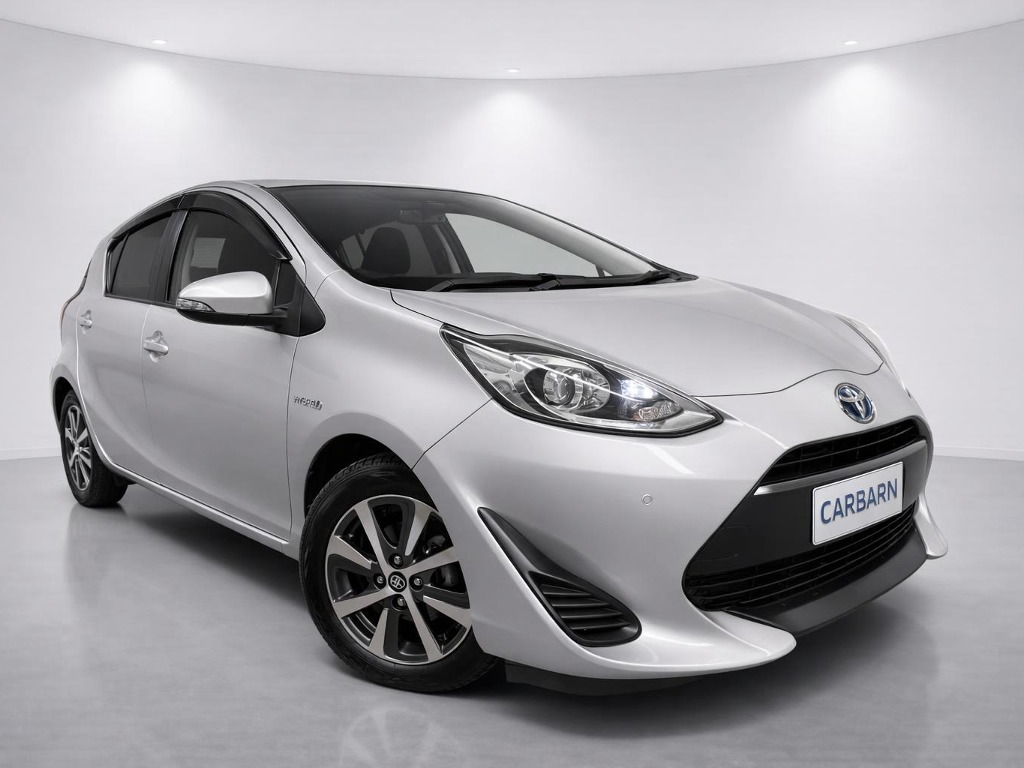 A silver Aqua NHP10 at Carbarn's Sydney site.
Carbarn works both ends of this. Gen 1 NHP10 Aquas are listed locally. You can browse available NHP10 listings at Carbarn, where you can see live prices, odometer histories and equipment lists, and cars there arrive with NSW registration, a roadworthy certificate, a dealer warranty plus a five-year extended warranty, roadside assistance and doorstep delivery across Greater Sydney. Both generations hold approvals under SEVS — the Specialist and Enthusiast Vehicle Scheme, which is the government's pathway for low-volume imports — so compliance can be handled through a registered workshop rather than a full individual vehicle approval. Gen 2 MXPK11 and MXPK15 examples are sourced from Japan on request through approved auctions, with pre-bid inspection, auction-sheet verification and bidding only after your approval. Compliance, AVV inspection and RAV entry are handled in-house at the Lidcombe workshop, and the full sourcing-to-delivery timeline runs six to ten weeks. Finance, trade-in and interstate delivery are available, and the wider Toyota hybrid range is worth a browse if you're still comparing.