



Ready to Hit the Road in Style?
Save money and reduce emissions with vehicles designed to deliver exceptional mileage. Visit our inventory and find a car that fits your lifestyle.
Ready to Hit the Road in Style?
Save money and reduce emissions with vehicles designed to deliver exceptional mileage. Visit our inventory and find a car that fits your lifestyle.
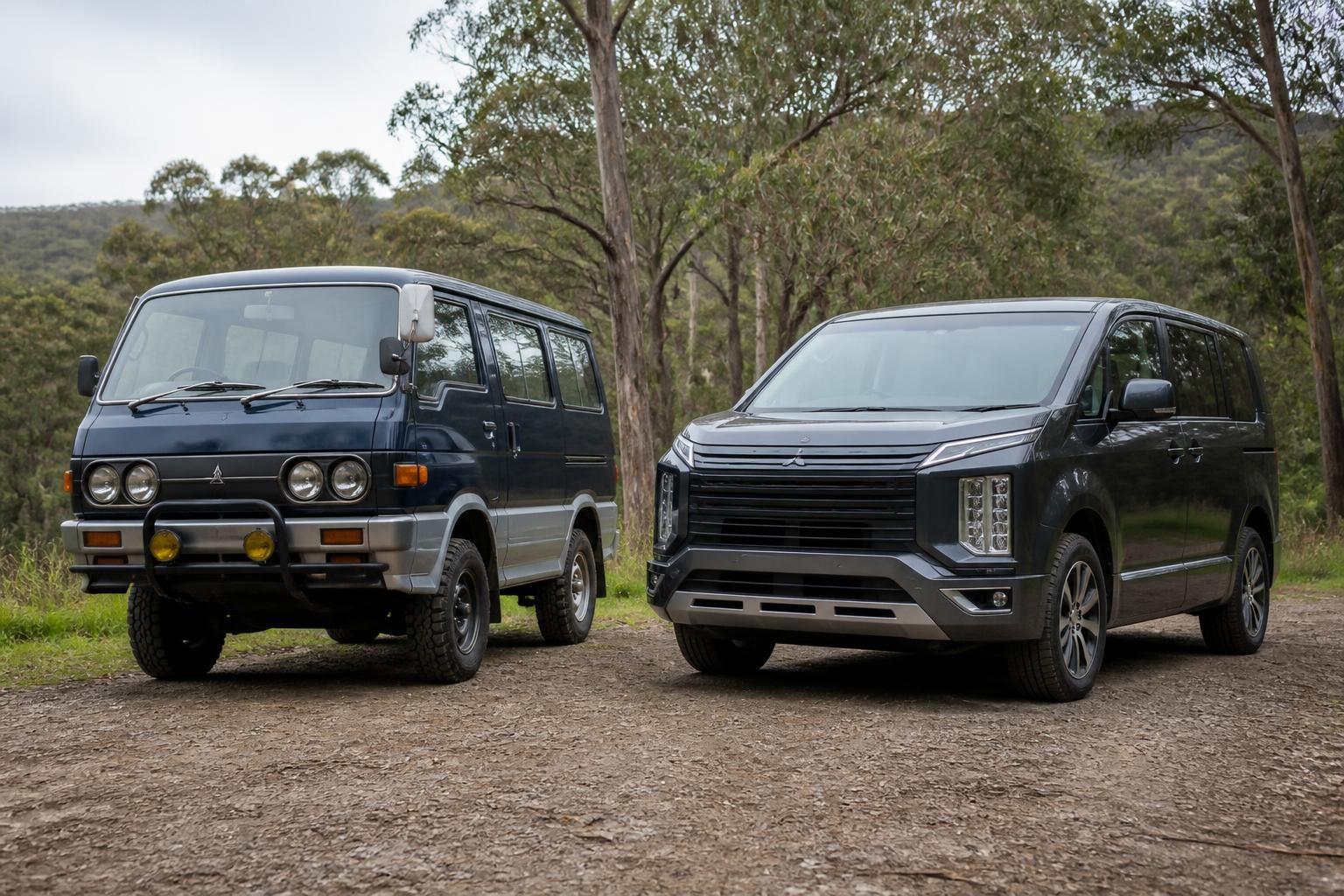
You've narrowed it down to a Delica. Now the harder question: which one? The PD8W Space Gear and the CV5W D:5 share the badge and a SEVS import pathway, but they were built for very different lives. The PD8W is a Pajero-derived diesel that will pick its way across a creek crossing. The CV5W is a quiet eight-seat MPV that handles a wet school run without fuss. Plenty of buyers import the wrong one because they shop the badge instead of the drivetrain. Here's how to avoid that.
The Bottom Line
- PD8W (L400 Space Gear, Sept 1993 to Dec 2006): 4M40 2.8-litre turbodiesel or 6G72 3.0-litre V6 petrol, Super Select 4WD with genuine low range. The off-road Delica.
- CV5W (D:5, Dec 2006 to Feb 2025 builds): 4B12 2.4-litre MIVEC petrol, AWC electronic all-wheel drive, no low range. The family Delica.
- Both are eight-seaters approved under SEVS (the Specialist and Enthusiast Vehicle Scheme), specifically the Campervans and Motorhomes Criterion, with a 6 to 10-week import timeline (Carbarn PD8W and CV5W import pages, 2026).
- CV5W condition: builds after 2016 must show 80,000 km or less on the odometer.
- If you genuinely leave the formed road, take the PD8W. If you don't, the D:5 is the better van.
How Do the PD8W and D:5 Compare Side by Side?
Same name, different machine. The PD8W's Super Select transfer case — Mitsubishi's four-mode, selectable-range 4WD system — includes a low range; the CV5W's AWC system does not, and that single line decides the purchase for most buyers. Everything else, seat count, timeline, compliance pathway, is broadly shared between the two.
| PD8W (L400 Space Gear) | CV5W (D:5) | |
|---|---|---|
| Engine options | Mitsubishi Delica PD8W — 4M40 2.8L turbodiesel or 6G72 3.0L V6 petrol | Mitsubishi Delica CV5W — 4B12 2.4L MIVEC petrol |
| Power / torque | 4M40: 103 kW (140 PS) @ 4,000 rpm, 314 Nm @ 2,000 rpm (Wikipedia, 4M4 engine) | 4B12: 125 kW @ 6,000 rpm, 226 Nm @ 4,100 rpm (auto-data.net) |
| Transmission | 4-speed automatic (6G72) or 5-speed manual | CVT, INVECS-III |
| 4WD system | Super Select: 2H / 4H / 4HLc / 4LLc | AWC electronic torque split |
| Low range | Yes, 4LLc with locked centre diff | No |
| Fuel economy | 6G72 petrol: around 8 to 9 km/L (Carbarn). 4M40 diesel: no published rating | 4B12 petrol: no published test-cycle rating |
| Approved builds | Sept 1993 to Dec 2006 | Dec 2006 to Feb 2025 |
| Seats | 8 | 8 |
| SEVS approval | SEV-000819, valid to 11 Mar 2028 | SEV-000822 and SEV-000823 |
| Import timeline | 6 to 10 weeks | 6 to 10 weeks |
| Best for | Off-road, rural, touring | Family, commuting, mixed roads |
What Makes the PD8W Space Gear the Off-Road Delica?
The Mitsubishi Delica PD8W carries Super Select four-wheel drive with four modes: 2H, 4H, 4HLc and 4LLc. The 4LLc mode combines low range with a locked centre differential — that's the capability the D:5 simply doesn't have (JDMBUYSELL PD8W guide, 2026). In plain terms: 2H for the highway, 4H for gravel and wet bitumen, 4HLc for sand and loose surfaces, and 4LLc for steep tracks, rock steps and creek crossings.
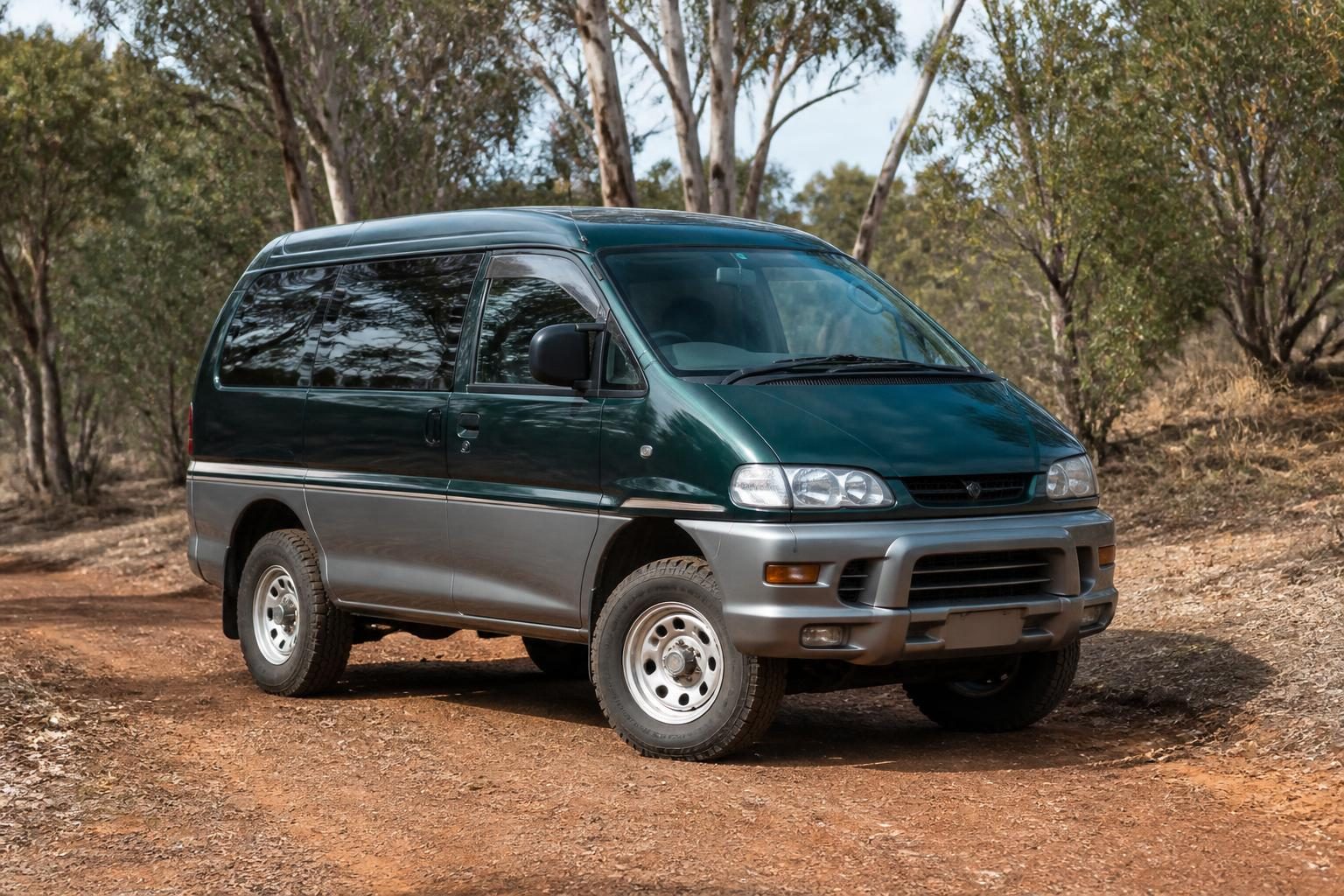 A Mitsubishi Delica Space Gear on a dusty Australian bush track.
Mechanically the pick is the 4M40 2.8-litre turbodiesel: 2,835 cc, 103 kW (140 PS) and 314 Nm arriving at just 2,000 rpm, with a 21.0:1 compression ratio (Wikipedia, 4M4 engine). That low-rev torque is the whole point. Fully loaded with eight people and camping gear, the van pulls without needing revs. The alternative is the 6G72 3.0-litre V6 petrol, paired with a four-speed automatic. Carbarn's own import walkthrough puts economy at around 8 to 9 km/L, with real-world figures typically lower. There's no published economy rating for the 4M40, so treat touring range as something to verify on the specific vehicle rather than a spec-sheet number.
Age is the honest trade-off. These are 20 to 30-year-old vans, so inspection matters more than badge appeal. Check injector seals and glow plugs on the 4M40, floor and sill rust on examples from wetter prefectures, transfer case seals and diff oil condition. Parts are straightforward because the 4M40 is mechanically the same engine used across the second-generation Pajero. Worth knowing on timing: SEV-000819 is valid until 11 March 2028 (ROVER register), which makes the eligibility window finite rather than open-ended. This van suits rural buyers, overlanders and anyone who'll actually use the low-range hardware. It's the wrong choice if your driving is school, servo and suburban bitumen.
Is the CV5W D:5 the Better Family Van?
The Mitsubishi Delica D:5 CV5W runs AWC (All Wheel Control), Mitsubishi's electronically managed system that adjusts torque between the front and rear axles, with no low-range transfer case and no manual diff lock (Carbarn CV5W import page). AWC works genuinely well on wet roads, gravel and loose formed tracks, which covers most of what a family van actually meets on a camping weekend. It is not a technical off-road system, and anyone picturing rock steps should read that sentence twice.
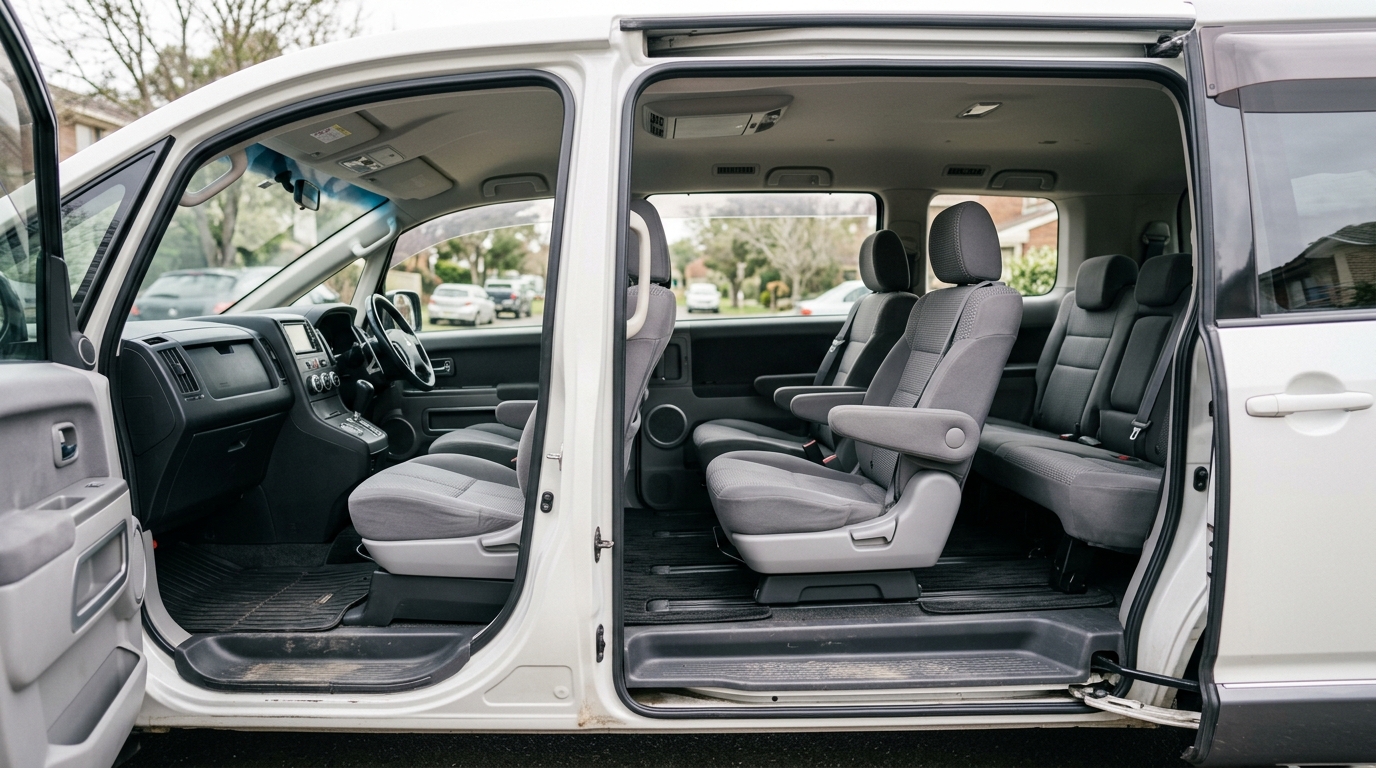 Clean grey three-row MPV cabin viewed through the open sliding door.
The 4B12 petrol is a 2,360 cc MIVEC (Mitsubishi Innovative Valve timing Electronic Control) inline-four making 125 kW (170 PS) at 6,000 rpm and 226 Nm at 4,100 rpm (auto-data.net). Power goes through an INVECS-III CVT — Mitsubishi's Intelligent and Innovative Vehicle Engineering Control System managing a continuously variable transmission. The CV5W is a unibody MPV built on the previous-generation Outlander platform, not a body-on-frame 4WD, and it drives accordingly: quieter, smoother and far less agricultural than the Space Gear. Dimensions are 4,730 mm long, 1,795 mm wide and 1,870 mm tall on a 2,850 mm wheelbase. Kerb weight sits around 1,770 kg. Published economy figures for the 4B12 petrol circulate widely without a named test cycle attached, so they're not worth repeating here.
One sourcing constraint is worth planning around. CV5W vehicles built after 2016 must have an odometer reading of 80,000 km or less to satisfy the SEVS condition, which meaningfully narrows the pool of later examples. Pre-2016 builds carry no such cap. Approvals SEV-000822 and SEV-000823 (ROVER register) cover builds from December 2006 through to February 2025, so the year spread is broad. Keep expectations calibrated on the cabin too: the CV5W is the pre-facelift D:5. The larger screens and updated interior from the 2019 redesign belong to a different variant. This van suits school-run families, gravel-road campers, and buyers who want eight seats without nursing a 30-year-old diesel.
Which Delica Suits You?
Most of this decision comes down to one honest answer about where you drive, not where you imagine driving.
| If you… | The right pick |
|---|---|
| Regularly drive off formed roads: tracks, creek crossings, steep terrain | PD8W |
| Mostly drive bitumen, gravel and wet suburban roads | CV5W D:5 |
| Treat low-range 4WD as non-negotiable | PD8W, the D:5 doesn't have it |
| Want a quieter, smoother daily drive | CV5W D:5 |
| Are relaxed about owning a 20 to 30-year-old vehicle | PD8W |
| Want a post-2016 build | Check CV5W sourcing early, the 80,000 km cap tightens the pool |
| Value diesel torque and proven Pajero running gear | PD8W |
Be blunt with yourself about the trade-offs. The PD8W is the wrong van for a buyer who wants to turn the key for five years and think about nothing: parts are available, but age brings rust checks, seal replacements and a mechanic on speed dial. The D:5 is the wrong van for someone who genuinely tours remote tracks, because competent AWD is not the same thing as low range when the surface turns technical.
Importing Either Delica From Japan
Both model codes carry SEVS approval and follow the same three-stage process — typically 6 to 10 weeks: source and approve in Japan, roll-on/roll-off freight to Australia, then local compliance. If you want to see exactly what that looks like stage by stage, the full import journey guide follows one PD8W from a Japanese auction bay to an Australian driveway. Carbarn handles the whole chain in-house. That covers auction-sheet verification and pre-bid inspection, bidding only to your agreed cap, and Vehicle Import Approval lodged before shipping. Customs and biosecurity clearance, SEVS compliance, and Approved Vehicle Verifier inspection at the RAW-certified Lidcombe workshop follow. RAV entry, warranty, finance, and Australia-wide delivery are included, with a compliance-only pathway available if you've already secured a vehicle yourself. If you'd rather not wait on a build, the 4WD range is worth a look. For sourcing lead times on either the PD8W or the CV5W, the import enquiry page is the right place to start.