



Ready to Hit the Road in Style?
Save money and reduce emissions with vehicles designed to deliver exceptional mileage. Visit our inventory and find a car that fits your lifestyle.
Ready to Hit the Road in Style?
Save money and reduce emissions with vehicles designed to deliver exceptional mileage. Visit our inventory and find a car that fits your lifestyle.
You want seven seats and sliding doors, but you don't want to wrestle a huge family bus through school pickup or tight suburban parking. That's exactly where the Honda StepWGN RP5 gets interesting. In Honda's 2022 archive, the RP5 hybrid is listed at 4,760mm long and 1,695mm wide, with a 2,890mm wheelbase, which is a very family-friendly footprint for a three-row vehicle (Honda, Step WGN specification list PDF, 2022).
This guide is for Australian buyers trying to work out whether the RP5 makes sense as a used family car, not whether they can import one. We'll look at space, hybrid driving, day-to-day usability, what to inspect before buying, and who should probably skip it. If you're also weighing up other 7-seater hybrid options or reading a Nissan Serena guide, this is the practical RP5 verdict.
If the RP5 is already on your shortlist, start here: Import Honda StepWGN RP5 from Japan to Australia. That page covers eligibility, sourcing and compliance next steps, while this guide stays focused on whether the car suits your family.
Quick Answer
- Strong fit if you want sliding doors and easier child-seat access than many SUVs.
- Honda's 2022 Step WGN spec sheet rates the RP5 hybrid at 20.0km/L WLTC (Honda, Step WGN specification list PDF, 2022).
- At 1,695mm wide, it feels easier to place than many large family cars.
- Buy on service history, condition and features, not just kilometres.
The shortlist logic is simple. If you need real third-row usability, easier kid access and lower fuel use than a thirsty petrol people mover, the RP5 deserves a look. If towing, brand image or broad local familiarity matter more, a Kluger or Carnival may still suit you better.
| Vehicle | Length | Width | Official fuel figure | Best for | Main trade-off |
|---|---|---|---|---|---|
| Honda StepWGN RP5 Hybrid | 4,760mm | 1,695mm | 20.0km/L WLTC, about 5.0L/100km equivalent | Families wanting sliding doors and easy access | Exact grade and features must be checked carefully |
| Toyota Kluger Hybrid | 4,966mm | 1,930mm | 5.6L/100km | Buyers who prefer a mainstream large SUV | Wider body and higher step-in |
| Kia Carnival Hybrid | 5,155mm | 1,995mm | 5.8L/100km | Families needing maximum local-space practicality | Bigger footprint around town |
| Kia Carnival Petrol | 5,155mm | 1,995mm | 9.6L/100km | Buyers prioritising space over fuel use | Much thirstier in stop-start driving |
In Honda's 2022 Step WGN spec PDF, Toyota Australia's current Kluger range page and Kia Australia's MY26 brochure, these are official claim figures from different test cycles, so treat fuel comparisons as directional rather than lab-equivalent (Honda, Step WGN specification list PDF, 2022; Toyota Australia, Kluger range page, 2026; Kia Australia, Carnival brochure, 2026).
StepWGN RP5 at a glance
In Honda's 2022 Step WGN specification archive, the Honda StepWGN RP5 measures 4,760mm long, 1,695mm wide and rides on a 2,890mm wheelbase (Honda, Step WGN specification list PDF, 2022). That's the heart of its appeal, because it gives you genuine family-car space without the width penalty of many local three-row SUVs and people movers.
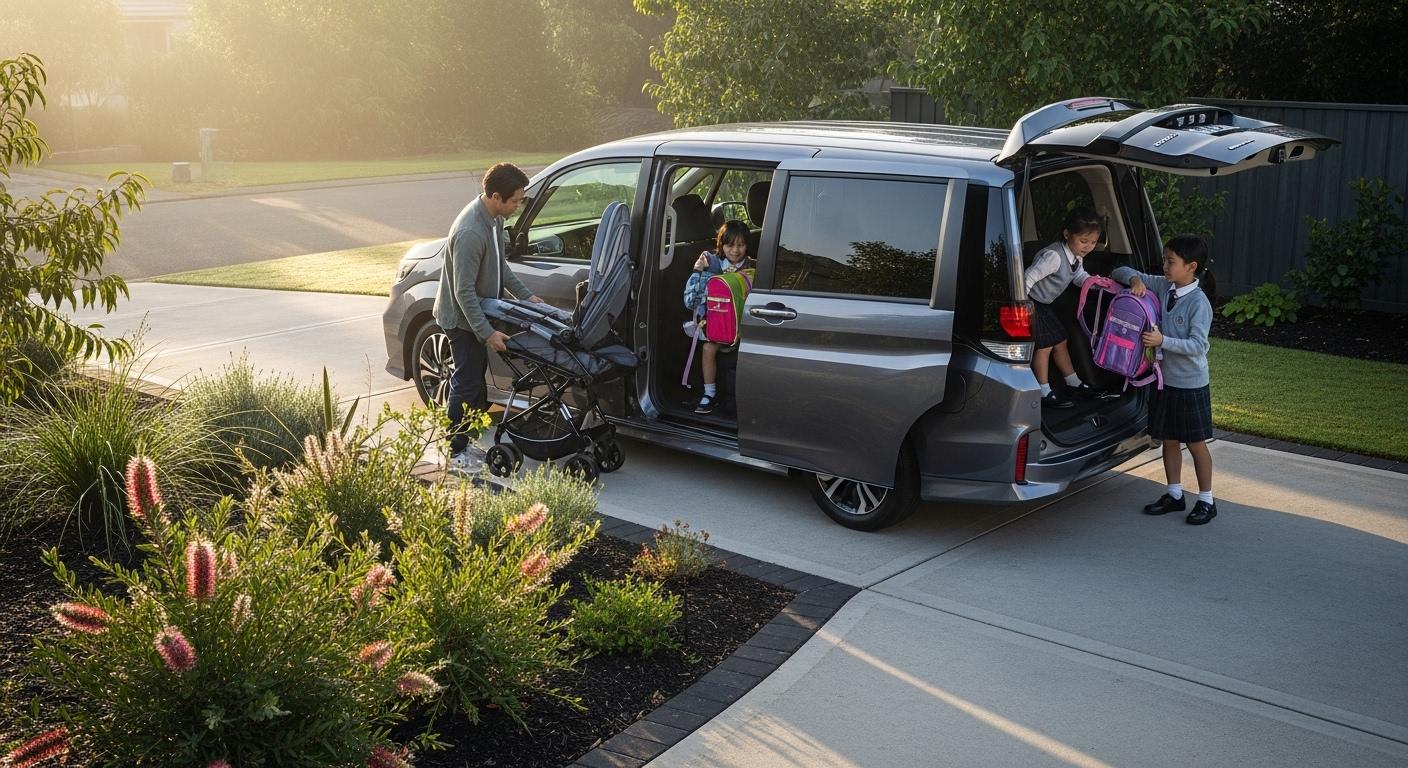
The RP5 makes sense if your week is full of child seats, school bags, grandparents and grocery runs. In Honda's 2022 archive, the turning circle is listed at 5.4m, which helps when you're doing U-turns, squeezing into shopping-centre bays or edging around older apartment garages (Honda, Step WGN driving performance page, 2022). Do you really need a broader SUV just to carry seven people? Often, you don't.
Most Australian buyer interest centres on the RP5 hybrid. In Honda's 2022 driving archive, the system pairs a 2.0-litre Atkinson-cycle engine producing 107kW and 175Nm with a traction motor producing 135kW and 315Nm (Honda, Step WGN driving performance page, 2022). Honda also lists 20.0km/L WLTC, which converts to about 5.0L/100km equivalent (Honda, Step WGN specification list PDF, 2022).
In 2022, Honda listed the RP5 at 1,695mm wide and a 5.4m turning circle, which helps explain why a boxy people mover can feel easier to live with than a much wider SUV in school zones and suburban garages (Honda, Step WGN specification list PDF, 2022).
[CHART: Bar chart - Honda StepWGN RP5 vs Toyota Kluger Hybrid vs Kia Carnival width and length comparison, using Honda 2022 dimensions, Toyota Australia's current Kluger overview page figures and Kia MY26 Australian brochure figures]
What makes the RP5 different from regular people movers?
In Honda's 2022 Waku Waku Gate page, the side-opening rear access is listed with 350mm, 610mm and 830mm opening widths, plus a 1,270mm-high cargo opening (Honda, Waku Waku Gate page, 2022). That matters because the RP5 isn't just roomy, it is cleverly usable in the sorts of cramped spaces families actually deal with.
Why does the Waku Waku Gate matter?
Ever tried loading a pram when someone has parked right up your bumper? That's where the RP5 feels properly thought through. In Honda's 2022 archive, the tailgate can open sideways in stages, which means you can load small bags, help kids into the third row, or grab sports gear without needing a full tailgate swing behind the car (Honda, Waku Waku Gate page, 2022).
In the same 2022 Honda page, the maximum cargo opening width is listed at 1,180mm and the opening height at 1,270mm (Honda, Waku Waku Gate page, 2022). That translates neatly into prams, airport bags, school gear and a weekly shop. It also helps if you often park kerbside and want children stepping in from the safer side.
In Honda's 2022 Waku Waku Gate archive, the RP5's 350mm, 610mm and 830mm staged openings show why this design is more than a novelty. It is a practical loading solution for tight parking, third-row access and quick family errands (Honda, Waku Waku Gate page, 2022).
How practical is the interior for family life?
In Honda's 2022 specification archive, the RP5 hybrid's cabin dimensions are listed at 3.220m long, 1.500m wide and 1.405m high (Honda, Step WGN specification list PDF, 2022). That's why the StepWGN feels family-first inside, because the boxy body turns into real passenger space rather than just a tall driving position.
Sliding doors are the headline feature, but the real win is how calm daily use becomes. In Honda's 2022 cabin page, the sliding-door step height is listed at 390mm, while the rear opening ground height is listed at 445mm (Honda, Step WGN interior cabin page, 2022). That lower step-in helps kids climb aboard, helps older passengers avoid a big stretch, and makes the school run less awkward in narrow bays.
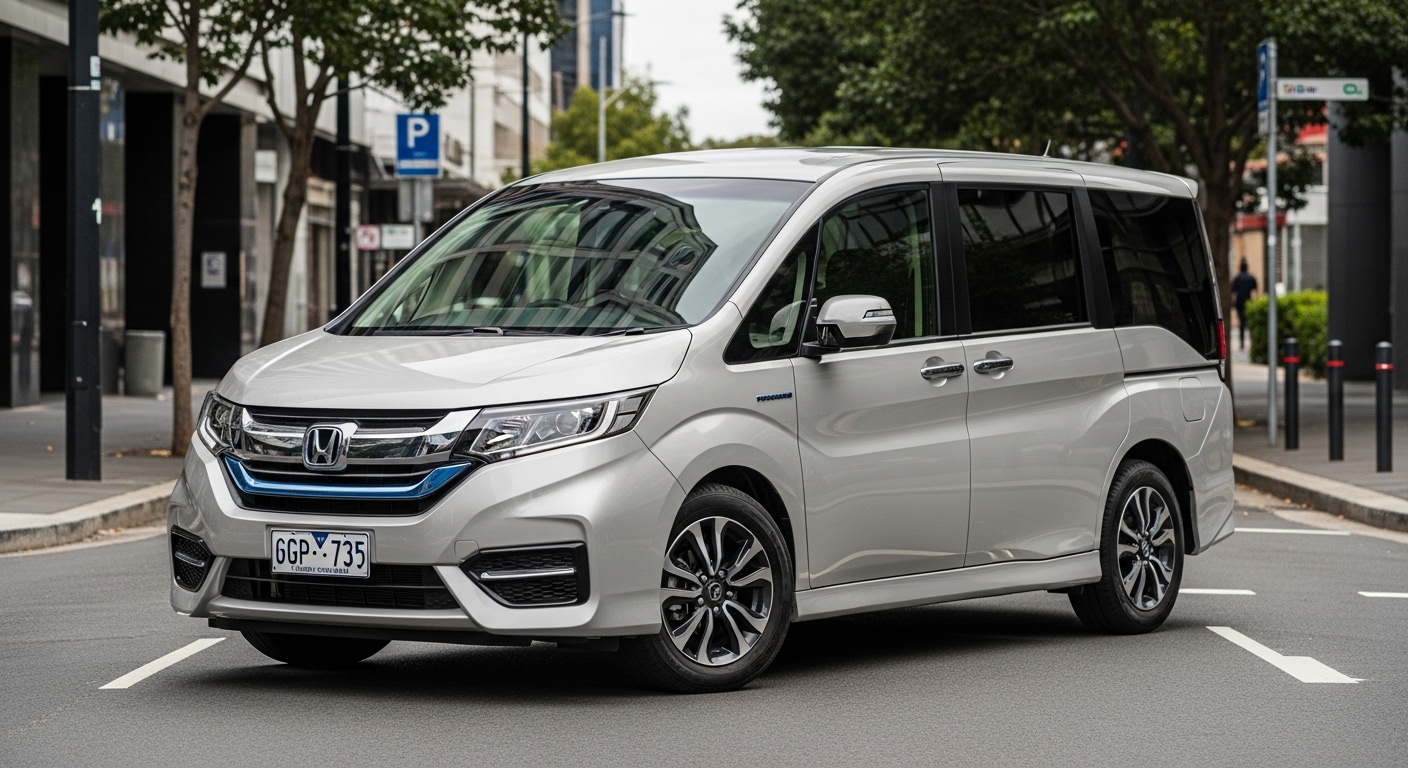 2017 HONDA StepWGN RP5 / stepwagon
What should you verify inside the exact vehicle?
One detail is worth getting right. In Honda's 2022 cabin page, the hybrid cabin height is 1.405m, while 1.425m is the petrol figure, so don't mix the two when comparing spec sheets (Honda, Step WGN interior cabin page, 2022). That's the sort of small accuracy check that separates a careful buyer from someone copying brochure claims.
For comfort and safety, check the exact grade and year. In Honda's current Step WGN Honda SENSING FAQ, RP5-era hybrid models are shown with core items such as CMBS, ACC, LKAS, road-sign recognition and auto high beam, while newer-only items such as Traffic Jam Assist and Blind Spot Information are not shown for RP5 (Honda, Step WGN Honda SENSING FAQ, 2026). So yes, some RP5s can be well equipped, but you still need to verify the actual car.
In Honda's 2022 archive, a 3.220m-long cabin, low 390mm step height and sliding-door access make the RP5 more family-friendly than many trendier SUVs when you're managing child seats, grandparents or regular third-row use (Honda, Step WGN interior cabin page, 2022).
What is the hybrid driving experience like?
In Honda's 2022 driving archive, the RP5's traction motor is rated at 135kW and 315Nm, while the 2.0-litre engine is rated at 107kW and 175Nm (Honda, Step WGN driving performance page, 2022). In plain English, that means the RP5 should feel smoother and quieter around town than a big petrol family car.
Honda's description is helpful here. In the 2022 archive, the system is described as motor-led at low and medium speeds, with EV drive, hybrid drive and engine drive modes used as conditions change (Honda, Step WGN driving performance page, 2022). Around suburbia, that usually means cleaner take-off, less fuss in traffic and less of that strained feeling some heavy petrol people movers get.
Don't read that as a promise of long EV-only driving. In Honda's 2022 archive, EV running depends on battery charge and operating conditions (Honda, Step WGN driving performance page, 2022). The better way to think about it is simple: the hybrid system helps the RP5 feel relaxed, not sporty, and that's a strength in family use.
In Honda's 2022 performance archive, the 315Nm motor torque is available from 0 to 2,000rpm, which is a big reason the RP5 feels easy and unstressed in stop-start traffic, school zones and suburban roundabouts (Honda, Step WGN driving performance page, 2022).
Expected running costs for buyers
In Honda's 2022 specification archive, the RP5 hybrid is rated at 20.0km/L WLTC, which is about 5.0L/100km equivalent, with 18.8km/L city, 21.7km/L suburban and 19.5km/L highway sub-mode figures (Honda, Step WGN specification list PDF, 2022). That's one of the strongest reasons to consider it over a big petrol family car.
Does that mean you'll always see 5.0L/100km in Australia? No. Load, tyres, traffic, road speed, air-conditioning use and maintenance all matter. Still, the official Honda figure gives the RP5 a strong starting point. On Toyota Australia's current Kluger range page, the Kluger Hybrid is listed at 5.6L/100km, while Kia Australia's MY26 Carnival brochure lists the Carnival Hybrid at 5.8L/100km and the petrol Carnival at 9.6L/100km (Toyota Australia, Kluger range page, 2026; Kia Australia, Carnival brochure, 2026).
At 12,000 kilometres a year, those official claim figures translate to about 600 litres for the StepWGN, 672 litres for the Kluger Hybrid, 696 litres for the Carnival Hybrid and 1,152 litres for the petrol Carnival. It is only an indicative calculation, because the test cycles differ, but it shows why the RP5 has such a solid efficiency case.
[CHART: Bar chart - Indicative annual fuel use at 12,000km: StepWGN 600L, Kluger Hybrid 672L, Carnival Hybrid 696L, Carnival petrol 1,152L. Source figures from Honda's 2022 spec PDF, Toyota Australia's current Kluger range page and Kia's MY26 Australian brochure. Note: test cycles differ.]
In Honda's 2022 archive, the RP5's 20.0km/L WLTC claim is the number that makes the ownership argument stack up. Even with real-world variation, it points to a family car that should feel materially lighter on fuel than a traditional petrol people mover (Honda, Step WGN specification list PDF, 2022).
What should Australian buyers check before buying one?
In 2026, the PPSR says an online used-vehicle search costs $2 and can show recorded debt, stolen status and written-off status (PPSR, Do a used car or vehicle search, 2026). That's where sensible RP5 buying starts, because paperwork, condition and maintenance matter more than the idea of the car.
Mechanical and hybrid checks
Check the service history first. Then check how the hybrid system behaves from cold start, in stop-start traffic and under steady acceleration. In Honda's 2022 archive, the RP5 relies heavily on its electric drive system, so smooth transitions and quiet operation matter (Honda, Step WGN driving performance page, 2022).
Look for warning lights, rough idle, odd noises, poor brake feel or jerky drivetrain behaviour. In the NSW Government's 2026 used-vehicle inspection checklist, buyers are told to confirm warning lights work correctly, the odometer functions properly, and brakes stop smoothly in a straight line (NSW Government, Vehicle inspections checklist, 2026).
Doors, interior and wear
Power sliding doors need close attention. They should open and shut smoothly, latch properly and respond consistently from the switch, remote and handles. Inside, check seat functions, trim wear, air-conditioning, windows, wipers, charging points and any infotainment features. If a family car has been used hard, the interior usually tells the truth quickly.
In the NSW Government's 2026 checklist, buyers are also told to inspect seat belts, child-restraint anchorage points, tyres, lights, horn and air-conditioning, and to confirm at least 5mm of tyre tread (NSW Government, Vehicle inspections checklist, 2026). That is basic advice, but it saves money.
Paperwork, history and suitability
Run a PPSR search as close to purchase as possible. In 2026, the PPSR recommends doing it on the day or the day before purchase, because the search certificate becomes part of your record (PPSR, Do a used car or vehicle search, 2026). Also verify VIN consistency, odometer records, accident history, auction grade where relevant, and maintenance paperwork.
If you're considering a Japan-sourced example, confirm compliance suitability before anything else. In 2026, the Department of Infrastructure says you must obtain import approval before importing a road vehicle, and importing without approval is an offence (Department of Infrastructure, Importing a road vehicle into Australia, 2026). This guide won't walk through that process, but it is a non-negotiable check.
In 2026, a $2 PPSR search and the NSW Government's inspection checklist are two of the best filters a buyer can use. They help you judge debt risk, written-off status, tyres, brakes, warning lights and odometer consistency before emotion takes over (PPSR, 2026; NSW Government, 2026).
Who is the RP5 hybrid best suited to?
In Honda's 2022 archive, the RP5 pairs a 1,695mm body width with a 390mm step height and sliding-door access (Honda, Step WGN interior cabin page, 2022). That combination makes it best suited to families who value easy access, efficiency and usable cabin space more than SUV image, towing muscle or a familiar local badge.
The best fit is a growing family doing daily school runs, airport pickups and weekend trips with plenty of soft bags and kid gear. It also suits multi-generational households, because low step-in and sliding doors are genuinely easier for older passengers. If you mostly drive around town and hate tight parking, the RP5's narrower footprint is a strong selling point.
Who should skip it? Buyers who want broad local dealer-network familiarity everywhere, people who care most about towing, and anyone who simply prefers the feel or look of a mainstream large SUV. If you want the newer-shape StepWGN and you're happy to compare generations, the Honda StepWGN RP8 is the obvious next reference point.
If you want to compare locally available alternatives first, browse used people movers and used hybrid cars. If the RP5 still looks like the right fit, View the Honda StepWGN RP5 import page. Carbarn used hybrid stock and import support covers locally available used vehicles, managed Japan-sourced vehicle support, finance options, warranty support and nationwide delivery.
Source notes
- Honda, Step WGN specification list PDF, retrieved 2026-07-06, https://www.honda.co.jp/auto-archive/stepwgn/normal/2022/common/pdf/stepwgn_spec_list.pdf
- Honda, Step WGN interior cabin page, retrieved 2026-07-06, https://www.honda.co.jp/auto-archive/stepwgn/normal/2022/webcatalog/interior/cabin/
- Honda, Waku Waku Gate page, retrieved 2026-07-06, https://www.honda.co.jp/auto-archive/stepwgn/normal/2022/webcatalog/interior/wakuwakugate/
- Honda, Step WGN driving performance page, retrieved 2026-07-06, https://www.honda.co.jp/auto-archive/stepwgn/normal/2022/webcatalog/performance/driving/
- Honda, Step WGN Honda SENSING FAQ, retrieved 2026-07-06, https://www.honda.co.jp/customer/auto/stepwgn/faq/qa001/
- PPSR, Do a used car or vehicle search, retrieved 2026-07-06, https://www.ppsr.gov.au/carcheck
- NSW Government, Vehicle inspections checklist, retrieved 2026-07-06, https://www.nsw.gov.au/driving-boating-and-transport/buying-and-selling-vehicles/buying-a-used-vehicle/vehicle-inspections-checklist
- Department of Infrastructure, Importing a road vehicle into Australia, retrieved 2026-07-06, https://www.infrastructure.gov.au/infrastructure-transport-vehicles/vehicles/importing-road-vehicle-australia
- Toyota Australia, Kluger range page, retrieved 2026-07-06, https://www.toyota.com.au/kluger/range
- Toyota Australia, Kluger overview page, retrieved 2026-07-06, https://www.toyota.com.au/kluger
- Kia Australia, Carnival brochure, retrieved 2026-07-06, https://www.kia.com/content/dam/kwcms/au/en/images/pdf/carnival/kia-carnival-brochure.pdf