



Ready to Hit the Road in Style?
Save money and reduce emissions with vehicles designed to deliver exceptional mileage. Visit our inventory and find a car that fits your lifestyle.
Ready to Hit the Road in Style?
Save money and reduce emissions with vehicles designed to deliver exceptional mileage. Visit our inventory and find a car that fits your lifestyle.
Hybrid cars and hybrid SUVs are no longer niche products in Australia. From the Toyota RAV4 Hybrid and Toyota Corolla Hybrid to Honda e: HEV models and Hyundai’s growing hybrid range, electrified powertrains have become a mainstream choice for private owners and fleet operators alike. But while the marketing often suggests that a hybrid car is “low maintenance”, the reality in Australian conditions is more complex.
Periodic hybrid vehicle maintenance in Australia is less about replacing worn-out belts and pads and more about managing heat, keeping fluids stable, protecting sensitive electronics, and respecting high-voltage safety. This guide brings together the technical, regulatory, and environmental factors that actually determine how long your hybrid car lasts, and how reliably it performs in the harsh Australian climate.
Executive Overview: Why Hybrid Vehicle Maintenance Has Changed
For decades, the Australian automotive landscape was dominated by large, naturally aspirated petrol sedans and utes. Maintenance was mostly mechanical: oil changes, timing belts, clutches, and brake pads. Today, hybrid electric vehicles (HEVs) add high-voltage battery packs, inverters, DC–DC converters, electric water pumps, and complex brake-by-wire systems to that mix.
On paper, hybrid car maintenance looks easier because the petrol engine runs less and regenerative braking saves the pads and rotors. In practice, the maintenance burden has shifted:
From mechanical abrasion to thermal management
From simple fluids to chemically stable, non-conductive coolants
From manual inspection to diagnostic software and battery health reports
In Australian conditions, high ambient heat, dust, long-distance highway driving and stop-start urban congestion all combine to classify most hybrids as operating under “severe service”. That means logbook intervals designed for cooler, cleaner environments are often too optimistic. To keep a hybrid vehicle reliable here, you need to think in terms of shortened oil intervals, stricter brake fluid changes, proactive cooling system management, and regular high-voltage battery cooling maintenance.
Who Should Be Maintaining Hybrids?
The Right to Repair and Access to Hybrid Data
Australia’s Motor Vehicle Service and Repair Information Sharing Scheme is a big deal for hybrid car owners. It forces manufacturers to share technical information, wiring diagrams, software update procedures, and hybrid diagnostic codes with independent workshops. In theory, this opens up hybrid vehicle maintenance to more than just dealership networks. It allows independent technicians to connect to battery management systems (BMS), reset hybrid error codes, and safely depower high-voltage systems.
However, having access to data is not the same as having the skills to use it. High-voltage hybrid systems demand specific training. Several states, including New South Wales, are moving toward mandatory EV/hybrid training for mechanics, even for relatively simple procedures that can affect regenerative braking or steering sensors. A wheel alignment on a modern hybrid is no longer a purely mechanical job; it can affect safety systems, lane-keep functions, and energy recovery.
For fleet managers and private owners, that means workshop selection is now strategic. You are looking not just for “hybrid-friendly” branding, but for technicians with dedicated hybrid and EV credentials, often identified by skill sets such as battery electric vehicle and hybrid diagnose-and-repair training.
High-Voltage Safety and the DIY Line in the Sand
Australian electrical safety regulations define anything above extra-low voltage as a serious hazard. Hybrid traction batteries run in the hundreds of volts, easily exceeding thresholds that can cause arc flash and cardiac arrest. That places strict boundaries around what a DIY owner should attempt.
A realistic division looks like this:
Owner-friendly tasks: checking tyre pressures, topping up washer fluid, replacing wiper blades, replacing cabin filters in accessible designs, and visually checking for leaks.
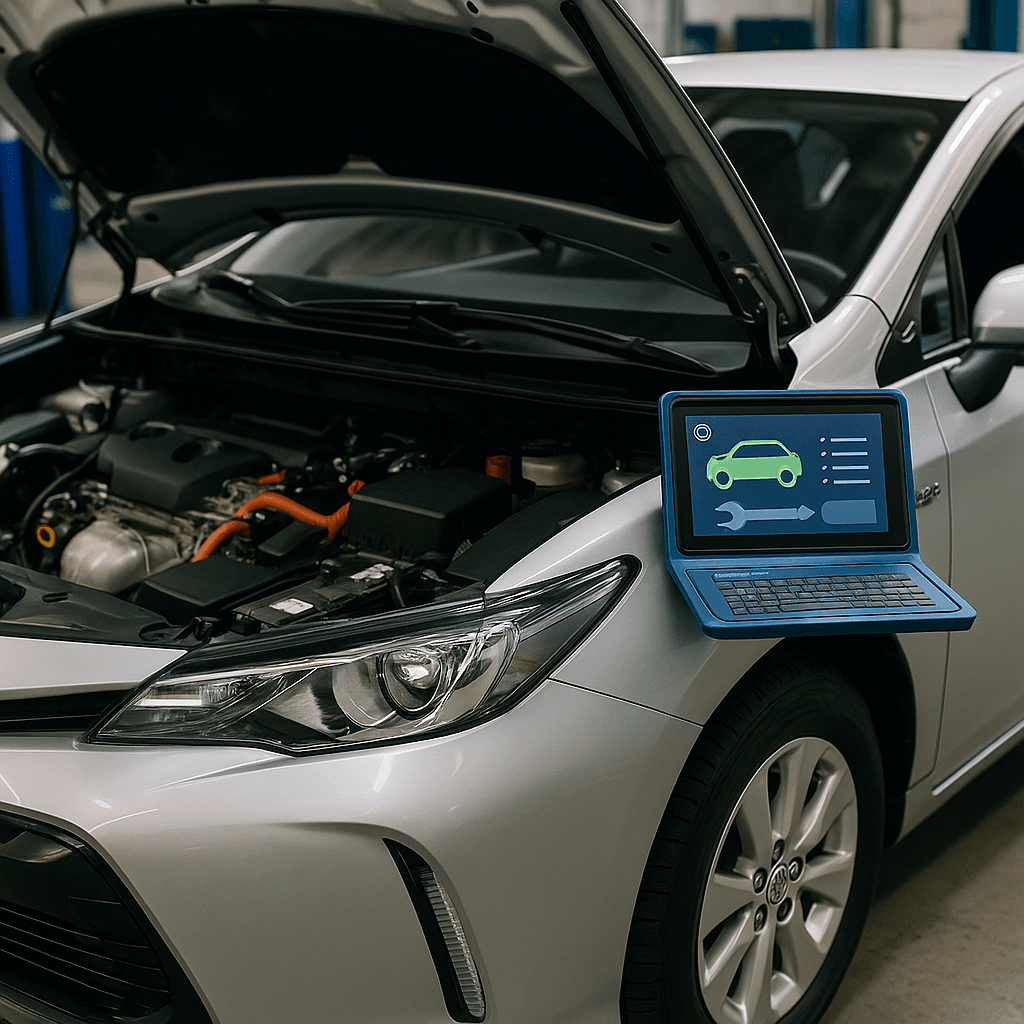
Workshop-only tasks: anything involving orange cables, battery packs, inverters, inverter coolant loops, high-voltage relays, brake actuator bleeding, hybrid software flashing, or DC–DC converter diagnosis.
Modern hybrid car maintenance is therefore a partnership: the owner handles basic periodic checks, and the workshop manages the high-voltage and electronic systems within a strict safety framework.
OEM Service Schedules vs Australian Realities
Manufacturers publish hybrid vehicle maintenance schedules that look neat on paper, but they are written for a mixture of global markets, many of which are cooler, cleaner, and less harsh than Australia.
Toyota Hybrid Synergy Drive: Normal vs Severe
Toyota’s Hybrid Synergy Drive powers iconic models like the Toyota Prius, Toyota Corolla Hybrid, Camry Hybrid, and RAV4 Hybrid. Officially, many of these cars run on 12-month or 15,000 km service intervals. That’s the “normal” schedule that appears in the logbook.
The same documentation, however, defines “severe” conditions: frequent short trips, extended idling, towing, heavy loads, dusty roads, and high ambient temperatures. That list describes a typical Australian hybrid’s life almost perfectly. Under severe conditions, Toyota’s own guidelines effectively halve many maintenance intervals. Engine oil and filter changes that are officially quoted as every 15,000 km become more realistic at 7,500–10,000 km. Inverter coolant that is nominally a 160,000 km fluid may be better replaced around the 80,000 km mark in constant heat.
The practical takeaway is that a hybrid Toyota used as a rideshare vehicle in Sydney or a family wagon in regional Queensland should be treated as severe service by default. Fleet operators who cling to “normal” intervals in a harsh environment are quietly shortening their asset life.
Honda e:HEV: Condition-Based Logic
Honda’s hybrid system, seen in models like the CR-V e: HEV and ZR-V e: HEV, uses a shorter baseline interval: 12 months or 10,000 km. More importantly, Honda leans on an Engine Oil Life monitoring system that calculates service needs based on how the engine is actually used.
Because hybrid petrol engines may do a lot of short, high-load bursts interspersed with EV operation, they are vulnerable to oil dilution, where unburnt fuel enters the sump. The monitoring algorithm accounts for engine temperature, load, trip length, and start frequency, and can call for service earlier than the nominal interval. In a city-driven hybrid in Melbourne or Brisbane, that often reflects reality better than distance alone.
Hyundai Hybrids: Structured High-Mileage Maintenance
Hyundai’s hybrid models, such as the Kona Hybrid and Santa Fe Hybrid, use 12-month or 15,000 km intervals, but their maintenance schedule is built around very clear high-mileage interventions: spark plugs at fixed kilometer markers, transmission fluid changes under severe conditions, and specific coolant change milestones.
Crucially, Hyundai’s warranty terms distinguish between private and commercial use. Where private owners enjoy long kilometre coverage, rideshare or taxi use compresses the allowance. This is an explicit acknowledgement that high-duty hybrid operation in real-world Australia needs tighter maintenance discipline to keep reliability and costs under control.
The “Severe Service” Default in Australian Hybrid Car Maintenance
When you overlay Australian weather, dust and driving habits onto OEM hybrid maintenance schedules, a pattern emerges: severe service is the rule, not the exception.
In much of the country, summer temperatures routinely exceed 32–35°C. Red dust and fine particulate matter are a fact of life on regional roads, unsealed driveways and construction areas. City congestion keeps engines and inverters running hot during long idle periods. Hybrids assigned to towing, ridesharing or delivery duties see even more stress.
That reality translates into several practical rules:
Plan engine oil and filter changes every 6–9 months or 7,500–10,000 km, not 15,000 km.
Treat inverter coolant as a consumable with a conservative lifespan, particularly once the car passes 80,000 km in hot climates.
Inspect air filters, battery cooling vents and cabin filters more frequently than a temperate-climate schedule might suggest.
Recognise that hybrid vehicle maintenance in Australia is largely about heat and dust management rather than squeezing the longest possible distance out of every fluid.
Owners who adopt this severe service mindset avoid the slow accumulation of wear that doesn’t show up immediately in fuel economy, but eventually appears as timing chain rattle, noisy inverters, random warning lights or early hybrid battery failure.
High-Voltage Battery Thermal Management
No component in a hybrid car is more expensive or more misunderstood than the high-voltage (HV) traction battery. Its health is determined by a mix of chemistry, usage patterns and temperature. In Australia, temperature is the silent killer.
As a rule, chemical degradation accelerates steeply with heat. A battery that spends its life operating at 40°C will decline much faster than one operating at 25°C. In Queensland, Western Australia or the Northern Territory, many hybrids start their day at elevated ambient temperatures before the first drive even begins.
Air-Cooled Batteries and the Hidden Cooling Fan Problem
Most earlier Toyota and Honda hybrids rely on air cooling for the HV battery. Cabin air is pulled through intake vents often hidden beside rear seats or beneath boot trim and blown across the battery modules by a small fan. In theory, this is simple and effective. In practice, Australian dust, lint and pet hair are relentless.
Over time, intake grilles and, more seriously, the fan blades themselves become clogged. Airflow drops, the battery runs hotter, and the battery management system compensates by spinning the fan faster. Owners sometimes notice a loud whirring noise behind the rear seats and assume it is a minor annoyance rather than a warning. If the airflow remains restricted, the battery may operate at elevated temperatures for months. The chemistry slowly dries and degrades until block voltages diverge and the car begins to trigger hybrid system warnings.
A practical, Australia-specific recommendation is to treat the HV battery fan as a periodic service item. Physically cleaning intake vents and removing the fan to clear the blades every 6–12 months, especially in dusty regions or in cars that regularly carry pets, is one of the most powerful ways to extend hybrid battery life. Light vacuuming across external grilles is not enough; the fine dust that makes Australian roads so distinctive infiltrates deeper into the system.
NiMH vs Li-ion in Australian Heat
Older hybrids like earlier Prius generations and some RAV4 Hybrid models use nickel-metal hydride (NiMH) batteries. These are robust but sensitive to heat-induced electrolyte loss and internal resistance growth. Newer models, such as the latest Corolla Hybrid and Camry Hybrid, use lithium-ion (Li-ion) batteries with higher energy density but a sharper response to temperature extremes.
Both chemistries suffer in hot cabins and under sustained high-load usage. Regular hybrid battery health checks, which monitor voltage differences across modules, become more meaningful once a car is five or more years old. A growing spread between the strongest and weakest modules is often the first sign of a pack entering the final phase of its service life.
Inverter and Engine Cooling
Hybrid vehicles generally operate two isolated cooling loops: one for the internal combustion engine and one for the inverter and electric motor-generators. These loops must be treated as separate systems in any serious hybrid car maintenance plan.
Inverter Coolant: Not Just Another Radiator Fluid
The inverter turns high-voltage DC into AC for the motors and handles significant power conversion for the rest of the system. It generates heat every time the car accelerates, regenerates or charges. The coolant that protects it is not generic; it is usually a carefully formulated, long-life fluid designed to remain non-conductive.
In theory, the inverter coolant in many hybrids is a “fill for long life” product rated to 160,000 km or beyond. In practice, Australian heat accelerates fluid breakdown. As coolant ages, its additive package degrades and its chemical properties change. If it becomes contaminated or conductive and leaks internally, the inverter can be damaged, turning a relatively cheap fluid service into a multi-thousand-dollar repair.
In a serious hybrid maintenance program, inverter coolant is examined not just for level, but for age, colour, and, where possible, condition. Full replacement on a conservative timetable, often around 80,000–100,000 km in harsh conditions, is cheap insurance compared with inverter replacement.
Electric Water Pumps
Unlike older belt-driven mechanical pumps, many modern hybrid engines and inverters are cooled by electric water pumps. These pumps can run whenever the control system requests flow, independent of engine RPM. They are crucial for maintaining a stable temperature in EV mode and during engine-off operation.
Electric pumps usually don’t telegraph their failure by leaking in a visible way. Instead, their internal electronics fail, or the impeller slows. The first visible symptom may be an overheating warning or the hybrid system shutting down to protect itself. For high-mileage hybrids, pre-emptive replacement of electric water pumps somewhere between 160,000 and 200,000 km is a defensible strategy, especially in fleet vehicles where unplanned downtime is expensive.
The Regenerative Braking Paradox
One of the most counter-intuitive aspects of hybrid car maintenance in Australia involves the braking system. Regenerative braking means the electric motor does much of the deceleration, turning kinetic energy back into electricity. The friction brakes are used heavily only during emergency stops or in the final moments before the car stops completely.
That leads to two realities:
Brake pads and rotors can last an extraordinarily long time in terms of wear.
The same components can suffer from corrosion, sticking and uneven behaviour because they rarely get hot enough to burn off moisture and rust.
In coastal or humid areas, light surface rust on rotors can progress to deeper pitting if the brakes are barely used. Caliper slide pins that are never fully exercised can dry out and seize. In an emergency, that translates into longer stopping distances or unstable braking, despite pads that still appear “fine” in a visual check.
A robust hybrid vehicle maintenance schedule includes regular brake servicing regardless of pad thickness. That means periodic disassembly, cleaning and lubricating of caliper slide pins and, critically, scheduled brake fluid changes. Brake fluid in hybrids remains cooler because the system doesn’t see the same friction heat as a conventional car; that sounds good, but it also means moisture accumulates quietly, increasing the risk of internal corrosion in the ABS and brake actuators. Replacing brake fluid every two years is a minimum standard for long-term reliability on most hybrid platforms.
The 12-Volt System: The Small Battery That Stops the Whole Car
In a conventional car, the 12-volt battery’s job is obvious: it cranks the engine. In a hybrid, the high-voltage system cranks the engine, but the 12-volt battery still plays a critical role. It powers the ECUs, controls, safety systems, door locks and, most importantly, closes the high-voltage relays so the main traction battery can join the circuit. If the 12-volt battery is weak, the hybrid simply won’t enter “READY” mode.
Many hybrid 12-volt batteries are absorbent glass mat (AGM) units mounted in the boot or under seats. They are more expensive than standard flooded lead-acid batteries and are often exposed to heat from cabin and boot spaces. They don’t always fail with the classic slow crank symptoms; instead, owners see odd warning lights, strange electrical behaviours and intermittent failure to start.
Because the 12-volt battery is small and heavily relied upon, a sensible hybrid car maintenance plan in Australia treats it as a preventative replacement item every four years or so, especially in hot climates. Proper testing under load, not just measuring open-circuit voltage, should be part of every service.
JDM Grey Import Hybrids
Japanese Domestic Market (JDM) hybrids such as Toyota Crown Hybrid, Alphard Hybrid or Honda Fit/Jazz Hybrid are increasingly common on Australian roads. They offer luxury, unique layouts and high specification at attractive prices, but they add complexity to hybrid vehicle maintenance.
Their infotainment and telematics systems are tuned for Japanese frequencies and maps, which makes factory navigation and radio of limited use locally. Replacement of the head unit with a modern CarPlay/Android Auto unit is often part of “maintenance” for usability, not just a cosmetic upgrade. More importantly, JDM hybrids may have different battery cooling designs or calibration assumptions that do not perfectly match Australian heat and dust patterns. This makes fan cleaning, coolant changes and severe service interpretations even more important.
Service histories can also be harder to verify. While Japanese auction sheets and shaken inspection stickers give some confidence, they rarely provide the depth of easily accessible digital records that local logbooks do. For these vehicles, partnering with a specialist importer or workshop that understands JDM hybrid maintenance patterns is crucial, and owners should take aftermarket hybrid warranty Product Disclosure Statements seriously. Not all warranties actually cover hybrid battery or inverter replacement to a meaningful amount.
Fuel Economy, Hybrid Performance and Total Cost of Ownership
Real-world fuel consumption is one of the main reasons Australians choose hybrid cars. However, hybrid vehicle maintenance in Australia is not just about fuel figures printed on a brochure.
In city and suburban driving, hybrids deliver their best results. The more stop–start traffic, the more the electric motors can work and the more energy can be recovered via regenerative braking. On long country runs at 110 km/h, the advantage narrows. The internal combustion engine does most of the work, and there are fewer opportunities for regeneration.
Even when consumption figures are slightly higher than official test numbers, hybrids typically attract strong resale demand and comparatively low depreciation, especially in models like the RAV4 Hybrid and Corolla Hybrid. Lower brake wear, reduced engine strain and long-term demand for efficient vehicles all contribute to a favourable total cost of ownership. However, that story holds only if periodic hybrid maintenance is taken seriously. Neglected coolant systems, ignored fan intakes or long-delayed oil changes will eat through those advantages quietly.
End-of-Life and Recycling: Managing Batteries Responsibly
As early generations of hybrids in Australia approach the end of their lives, high-voltage battery recycling becomes an increasingly important part of the hybrid story. NiMH and certain Li-ion chemistries contain valuable metals that can be recovered, making them good candidates for regulated recycling programs. Manufacturers and recyclers are gradually building the infrastructure needed to handle larger volumes of spent packs.
Owners should never attempt to dispose of hybrid batteries informally. High-voltage packs and even 12-volt AGM batteries must go through approved channels to avoid environmental harm and fire risk. Many dealers and specialist recyclers accept hybrid batteries and may offer rebates or discounts on replacement packs when the old core is returned.
Strategic Maintenance Recommendations for Hybrid Cars in Australia (2025)
Putting all of this together, a practical hybrid car maintenance strategy for Australian conditions in 2025 looks like this:
Treat your hybrid as a severe service vehicle by default, unless it lives an unusually gentle life. Shorten oil and filter change intervals, and don’t assume “long-life” fluids will survive unlimited Australian summers.
Pay attention to high-voltage battery cooling, especially in models with air-cooled packs. Regularly inspect and clean battery cooling intakes and fans, particularly if your car lives in dusty or pet-friendly environments.
Respect fluid hygiene in the inverter and brake systems. Inverter coolant and brake fluid may not look dramatic when they age, but neglected fluids are responsible for many expensive failures.
Don’t overlook the 12-volt auxiliary battery as a key part of hybrid reliability. Test it properly at each service and replace it proactively to avoid strange electrical symptoms and non-start situations.
If you operate JDM hybrid imports, invest time in understanding their specific maintenance quirks, cooling systems and warranty conditions. Quality aftermarket infotainment and clear service histories are not luxuries; they are part of making the car work properly in Australia.
Most importantly, choose workshops that genuinely understand hybrid vehicle maintenance. A hybrid-trained technician with access to proper data, tools and safety gear is worth more than the cheapest service coupon.
Hybrid vehicle maintenance in Australia is no longer about doing the bare minimum when the warning sticker on the windscreen tells you to. It is about understanding how heat, dust, and high-voltage systems interact, and building a periodic maintenance plan that respects those realities. Do that well, and a hybrid car will reward you with excellent fuel economy, strong performance, and long service life even in the toughest corners of the Australian automotive landscape.