




Ready to Hit the Road in Style?
Save money and reduce emissions with vehicles designed to deliver exceptional mileage. Visit our inventory and find a car that fits your lifestyle.
Ready to Hit the Road in Style?
Save money and reduce emissions with vehicles designed to deliver exceptional mileage. Visit our inventory and find a car that fits your lifestyle.
Toyota quietly ended the Prius story in Australia in 2022, closing the book on a nameplate that had defined hybrids here for more than two decades. Then, almost immediately, the fifth-generation Toyota Prius appeared overseas, looking like a car reborn, lower, wider, sharper, and far more performance-focused than any Prius before it.
Toyota Australia has shown no urgency to bring it back, and that uncertainty is exactly why the MXWH65 has become such an appealing grey-import proposition. In a local market dominated by small SUVs, the XW60 Prius feels refreshingly different: a proper, low-slung liftback engineered around efficiency rather than ride height.
Add E-Four all-wheel drive, and the Toyota Prius MXWH65 stops being just an eco choice. It becomes a genuinely capable, all-weather, daily secure in the wet, easy to place in traffic, comfortable on long highway runs, and still sipping fuel like a Prius should. If you want a modern Toyota hybrid that Australia doesn’t offer, and you want it with AWD, this is the Prius worth paying attention to.
Toyota Prius Lineage in 90 Seconds: Gen 1 to Gen 5
The Prius story breaks neatly into five clear chapters, each reflecting how Toyota saw hybrids at the time.
Gen 1 (1997–2003) was the proof-of-concept: the world’s first mass-produced hybrid, built to show the technology could work reliably at scale.
Gen 2 (2003–2009) is the car everyone remembers. The slippery wedge shape turned Prius into a global shorthand for “hybrid,” for better or worse.
Gen 3 (2009–2015) added meaningful performance and highway ability, pushing Prius firmly into the mainstream rather than early-adopter territory.
Gen 4 (2015–2022) delivered big efficiency gains on Toyota’s TNGA foundations, but polarising styling and shifting buyer tastes saw Australian interest fade and the model quietly exited the local market.
Gen 5 (XW60, 2022–present) is the reset. Lower, wider, and far more confident, it introduces a stronger performance focus and updated hybrid systems in both 1.8- and 2.0-litre forms.
What Toyota Prius MXWH65 Means
Toyota Prius MXWH65 is the chassis code that tells you what the car actually is, beyond badge and marketing. In Japanese auction listings, you’ll usually see it written as 6AA-MXWH65. The “6AA” prefix is just a domestic classification used for registration and listings. The part that actually matters is MXWH65 because that code defines what the car is for paperwork, parts, and compliance purposes.
Most importantly, it tells you the drivetrain you’re buying.
Toyota Prius MXWH60 vs MXWH65 vs MXWH61; HEV vs E-Four AWD vs Plug-in Hybrid Explained
MXWH60 is the front-wheel-drive Prius, efficient, familiar, and lighter, designed for maximum fuel economy and smooth daily driving.
MXWH65 adds Toyota’s E-Four AWD system, using a dedicated rear electric motor to provide extra traction when conditions demand it, giving better stability in rain, gravel, or light off-road situations.
MXWH61 is the Plug-in Hybrid (PHV) version of the 5th-generation Prius. It combines the same advanced hybrid system with a much larger battery that can be charged externally, allowing meaningful pure-electric driving before the petrol engine engages. It delivers stronger performance, longer EV-only range for daily commuting, and the flexibility of hybrid operation for longer trips, making it the most advanced and efficient option in the lineup.
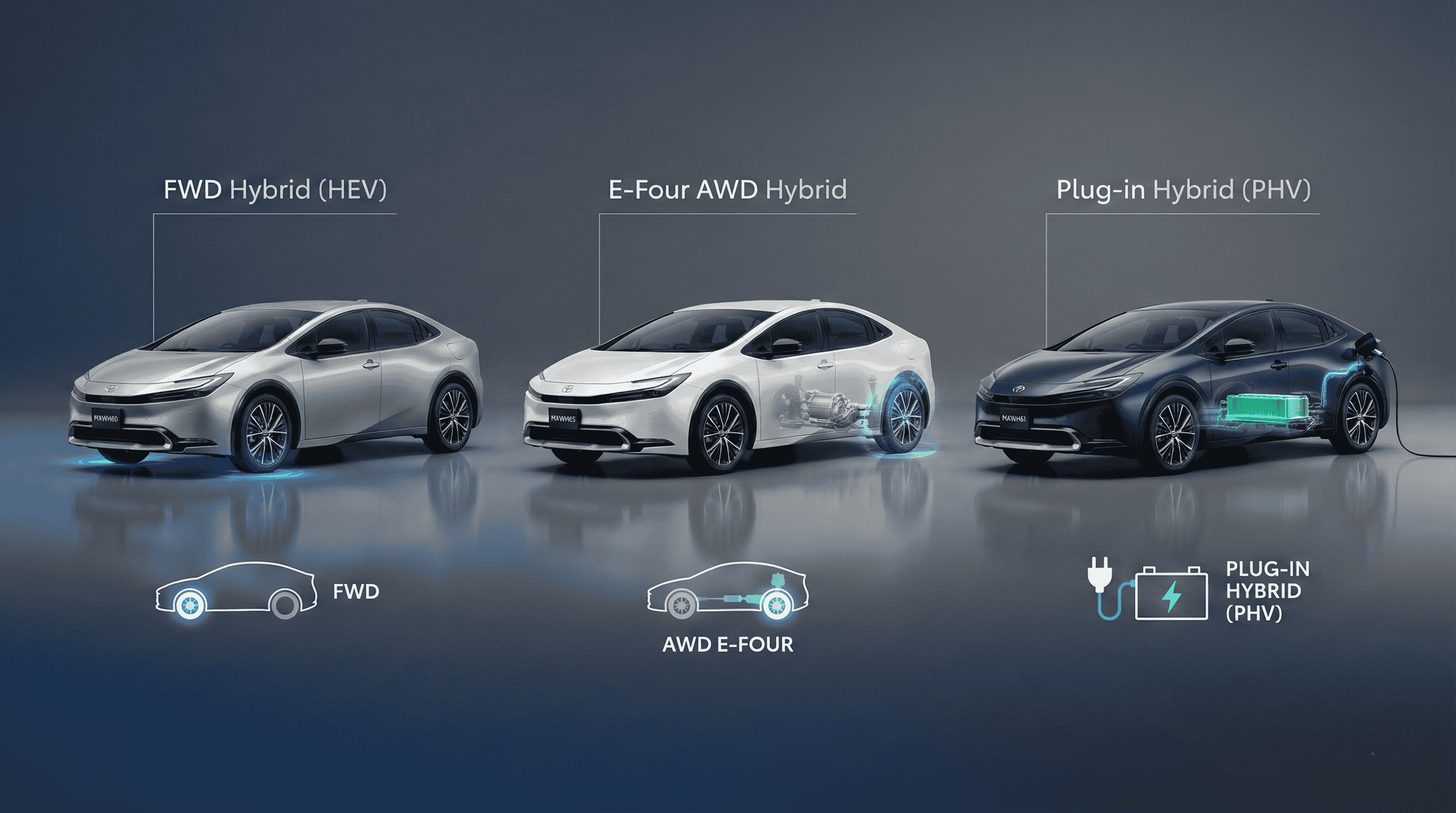
In short, MXWH65 is the all-weather Prius, and getting that code right upfront is what keeps eligibility, compliance assumptions, and ownership expectations aligned.
Powertrain Engineering: Fifth-Gen Hybrid
At the core of the MXWH65 is Toyota’s latest-generation hybrid setup: a 2.0-litre ‘Dynamic Force’ petrol engine working with a redesigned hybrid transaxle, tuned to feel more responsive and less “rubber band” than older Prius generations. In day-to-day driving, the benefit isn’t just economy, it’s the way the car accelerates and settles into highway pace with less noise and less effort.
M20A-FXS 2.0-litre petrol engine
Toyota’s 2.0-litre M20A-FXS runs an Atkinson-cycle strategy for efficiency, paired with D-4S dual injection (port + direct) and modern valve control. The headline for Australian buyers is simple: compared to the older 1.8-litre Prius formula, the 2.0 has more breathing room on the highway so it can cruise at lower effort, feel quieter, and give you more confidence when you lean on it for an overtake.
Toyota’s hybrid ‘e-CVT’ behaviour still exists; it’s a power-split system doing its thing, but the newer hardware is designed to reduce friction and improve power density. The battery packaging is also part of the story: in this generation, lithium-ion is commonly referenced on the higher consumer grades, and it’s typically packaged to keep the centre of gravity low and cabin space usable.
E-Four AWD: the MXWH65 Point Of Difference
Here’s the key: E-Four isn’t mechanical AWD. It’s an on-demand rear electric drive unit that joins in when the system wants extra traction or stability.
Old-school E-Four (earlier Prius AWD) is often described as a low-speed traction assist concept.
New-gen E-Four (MXWH65) is commonly quoted as a much more powerful rear motor than previous Prius AWD setups, which is why it can feel more meaningful in real driving, not just “get you moving on a slippery surface”.
In Australian terms, the win is traction confidence: wet take-offs, steep driveway ramps, greasy roundabouts, gravel access road,s the moments where a front-drive hybrid can ask too much of its front tyres, and E-Four quietly shares the load so it just hooks up and goes.
E-Four AWD explained: what it does
Toyota’s E-Four system needs to be understood for what it is and what it isn’t because it behaves very differently from a traditional mechanical AWD setup.
What it does
E-Four is an on-demand electric AWD assist. In everyday driving, the car runs as a front-drive hybrid, but when grip drops or stability is needed, an electric motor on the rear axle steps in. Toyota’s focus here is traction and composure on low-friction surfaces, not constant torque to all four wheels.
What it doesn’t do
There’s no centre diff, no propshaft, and no permanent AWD feel. This isn’t Subaru-style symmetrical AWD, and it’s not designed for sustained load or off-road use. Think traction support, not full-time drivetrain engagement.
The Key Split: 2.0 vs 1.8 in Toyota Prius MXWH65
This is the fork in the road that decides whether you’ll love the car.
2.0-litre (M20A-FXS) typically G and Z grades
Toyota’s launch info states the 2.0-litre Prius (Z and G grades) achieves maximum system output of 144 kW (196 PS) and is positioned as the performance-balanced option.
Who it suits in Australia:
commuters doing mixed freeway + urban
buyers stepping out of a warm hatch / sporty sedan who still want a response
drivers carrying passengers regularly (less “strained” feel)
Anyone who wants Prius efficiency without accepting slow-car energy
1.8-litre (2ZR-FXE) typically X and U grades
Toyota positions the 1.8-litre Prius (U and X grades) around fuel efficiency improvements, with the 1.8 playing the long game rather than chasing output.
Japanese-market import summaries commonly quote around 103 kW system output for the 1.8 grades.
Who it suits in Australia:
Metro commuters prioritising running cost
buyers doing mostly 60–80 km/h corridors and suburb work
fleet-style users who want a newer Prius with minimal spend (where available)
drivers who don’t care about “quick”, only “cheap to run.”
Detailed Grade Breakdown of Toyota Prius MXWH65
The MXWH65 range is simple underneath: same fifth-gen Prius platform, with E-Four AWD as the headline. The real separation is grade intent, how premium it feels, what tech you get, and how much of the “new Prius” vibe you’re actually paying for.
Toyota Prius MXWH65 Z E-Four (Flagship)
Toyota’s own launch notes reference the Z grade in the 2.0 family and highlight that the new Prius is designed around a lower centre of gravity and large-diameter tyres. In real listings, Z is often the one wearing the biggest wheels and the most aggressive spec presentation.
Key features you’ll commonly see (verify per car):
higher-end infotainment/display options (large screen configurations are common in this range)
Premium convenience features like digital mirror/seat upgrades often appear on higher grades
The “full suite” Toyota Safety Sense style feature set is typically present across the range
What to look for (Australia buyer checks):
wheel size and tyre cost reality (flagships often mean pricier rubber)
option stack: panoramic roof / digital mirror / advanced cameras can change value materially
interior wear: sport-style bolstering looks good but shows wear faster if the car’s been driven hard
Best for: buyers who want the Prius as a premium daily, not a bargain hybrid.
Toyota Prius MXWH65 G E-Four
Toyota explicitly groups G with Z as the 2.0-litre, higher-output variants. That’s the core reason G is usually the best MXWH65 pick: you get the drivetrain you actually want.
Key features (typical, confirm on the build sheet):
2.0 system performance character
modern safety suite
infotainment that’s “enough” without chasing every premium option
What to look for:
Seek a car with the options that matter in Australia:
CarPlay support (common, but confirm head unit/version)
the driver assist features you’ll actually use (radar cruise, lane functions)
avoid overpaying for cosmetic packs if you don’t care (body kits can add cost without adding “better car”)
Best for: most Australian grey-import buyers, especially anyone who wants the 2.0 response but doesn’t need a flagship flex.
Toyota Prius MXWH65 X E-Four (Budget / Eco)
The X Grade is generally paired with the 1.8L powertrain (ZVW chassis), though rare 2.0L versions exist for specific commercial channels.
Key features (typical):
1.8 hybrid setup
fewer premium comfort items
still benefits from the 5th-gen platform fundamentals
What to look for:
Don’t assume “base grade” means “cheap in Australia” — exchange rates + shipping + compliance can erase the gap
Confirm the exact safety and infotainment fitment; don’t buy blind
Check for steel wheels vs alloys, wheel size, and tyre condition at auction (budget grades can be run on cheaper tyres)
Best for: buyers who are disciplined on budget and genuinely prioritise running cost over performance feel.
Toyota Prius MXWH65 Grades Compared
(Outputs and grade/engine pairing reflect Toyota’s launch info for Z/G vs U/X and common import summaries; always verify per VIN/build sheet.)
Import Approval Chain (Australia)
Assuming a SEVS listing is an import approval is like assuming having a ticket means you're already on the plane. You still have to get through security. The SEVS Register is just the first checkpoint; it confirms the vehicle is eligible for the process, but it is definitely not the final green light.
The practical chain
SEVS eligibility → ROVER → RAW processing → AVV verification → RAV entry
SEVS eligibility (model/variant match)
The car must match the exact SEVS variant details (build month range, drivetrain, powertrain, etc.).
Eligibility must be valid at the time your application is assessed, not when the seller wrote the ad.
ROVER (approval for this car)
This is where the paperwork becomes vehicle-specific.
The VIN/chassis number is what gets assessed not the badge, not the listing headline, not assumptions.
RAW processing (doing the work the right way)
If the car requires workshop processing, it must be handled by a Registered Automotive Workshop using an approved Model Report and its Work Instructions.
This is evidence-driven: the RAW records the compliance work properly so it can be verified.
AVV verification (independent sign-off)
An Authorised Vehicle Verifier checks the vehicle and the evidence pack.
If it doesn’t meet the required standards for that approval pathway, it doesn’t progress.
RAV entry (the federal milestone)
Once verified, the car is entered on the Register of Approved Vehicles (RAV).
This is the key step that puts it in a position to move into state/territory registration (roadworthy, CTP, stamp duty, plates).
If you want a sanity check at the end, the RAV is publicly searchable by VIN — but note the RAV itself carries a disclaimer about timeliness/accuracy and may not show entries immediately.
How Carbarn can handle your Toyota Prius MXWH65 import
Carbarn can run the MXWH65 process as one joined-up pathway, so the eligibility, approvals, compliance work, and verification don’t get split across multiple parties.
What we do:
Verify the car upfront: MXWH65 identity, grade, engine family, drivetrain, and build month (before you commit money).
Confirm the pathway is workable in practice, not just “it’s listed”.
Lodge the ROVER application against the exact VIN/chassis.
Coordinate RAW processing under the correct Model Report and evidence requirements.
Carry it through AVV verification and into RAV entry, so it’s positioned for registration.
If you’re considering bringing one in, make sure the process is as solid as the car itself.