



Ready to Hit the Road in Style?
Save money and reduce emissions with vehicles designed to deliver exceptional mileage. Visit our inventory and find a car that fits your lifestyle.
Ready to Hit the Road in Style?
Save money and reduce emissions with vehicles designed to deliver exceptional mileage. Visit our inventory and find a car that fits your lifestyle.
- 1 Necessity of fuel efficiency in modern vehicles
- 2 Fuel Consumption Insights for Australian Hiace Owners
- 2.1 Toyota Hiace Fuel Consumption Rates in Australia
- 2.2 Factors Influencing Fuel Efficiency
- 2.3 Comparison with Competitors
- 3 Summary of available engine types (diesel vs petrol)
- 4 How engine type affects Toyota Hiace fuel consumption
- 5 Comparison between older and newer models
- 6 Factors Affecting Toyota Hiace Fuel Consumption
- 6.1 How You Drive
- 6.2 Capacity for Load
- 6.3 The Terrain and the State of the Road
- 6.4 Care and Maintenance for the Engine
- 6.5 Air in the tyres
- 6.6 Quickness
- 6.7 Kind of Engine Fuel
- 6.8 Conditions of the Weather
- 7 Toyota Hiace Fuel-Saving Tips
- 7.1 Improve Your Driving Habits
- 7.2 Maintain Proper Load
- 7.3 Use Idle-Stop System
- 7.4 Regular Service
- 8 Toyota’s initiatives for reducing the environmental impact of the Hiace
Are you worried about how much the Toyota Hiace fuel consumption might cost you? For Australian drivers, especially those who rely on the dependable Toyota Hiace for work or travel, rising fuel prices and environmental concerns are significant issues. But does your Hiace consume more fuel than it should?
The Toyota Hiace is known for its flexibility and reliability, but optimising fuel mileage is crucial particularly in city traffic or when transporting heavy loads. Want to know how to save on fuel costs? Discover how to make your Hiace more fuel-efficient by reading on!
Necessity of fuel efficiency in modern vehicles
Australian cars need to be more fuel efficient because petrol prices are going up and people are worried about the environment. Fuel prices in Australia averaged AUD 1.60 per litre. This means that fuel-efficient cars are a good choice for Australians, especially those who drive long distances.
In terms of the environment, 18% of Australia's greenhouse fuel pollution comes from the transport sector.
Nowadays, the fuel economy has also improved with new technologies like start-stop systems and turbocharging. Saving money and cutting down on pollution require vehicles that use less fuel. With help from the government and better technology, this is becoming easier for Australians to do.
Fuel Consumption Insights for Australian Hiace Owners
People in Australia like the Toyota Hiace because it is reliable, can be used for many things, and performs well. To cut costs and protect the earth, you need to know how much fuel it uses.
Toyota Hiace Fuel Consumption Rates in Australia
Under normal conditions, the 2.8-litre turbo diesel Hiace gets 7.4 to 8.2 litres per 100 km (36 to 38 MPG), which makes it perfect for long drives in Australia's vast scenery. Newer models get better fuel economy thanks to turbocharging and better airflow.
Factors Influencing Fuel Efficiency
Fuel use is affected by how you drive, how much you load, and how often you service your car. Too much stalling, heavy loads, and stopping a lot in cities can all make a vehicle less efficient. Proper tyre pressure and regular maintenance can help your car use less fuel.
Comparison with Competitors
Compared to vans like the Ford Transit and Hyundai iLoad, the Hiace gets good fuel mileage, which makes it a good choice for Australian drivers who want to save money.
Summary of available engine types (diesel vs petrol)
.jpg)
When picking out a car, knowing the differences between diesel and petrol engines can help you make a smart choice based on how you want to drive. And how much petrol you want to use and your worries about the environment:
Diesel Engines
Diesel engines are great for heavy-duty cars and long trips because they use little fuel and have a lot of torque. Diesel engines usually have a better fuel economy than gasoline engines, which is why they are often chosen for commercial and camper uses. However, they can release more nitrogen oxides (NOx), which means there need to be more rules for the environment.
Petrol Engines
Smaller cars are more likely to have petrol engines, which makes driving smoother and quieter. Diesel engines usually use more fuel than petrol engines, but petrol engines usually put out less NOx (Nitrogen oxide) and cost less to operate. These engines are great for moving in cities and over short distances.
Fuel Wise Engine Codes
| PETROL | DIESEL |
| TRH200K-1TR-FE(1998cc) TRH223B-2TR-FE(2694cc) TRH228B-2TR-FE(2694cc) TRH200V-1TR-FE(1998cc) TRH214W-2TR-FE(2694cc) TRH219W-2TR-FE(2694cc) | KDH206K-1KD-FTV(2982cc) KDH201V-1KD-FTV(2982cc) KDH206V-1KD-FTV(2982cc) KDH205K-2KD-FTV(2494cc) GDH206K-1GD-FTV(2754cc) GDH226K-1GD-FTV(2754cc) GDH206V-1GD-FTV(2754cc) GDH201V-1GD-FTV(2754cc) |
It's important to save fuel and take care of the land everywhere. Many individuals enjoy the Toyota Hiace since it is highly dependable and can perform a significant range of tasks. If Hiace drivers want to save money on fuel and do their part for the earth, they should know how diesel and gasoline engines affect how much fuel they use.
Hiace Diesel Engines
Diesel versions of the Toyota Hiace are popular because they use very little fuel, which is great for long trips or moving big things. Diesel engines usually use 20 to 30 per cent less fuel than gasoline engines because they have higher compression ratios, which lets them get more power from the same amount of fuel. For instance, the 2.8-litre turbo diesel Hiace gets great fuel mileage, usually between 7.5 and 8 litres per 100 km.
Hiace Petrol Engines
People like gasoline-powered Hiace models because they run more smoothly and quietly, which makes them great for driving in cities and on shorter trips. Petrol engines use more fuel than diesel engines. Depending on the type and driving conditions, gasoline engines usually use between 8.5 and 10 litres of fuel per 100 km
Comparison between older and newer models
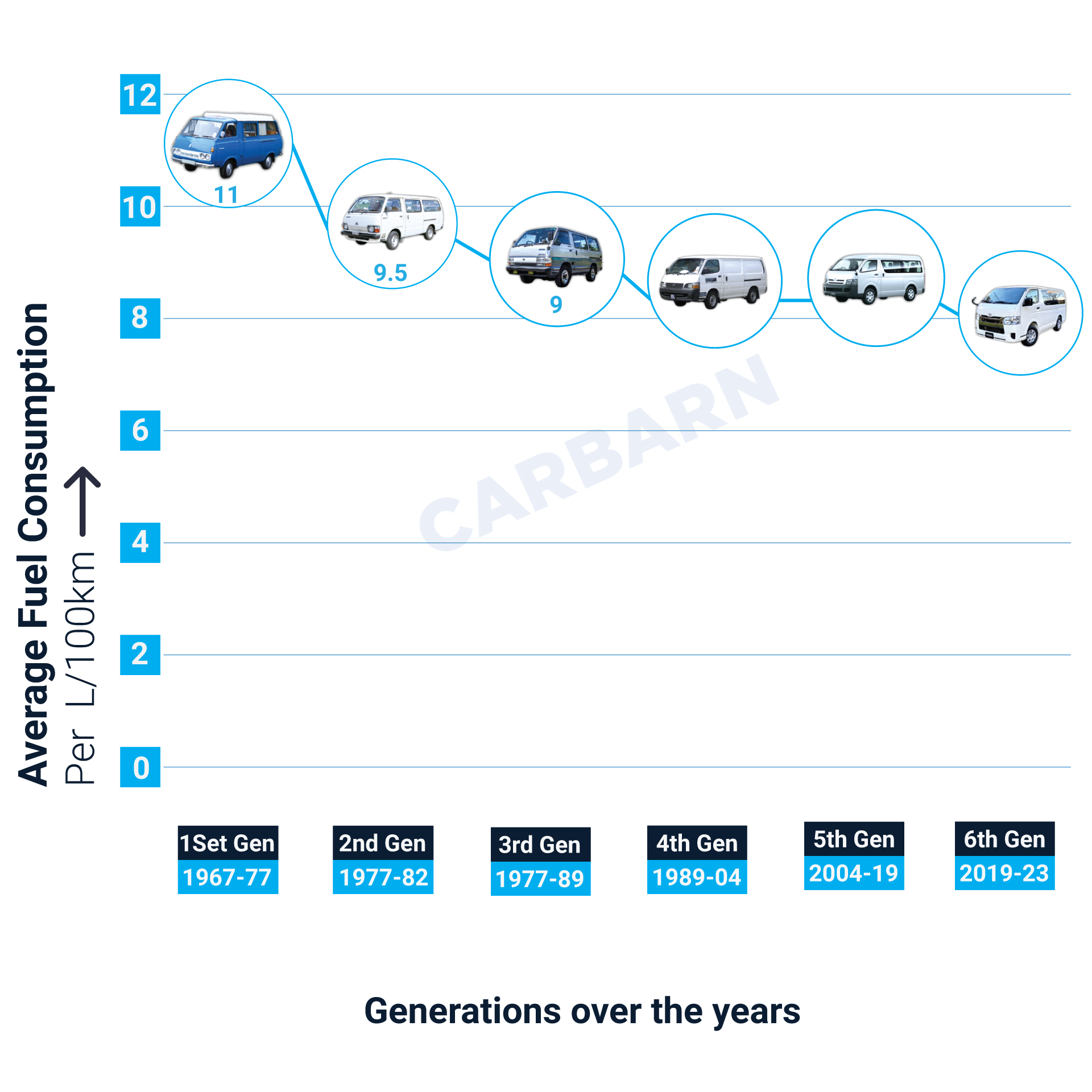
Toyota Hiace fuel consumption stands out for being more efficient. From its first release in 1967, the Toyota Hiace has gone through six versions. Between 1967 and 1977, the first generation was made. It used between 9.0 and 12.0 litres of fuel per 100 kilometres. The fuel economy got better as new generations came out. The sixth generation, which came out in 2019, gets between 7.5 and 9.0 litres per 100 kilometres.
The engines powering the Hiace have also evolved. Earlier models used the 12R and 18R engines, while the latest models are equipped with more efficient and powerful 1GD-FTV and 2TR-FE engines. This progression highlights how the Toyota Hiace fuel economy and engine technology have improved, making the vehicle suitable for both business and personal use.
Factors Affecting Toyota Hiace Fuel Consumption
People like and trust the Toyota Hiace van because it lasts a long time, is comfortable, and can be used in many different ways, especially in the transportation and business sectors. However, like any other car, its fuel mileage can change depending on a number of things. Drivers can get the most out of their Hiace and save money on fuel by understanding these.
How You Drive
How you drive has a big effect on how much fuel you use. Driving aggressively, like speeding up or slowing down quickly, uses more fuel. Keeping your speed steady can help the Toyota Hiace get better fuel mileage, especially on roads.
Capacity for Load
While the Toyota Hiace is made to carry big loads, driving with too much weight on board can cause it to use more fuel. When you overload the car, the engine has to work harder, which means it needs more fuel to run. It's important to stick to the manufacturer's suggested load limits to avoid extra fuel costs.
The Terrain and the State of the Road
It takes more fuel to drive uphill or on rough, uneven ground. It takes more fuel to get the engine to work against the barrier. Smooth roads and flat ground, on the other hand, use less fuel.
Care and Maintenance for the Engine
Maintenance must be done on a regular basis for the best fuel economy. A well-kept Toyota Hiace with clean air filters, tyres that are properly filled, and oil changes on a regular basis will use less fuel. A poorly kept engine, on the other hand, will use more fuel because it won't burn fuel as efficiently and won't work as well.
Air in the tyres
More rolling resistance is made when tyres aren't filled properly. This makes the engine work harder and use more fuel. Keeping your tyres properly inflated can help improve fuel efficiency.
Quickness
Wind resistance goes up when you drive faster, which makes the engine work harder and use more fuel. Keeping your speed down, especially on roads, can help the Toyota Hiace use less fuel and be more fuel efficient overall.
Kind of Engine Fuel
The Hiace may use more or less fuel depending on the quantity and type of fuel you use. It depends on the engine, but using premium oils with higher octane levels can sometimes make it run better and use less fuel.
Conditions of the Weather
It takes longer for the engine to reach its best working temperature when it's cold, which can waste fuel on shorter trips. Similarly, using air conditioning when it's very hot outside makes you use more fuel.
Toyota Hiace Fuel-Saving Tips
If you live in Australia and want to buy a Toyota Hiace van you need to know a few Fuel saving tips.
Improve Your Driving Habits
Accelerating smoothly, keeping your speed steady, and not stopping hard can all help you use less fuel. For the best mileage, try to keep the car at its ideal cruising speed, which on highways is generally between 90 and 100 km/h.
Maintain Proper Load
Don't put too much weight on the Hiace; doing so will cause it to use more fuel. The engine won't have to work harder than it needs to if the load stays within the limits that have been set.
Use Idle-Stop System
Newer Hiace models have an automatic system that turns the engine off when it's not being used. This saves fuel, especially when going to cities. This function can make a big difference if you often sit at traffic lights or in lines for a long time.
Regular Service
Make sure your Hiace's air filters are clean, its tyres are properly filled, and its engines are well taken care of. A vehicle that is well taken care of uses less fuel.
Toyota’s initiatives for reducing the environmental impact of the Hiace
Toyota has worked hard to make its cars less harmful to the environment. The famous Hiace van, which has been used for both business and personal travel in Australia, is one example.
Toyota has put in a number of eco-friendly features in the Hiace. One of these features is the automatic idle-stop system, which turns off the engine when the van is not moving. This saves fuel and lowers emissions during long times of idling, which happen a lot in cities. The turbo-diesel engines in the Hiace are also designed to use less fuel, with combined fuel usage as low as 7.5L/100km. This lowers the car's overall carbon footprint.
Toyota wants to be carbon neutral by 2050, which shows how committed it is to sustainability. This will make sure that future eco-friendly needs are taken into account when making cars like the Hiace.
In conclusion, Toyota Hiace fuel consumption has gone down a lot over the years. This shows that Toyota is committed to making the car more fuel-efficient while keeping it reliable and flexible. No matter which version you choose—petrol or diesel the Toyota Hiace fuel economy is one of its best features. This makes it a cost-effective and useful choice for many situations.